



Envoyez vos Photos et vidéos
Images | Images Google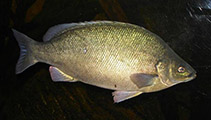 Bidyanus bidyanus
Photo de Meyer, T.
Images | Images Google
Photo de Meyer, T.
Classification / Noms Noms communs | Synonymes | Catalog of Fishes(Genre, Espèce) | ITIS | CoL | WoRMS | Cloffa
> Centrarchiformes (Basses) > Terapontidae (Grunters or tigerperches)
Etymology: Bidyanus: A local name, "bidyani" in Australia, New South Wales.
Etymology: Bidyanus: A local name, "bidyani" in Australia, New South Wales.
Environnement : milieu / zone climatique / profondeur / gamme de distribution Écologie
; eau douce benthopélagique; potamodrome (Ref. 51243); profondeur 10 - ? m. Subtropical; 10°C - 30°C (Ref. 2060); 29°S - 35°S
Distribution Territoires | Zones FAO | Écosystèmes | Occurrences | Carte par point | Introductions | Faunafri
Oceania: known only from the Murray-Darling River system, Australia. Range boundaries: Chinchilla (on the Condamine River), South Queensland, Bonshaw (on the Dumaresq River), northeastern New South Wales, Albury (on the Murray River), southeastern New South Wales, Seven Creek and Goulburn River, South Victoria.
Longueur à la première maturité / Taille / Poids / Âge
Maturité: Lm ?, range 34 - ? cm
Max length : 40.0 cm SL mâle / non sexé; (Ref. 2906); common length : 30.0 cm SL mâle / non sexé; (Ref. 44894); poids max. publié: 1.5 kg (Ref. 5259)
Max length : 40.0 cm SL mâle / non sexé; (Ref. 2906); common length : 30.0 cm SL mâle / non sexé; (Ref. 44894); poids max. publié: 1.5 kg (Ref. 5259)
Adults are found in rivers, lakes and reservoirs, preferring fast-flowing waters of rapids and races and usually forming aggregations near the surface. Usually found below rapids and weirs (Ref. 44894). Feed on aquatic insects, mollusks, earthworms and plants. Temp.: 2-37°C. Maturity: F, 3 y and 34 cm SL; M, 23.3 cm SL. Spawning: summer (Nov.-Jan., 23-30°C water temp.), effect upstream migration. Fecundity: 500000 eggs per 1.8kg. Eggs: pelagic, 2.7-2.8 mm diameter. Hatching: 30 hrs at 26-27°C. Larvae: 3.6 mm at hatching. A good angling and food fish which has been increasingly utilized as an aquaculture species in farm dams throughout Australia (Ref. 44894).
Cycle de vie et comportement reproducteur Maturité | Reproduction | Frai | Œufs | Fécondité | Larves
Upstream spawning migration in summer to areas behind the peak of the flood. Spawning commences late in the afternoon from the surface to a depth of about 4 m, where there is a flow over a gravel, rock rubble substrate. Considerable spawning activity happens at the water surface. A single female circles slowly to the surface with her head deep and several males participate in courtship and finally in fertilization (Ref. 2906).
Référence principale
Téléchargez vos références | Références | Coordinateur | Collaborateurs
Paxton, J.R., D.F. Hoese, G.R. Allen and J.E. Hanley, 1989. Pisces. Petromyzontidae to Carangidae. Zoological Catalogue of Australia, Vol. 7. Australian Government Publishing Service, Canberra, 665 p. (Ref. 7300)
Statut dans la liste rouge de l'IUCN (Ref. 130435: Version 2025-2 (Global))
Quasi-menacé (NT) ; Date assessed: 13 February 2019
CITES
Not Evaluated
Menace pour l'homme
Harmless (Ref. 2906)
Utilisations par l'homme
Pêcheries: commercial; Aquaculture: commercial; pêche sportive: oui
FAO - Systèmes d'aquaculture: production; ; Publication: search | FishSource |
Plus d'informations
Écologie trophique
Aliments (proies)
Composition du régime alimentaire
Consommation alimentaire
Rations alimentaires
Prédateurs
Aliments (proies)
Composition du régime alimentaire
Consommation alimentaire
Rations alimentaires
Prédateurs
Dynamique des populations
Paramètres de croissance
Âges / tailles maximales
Longueur-poids rel.
Rel. longueur-longueur.
Fréquences de longueurs
Conversion de masse
Recrutement
Abondance
Paramètres de croissance
Âges / tailles maximales
Longueur-poids rel.
Rel. longueur-longueur.
Fréquences de longueurs
Conversion de masse
Recrutement
Abondance
Cycle de vie
Reproduction
Maturité
Maturité/épines rel.
Fécondité
Frai
Agrégats de frai
Œufs
Développement de l'œuf
Larves
Dynamique des populations larvaires
Reproduction
Maturité
Maturité/épines rel.
Fécondité
Frai
Agrégats de frai
Œufs
Développement de l'œuf
Larves
Dynamique des populations larvaires
Anatomie
Surface branchiale
Cerveau
Otolithe
Surface branchiale
Cerveau
Otolithe
Physiologie
Composition corporelle
Nutriments
Consommation d'oxygène
Type de natation
Vitesse de nage
Pigments visuels
Son de poisson
Maladies et parasites
Toxicité (CL50)
Composition corporelle
Nutriments
Consommation d'oxygène
Type de natation
Vitesse de nage
Pigments visuels
Son de poisson
Maladies et parasites
Toxicité (CL50)
Génétique
génôme
Génétique
Hétérozygotie
Héritabilité
Diversité génétique
génôme
Génétique
Hétérozygotie
Héritabilité
Diversité génétique
Liées à l'homme
Systèmes d'aquaculture
Profils d'aquaculture
Souches
Cas de ciguatera
Timbres, pièces de monnaie, divers
Systèmes d'aquaculture
Profils d'aquaculture
Souches
Cas de ciguatera
Timbres, pièces de monnaie, divers
Outils
E-book | Guide de terrain | Générateur de fréquences de longueur | Outil de dynamique de population | Carte par point |
Capture-MSY |
Articles particuliers
Télécharger en XML
Sources Internet
AFORO (otoliths) | Alien/Invasive Species database | Aquatic Commons | BHL | Cloffa | Websites from users | FishWatcher | CISTI | Catalog of Fishes: Genre, Espèce | DiscoverLife | ECOTOX | FAO - Systèmes d'aquaculture: production; ; Publication: search | Faunafri | Fishipedia | Fishtrace | GloBI | Google Books | Google Scholar | Google | IGFA World Record | Bases de données nationales | OneZoom | Open Tree of Life | Otolith Atlas of Taiwan Fishes | PubMed | Reef Life Survey | Socotra Atlas | TreeBase | Arbre de Vie | Wikipedia: aller à, chercher | World Records Freshwater Fishing | Zoological Record
Estimations basées sur des modèles
Indice de diversité phylogénétique (Réf. 82804): PD50 = 0.7500 [Uniqueness, from 0.5 = low to 2.0 = high].
Bayesian length-weight: a=0.01660 (0.00632 - 0.04360), b=2.99 (2.76 - 3.22), in cm total length, based on LWR estimates for this (Sub)family-body shape (Ref. 93245).
Niveau trophique (Réf. 69278): 3.0 ±0.34 se; based on food items.
Résilience (Réf. 120179): Milieu, temps minimum de doublement de population : 1,4 à 4,4 années (tm=2-3).