This website uses cookies to enhance your browsing experience and ensure the functionality of our site. For more detailed information about the types of cookies we use and how we protect your privacy, please visit our Privacy Information page.
×
Cookie Settings
This website uses different types of cookies to enhance your experience. Please select your preferences below:
Myliobatis freminvillei, Bullnose eagle ray : fisheries
Elasmobranchii (tubarões e raias) (sharks and rays) > Myliobatiformes (Stingrays) > Myliobatidae (Eagle and manta rays)
Etymology: Myliobatis:Greek, mylo = mill + Greek, + Greek, batis,-idos = a ray (Raja sp.) (Ref. 45335). Eponymy: Christophe/Chrétien-Paulin de la Poix Chevalier de Fréminville (1787–1848) was a French naval officer and naturalist. [...] (Ref. 128868), visit book page. More on author: Lesueur.
Ambiente: milieu / zona climática / intervalo de profundidade / gama de distribuição Ecologia
marinhas; estuarina bentopelágico; intervalo de profundidade 0 - 100 m (Ref. 57911), usually 1 - 10 m. Subtropical; 43°N - 42°S, 97°W - 33°W
Western Atlantic: continental waters from Cape Cod to southeastern Florida (?) in the USA; also southern Brazil to Argentina (Ref. 58839). Reported (but not known for certain) from Gulf of Mexico, Florida and Caribbean islands, and northern South America. Often confused with Myliobatis goodei (Ref. 3173).
Comprimento na primeira maturidade / Tamanho / Peso / Idade
Maturidade: Lm65.0, range 60 - 70 cm Max length : 129 cm WD macho/indeterminado; (Ref. 49746); common length : 70.0 cm WD macho/indeterminado; (Ref. 5217)
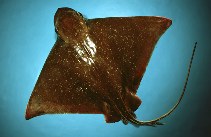
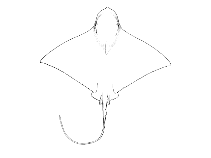
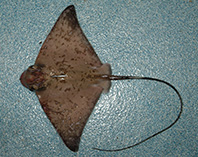
Disk broad with long sharply pointed wings and projecting snout. Tail very long, Few middorsal spines on disk in adults (Ref. 7251). Greyish, reddish chocolate or dusky brown above. Lower surface either pure white or whitish. Teeth green (Ref. 6902). Body shape (shape guide): other.
Found frequently in coastal waters to 10 m depth, mainly in shallow estuaries. Capable of traveling long distances, occasionally leaps out of the water. Swims in midwater. Cruises slowly over the bottom, rooting out bivalves with its beak and wings when feeding (Ref. 7251). Ovoviviparous (Ref. 50449).
Exhibit ovoviparity (aplacental viviparity), with embryos feeding initially on yolk, then receiving additional nourishment from the mother by indirect absorption of uterine fluid enriched with mucus, fat or protein through specialised structures (Ref. 50449).
Dinâmica das populações Parâmetros de crescimento Idades / tamanhos máximos Comprimento-peso rel. Comprimento-comprimento rel. Frequência de comprimento Conversão de massa Recrutamento Abundância
Ciclo de vida Reprodução Maturidade Maturidade/Rel. das guelras Fecundidade Desova Agregações de desova Ovos Desenvolvimento dos ovos Larvas Dinâmica larvar
Fisiologia Composição corporal Nutrientes Consumo de oxigénio Tipo de natação Velocidade de natação Pigmentos visuais Som de peixe Doenças e Parasitas Toxicidade (LC50s)
Temperatura preferida (Ref. 123201): 14.2 - 28.1, mean 24.2 °C (based on 594 cells).
Índice de diversidade filogenética (Ref. 82804): PD50 = 0.5002 [Uniqueness, from 0.5 = low to 2.0 = high].
Bayesian length-weight: a=0.00389 (0.00124 - 0.01219), b=3.08 (2.83 - 3.33), in cm total length, based on LWR estimates for this (Sub)family-body shape (Ref. 93245).
Nível Trófico (Ref. 69278): 3.4 ±0.0 se; based on diet studies.
Resiliência (Ref. 120179): Muito baixo, tempo mínimo de duplicação da população maior que 14 anos (Fec=4-8).
Vulnerabilidade da pesca (Ref. 59153): Very high vulnerability (83 of 100). 🛈