>
Beryciformes (Sawbellies) >
Berycidae (Alfonsinos)
Etymology: Beryx: Greek, beryx or berys = a name of a fish. Cuvier & Valenciennes (1829:221) precise that the name was used by Gesner from Varinus, but with no indication whatsoever helping identifying any species. After D'Arcy Wentworth Thompson (A glossary of Greek fishes, 1947), the name actually seems to come originally from Hesychius, but perhaps the name was not originally a fish name. Thompson compares it to meryx (ruminant), applied on skaros (Scarus), so it may have been applied on a parrot fish referring to its browsing/grazing behavior described by Aristoteles and followers.
More on author: Cuvier.
Environment: milieu / climate zone / εύρος βάθους / distribution range
Οικολογία
Θαλασσινό(ά) βαθύβιο(ς); εύρος βάθους 110 - 1300 m (Ref. 126224), usually 200 - 800 m (Ref. 126224). Deep-water; 70°N - 48°S, 180°W - 180°E
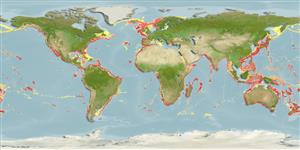
Worldwide in temperate and tropical latitudes, except the eastern Pacific. Eastern Atlantic: Greenland, Iceland, and Norway to Western Sahara and South Africa, including western Mediterranean. Western Atlantic: south to Brazil. Also found in Argentine (Ref. 2806). Indo-Pacific: East Africa (including the Madascar Ridge and Saya de Malha Bank, Ref. 33390) to Japan, Australia, and New Zealand (Ref. 5755). The limited number of records in the western Pacific is doubtless the result of limited fishing effort below 200 m (Ref. 9833).
Length at first maturity / Μέγεθος / Βάρος / Age
Γεννητική Ωρίμανση: Lm 27.6 range ? - ? cm
Max length : 100.0 cm TL αρσενικό/απροσδιόριστο; (Ref. 26340); common length : 35.0 cm TL αρσενικό/απροσδιόριστο; (Ref. 9833); μεγ. δημοσιευμένο βάρος: 4.0 kg (Ref. 126224); μεγ. αναφερόμενη ηλικία: 69 έτη (Ref. 86253)
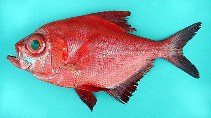
Ραχιαίες άκανθες (συνολικά) : 4; Μαλακές ραχιαίες ακτίνες (συνολικά) : 18 - 20; Εδρικές άκανθες: 4; Μαλακές εδρικές ακτίνες: 25 - 30. Body deep, compressed and has a large eye. Top of head, iris, back and all fins bright blood red. Orbital bones, cheeks and opercular bones shiny white. Breast shiny yellowish white. Body silvery with thin lengthwise lines (Ref. 37108).
Body shape (shape guide): fusiform / normal; Cross section: compressed.
Found in ca. 500 m on mud or sandy mud bottom (Ref. 11230). Occurs on the continental slope; adults demersal, young pelagic (Ref. 9563). Feeds on crustaceans, small fishes and cephalopods (Ref. 3321). A 35 cm SL specimen was found in the stomach of Latimeria (Ref. 58472). Young have heavy spines on the head (Ref. 35388).
Life cycle and mating behavior
Γεννητική Ωρίμανση | Αναπαραγωγή | Γεννοβολία | Αβγά | Γονιμότητα | Προνύμφες
Maul, G.E., 1990. Berycidae. p. 626. In J.C. Quero, J.C. Hureau, C. Karrer, A. Post and L. Saldanha (eds.) Check-list of the fishes of the eastern tropical Atlantic (CLOFETA). JNICT, Lisbon; SEI, Paris; and UNESCO, Paris. Vol. 2. (Ref. 7413)
IUCN Red List Status (Ref. 130435: Version 2025-1)
Threat to humans
Harmless
Human uses
αλιεία: Εμπορικό(ά)
Εργαλεία
Special reports
Download XML
Διαδικτυακές πηγές
Estimates based on models
Preferred temperature (Αναφ.
123201): 4.5 - 18.3, mean 11.2 °C (based on 1031 cells).
Phylogenetic diversity index (Αναφ.
82804): PD
50 = 0.6260 [Uniqueness, from 0.5 = low to 2.0 = high].
Bayesian length-weight: a=0.01445 (0.00900 - 0.02322), b=3.05 (2.91 - 3.19), in cm total length, based on LWR estimates for this species & (Sub)family-body (Ref.
93245).
Τροφικό Επίπεδο (Αναφ.
69278): 4.1 ±0.76 se; based on food items.
Ελαστικότητα (Αναφ.
120179): Χαμηλό, ελάχιστος χρόνος για διπλασιασμό πληθυσμού 4,5 - 14 έτη (K = 0.11-0.16; tmax >11).
Fishing Vulnerability (Ref.
59153): High to very high vulnerability (69 of 100).
🛈
Climate Vulnerability (Ref.
125649): High vulnerability (62 of 100).
🛈
Nutrients (Ref.
124155): Calcium = 12.8 [4.1, 39.6] mg/100g; Iron = 0.379 [0.162, 0.819] mg/100g; Protein = 17.2 [16.2, 18.3] %; Omega3 = 0.382 [0.155, 0.983] g/100g; Selenium = 22.9 [10.2, 51.9] μg/100g; VitaminA = 14 [3, 66] μg/100g; Zinc = 0.314 [0.209, 0.501] mg/100g (wet weight);