



Hyporhamphus melanochir (Valenciennes, 1847)
Southern garfish
Waarneming toevoegen in Fish Watcher
| Native range | All suitable habitat | Point map | Year 2050 |

|
| This map was computer-generated and has not yet been reviewed. |
| Hyporhamphus melanochir AquaMaps Data sources: GBIF OBIS |
Uploaden van uw Foto's en video's
Afbeeldingen | Google afbeelding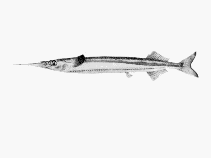 Hyporhamphus melanochir
Afbeelding van CSIRO
Afbeeldingen | Google afbeelding
Afbeelding van CSIRO
Classificatie / Namen Lokale namen | Synoniemen | Catalog of Fishes(Genus, Soort(en)) | ITIS | CoL | WoRMS | Cloffa
> Beloniformes (Needle fishes) > Hemiramphidae (Halfbeaks)
Etymology: Hyporhamphus: Greek, hypo = under + Greek, rhamphos = beak, bill (Ref. 45335).
More on author: Valenciennes.
Etymology: Hyporhamphus: Greek, hypo = under + Greek, rhamphos = beak, bill (Ref. 45335).
More on author: Valenciennes.
Milieu: milieu / Klimaatzone / Diepte / verspreidingsgebied Ecologie
marien; brak water pelagic-neritic; diepte 0 - 20 m (Ref. 6390). Temperate; 27°S - 44°S
Verspreiding Gebieden | FAO regio's | Ecosystemen | Voorkomen | Verspreidingskaart | Introducties | Faunafri
Eastern Indian Ocean: Endemic to Australian temperate waters (Murchison River, Kalbarri in Western Australia to Eden, New South Wales, including Tasmania).
Lengte bij maturiteit / Grootte / Gewicht / Leeftijd
Maturiteit: Lm ?, range 25 - ? cm
Max length : 52.0 cm SL mannelijk / geslacht onbekend; (Ref. 10988); max. gepubliceerd gewicht: 600.00 g (Ref. 6390); max. gerapporteerde leeftijd: 10 Jaren (Ref. 27011)
Max length : 52.0 cm SL mannelijk / geslacht onbekend; (Ref. 10988); max. gepubliceerd gewicht: 600.00 g (Ref. 6390); max. gerapporteerde leeftijd: 10 Jaren (Ref. 27011)
Korte beschrijving Determinatiesleutels | Morfologie | Morfometrie
Dorsale stekels (totaal) : 0; Dorsale zachte stralen (totaal) : 15 - 18; Anale stekels: 0; Anale zachte stralen: 17 - 20; Wervels: 55 - 61. Gill rakers usually 33 or less on the first arch and usually 26 or less on the second arch. Relatively shorter upper and lower jaw, especially at larger sizes.
Body shape (shape guide): elongated.
Body shape (shape guide): elongated.
Found inshore in surface waters of estuaries, bays, inlets and gulfs to a depth of about 20 m (Ref. 9563). In the South Australian gulfs, southern sea garfish may be found in deeper waters during the colder months (Ref. 27008). Generally herbivorous, seagrasses and algal filaments comprise about 75% of their food (Refs. 26551, 27013). Form schools, generally found near the surface at night and close to the bottom over seagrass beds during the day (Ref. 6390). Post-larvae or young fish less than 1-year-old live in estuaries from March to July then move to inshore marine waters, remaining there for up to 2 years (Ref. 27012).
Levenscyclus en paargedrag Maturiteit | Voortplanting | Paaien | Eieren | Fecunditeit | Larven
Also Ref 101194.
Hoofdreferentie
Upload uw referenties | Referenties | Coördinator : Collette, Bruce B. | Medewerkers
Collette, B.B., 1974. The garfishes (Hemiramphidae) of Australia and New Zealand. Records of the Australian Museum 29(2):11-105. (Ref. 10988)
CITES
Not Evaluated
Gevaar voor de mens
Harmless
Gebruik door de mens
Visserij: commercieel; aas: usually
FAO - Publication: search | FishSource |
Meer informatie
Trofische ecologie
Voedsel (prooien)
Dieetsamenstelling
Voedselconsumptie
Voedselrantsoenen
Predatoren
Voedsel (prooien)
Dieetsamenstelling
Voedselconsumptie
Voedselrantsoenen
Predatoren
Populatiedynamica
Groeiparameters
Max. leeftijden / maten
Lengte-gewicht rel.
Lengte-lengte rel.
Lengtefrequenties
Massaconversie
Rekrutering
Abundantie
Groeiparameters
Max. leeftijden / maten
Lengte-gewicht rel.
Lengte-lengte rel.
Lengtefrequenties
Massaconversie
Rekrutering
Abundantie
Levenscyclus
Voortplanting
Maturiteit
Rijpheid/kieuwen rel.
Fecunditeit
Paaien
Paaibestanden
Eieren
Ontwikkeling van de eieren
Larven
Larvale populatiedynamiek
Voortplanting
Maturiteit
Rijpheid/kieuwen rel.
Fecunditeit
Paaien
Paaibestanden
Eieren
Ontwikkeling van de eieren
Larven
Larvale populatiedynamiek
Anatomie
Kieuwoppervlak
Hersenen
Otoliet
Kieuwoppervlak
Hersenen
Otoliet
Fysiologie
Lichaamssamenstelling
Voedingsstoffen
Zuurstofverbruik
Type zwemmen
Zwemsnelheid
Visuele pigmenten
Vis geluid
Ziekten en parasieten
Toxiciteit (LC50)
Lichaamssamenstelling
Voedingsstoffen
Zuurstofverbruik
Type zwemmen
Zwemsnelheid
Visuele pigmenten
Vis geluid
Ziekten en parasieten
Toxiciteit (LC50)
Menselijk gerelateerd
Aquacultuursystemen
Aquacultuurprofielen
Kweeklijnen
Ciguatera gevallen
Postzegels, munten, diversen.
Aquacultuursystemen
Aquacultuurprofielen
Kweeklijnen
Ciguatera gevallen
Postzegels, munten, diversen.
Tools
Speciale rapporten
Bekijk gegevens voor het houden in een aquarium | Bekijk Fact Sheets voor de soort | Bekijk Aquacultuur Fact Sheets
Download XML
Internetbronnen
AFORO (otoliths) | Aquatic Commons | BHL | Cloffa | Websites from users | Bekijk FishWatcher | CISTI | Catalog of Fishes: Genus, Soort(en) | DiscoverLife | ECOTOX | FAO - Publication: search | Faunafri | Fishipedia | Fishtrace | GloBI | Google Books | Google Scholar | Google | IGFA World Record | OneZoom | Open Tree of Life | Otolith Atlas of Taiwan Fishes | PubMed | Reef Life Survey | Socotra Atlas | TreeBase | Tree of Life | Wikipedia: ga naar, zoek | World Records Freshwater Fishing | Zoological Record
Schattingen op basis van modellen
Gewenste temperatuur (Ref. 123201): 14.3 - 22.3, mean 17.6 °C (based on 324 cells).
Fylogenetische diversiteitsindex (Ref. 82804): PD50 = 0.5000 [Uniqueness, from 0.5 = low to 2.0 = high].
Bayesian length-weight: a=0.00257 (0.00116 - 0.00571), b=3.09 (2.92 - 3.26), in cm total length, based on LWR estimates for this Genus-body shape (Ref. 93245).
Trofisch niveau (Ref. 69278): 2.7 ±0.27 se; based on food items.
Weerstandsvermogen (Ref. 120179): Gemiddeld, minimale populatieverdubbelingstijd 1,4-4,4 jaar (K=0.51-0.77; tm=2-3; tmax=10).