Environment: milieu / climate zone / rango de profundidad / distribution range
Ecología
marino asociado a arrecife; no migratorio; rango de profundidad 1 - 200 m (Ref. 27560). Subtropical; 16°S - 36°S
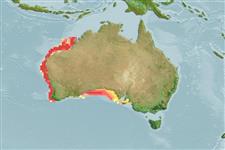
Eastern Indian Ocean: endemic to Australian waters. Distributed from the Recherche Archipelago off Esperance, to Beagle Island, although they are rare north of Shark Bay. Records from Japan (Ref. 559, 12517) and Taiwan (Ref. 5193) are Glaucosoma buergeri (Ref. 27621).
Length at first maturity / Tamaño / Peso / Age
Madurez: Lm 30.1, range 59 - ? cm
Max length : 122 cm TL macho / no sexado; (Ref. 27296); common length : 80.0 cm TL macho / no sexado; (Ref. 27621); peso máximo publicado: 26.0 kg (Ref. 27621)
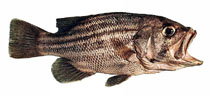
Espinas dorsales (total) : 8; Radios blandos dorsales (total) : 11; Espinas anales: 3; Radios blandos anales: 9. One dark vertical band through eye which may disappear with an increase in size; 11 dorsal fin rays and 9 anal fin rays. Supraclavicle not developed into a bony shield. Peritoneum and gill rakers pale; lateral line with 44 to 48 pored scales; juveniles with wide dark horizontal bands wider than interspaces.
Body shape (shape guide): fusiform / normal; Cross section: compressed.
Westralian jewfish live in shallow inshore waters and depths to over 200 m (Ref. 27560). They are present over hard, flat sea beds (e.g. limestone shelf) and in reefs, wrecks and underwater caverns and gutters. Adult fish move into shallower waters in the cooler months between April and June (Ref. 27560, 27561). Juveniles tend to remain in shallower water than adults and are rarely found in waters more than 100 m deep (Ref. 27560). Adults feed mainly on fish, also rock lobsters, crabs, squid, octopus and cuttlefish. Marketed as fresh fish (Ref. 10384).
Female Westralian jewfish are broadcast spawners, releasing floating eggs into the water column; these are pelagic and can be carried large distances on ocean surface currents (Ref. 6390). Larvae feed on plankton (Ref. 6390).
McKay, R.J., 1997. FAO Species Catalogue. Vol. 17. Pearl perches of the world (family Glaucosomatidae). An annotated and illustrated catalogue of the pearl peches known to date. FAO Fish. Synop. 125(17):26p. Rome: FAO. (Ref. 27621)
IUCN Red List Status (Ref. 130435: Version 2025-1)
Threat to humans
Harmless
Human uses
Pesquerías: comercial; pesca deportiva: si
Herramientas
Special reports
Download XML
Fuentes de Internet
Estimates based on models
Preferred temperature (Referencia
123201): 15.9 - 26.7, mean 20.4 °C (based on 86 cells).
Phylogenetic diversity index (Referencia
82804): PD
50 = 0.6250 [Uniqueness, from 0.5 = low to 2.0 = high].
Bayesian length-weight: a=0.01622 (0.00756 - 0.03477), b=2.94 (2.75 - 3.13), in cm total length, based on LWR estimates for this (Sub)family-body shape (Ref.
93245).
Nivel trófico (Referencia
69278): 4.3 ±0.62 se; based on food items.
Resiliencia (Referencia
120179): Muy bajo, población duplicada en un tiempo mínimo superior a 14 años (K-0.07-0.2; tm=3-4; tmax-41; Fec=300,000).
Fishing Vulnerability (Ref.
59153): High to very high vulnerability (72 of 100).
🛈
Nutrients (Ref.
124155): Calcium = 13.1 [7.2, 22.1] mg/100g; Iron = 0.462 [0.271, 0.742] mg/100g; Protein = 20 [19, 21] %; Omega3 = 0.209 [0.128, 0.335] g/100g; Selenium = 24.5 [12.8, 44.0] μg/100g; VitaminA = 50.5 [18.2, 135.2] μg/100g; Zinc = 0.478 [0.332, 0.687] mg/100g (wet weight);