



Glaucosoma hebraicum Richardson, 1845
West Australian dhufish
Lägg till din observation i Fish Watcher
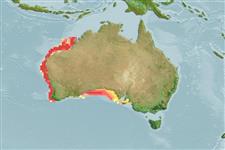
| Native range | All suitable habitat | Point map | Year 2050 |
|
| This map was computer-generated and has not yet been reviewed. |
| Glaucosoma hebraicum AquaMaps Data sources: GBIF OBIS |
Ladda upp din foton och Videor
Bilder | Frimärken, mynt, diverse. | Google image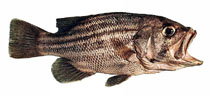 Glaucosoma hebraicum
Bild av Good, P.
Bilder | Frimärken, mynt, diverse. | Google image
Bild av Good, P.
Klassificering / Namn Populärnamn | synonymer | Catalog of Fishes(Släkte, Arter) | ITIS | CoL | WoRMS | Cloffa
> Acropomatiformes (Oceanic basses) > Glaucosomatidae (Pearl perches)
Etymology: Glaucosoma: Greek, glaukos = white, shining + Greek, soma = body (Ref. 45335).
More on author: Richardson.
Etymology: Glaucosoma: Greek, glaukos = white, shining + Greek, soma = body (Ref. 45335).
More on author: Richardson.
Miljö: miljö / Klimatzon / djupintervall / distributionsområde Ekologi
marina revassocierade; ej vandrande; djupintervall 1 - 200 m (Ref. 27560). Subtropical; 16°S - 36°S
Utbredning Territorier | FAO områden | Ekosystem | Förekomster | Prickkarta | Utplanteringar | Faunafri
Eastern Indian Ocean: endemic to Australian waters. Distributed from the Recherche Archipelago off Esperance, to Beagle Island, although they are rare north of Shark Bay. Records from Japan (Ref. 559, 12517) and Taiwan (Ref. 5193) are Glaucosoma buergeri (Ref. 27621).
Längd vid första mognad / Storlek / Vikt / Ålder
Könsmognad: Lm 30.1, range 59 - ? cm
Max length : 122 cm TL hane/ej könsbestämd; (Ref. 27296); common length : 80.0 cm TL hane/ej könsbestämd; (Ref. 27621); publicerad maxvikt: 26.0 kg (Ref. 27621)
Max length : 122 cm TL hane/ej könsbestämd; (Ref. 27296); common length : 80.0 cm TL hane/ej könsbestämd; (Ref. 27621); publicerad maxvikt: 26.0 kg (Ref. 27621)
Kort beskrivning Bestämningsnycklar | Morfologi | Morfometri
Taggstrålar i ryggfenan (totalt) : 8; Mjukstrålar i ryggfenan (totalt) : 11; Taggstrålar i analfenan: 3; Mjukstrålar i analfenan: 9. One dark vertical band through eye which may disappear with an increase in size; 11 dorsal fin rays and 9 anal fin rays. Supraclavicle not developed into a bony shield. Peritoneum and gill rakers pale; lateral line with 44 to 48 pored scales; juveniles with wide dark horizontal bands wider than interspaces.
Body shape (shape guide): fusiform / normal; Cross section: compressed.
Body shape (shape guide): fusiform / normal; Cross section: compressed.
Westralian jewfish live in shallow inshore waters and depths to over 200 m (Ref. 27560). They are present over hard, flat sea beds (e.g. limestone shelf) and in reefs, wrecks and underwater caverns and gutters. Adult fish move into shallower waters in the cooler months between April and June (Ref. 27560, 27561). Juveniles tend to remain in shallower water than adults and are rarely found in waters more than 100 m deep (Ref. 27560). Adults feed mainly on fish, also rock lobsters, crabs, squid, octopus and cuttlefish. Marketed as fresh fish (Ref. 10384).
Livscykel och parningsbeteende Könsmognad | Reproduktion | Lek | Ägg | Fekunditet | Larver
Female Westralian jewfish are broadcast spawners, releasing floating eggs into the water column; these are pelagic and can be carried large distances on ocean surface currents (Ref. 6390). Larvae feed on plankton (Ref. 6390).
Huvudreferens
Ladda upp dina referenser | referenser | Koordinator | Medarbetare
McKay, R.J., 1997. FAO Species Catalogue. Vol. 17. Pearl perches of the world (family Glaucosomatidae). An annotated and illustrated catalogue of the pearl peches known to date. FAO Fish. Synop. 125(17):26p. Rome: FAO. (Ref. 27621)
CITES
Not Evaluated
Hot mot människor
Harmless
Mänskliga användningsområden
Fiskeri: kommersiell; sportfisk: ja
FAO - Publication: search | FishSource |
Ytterligare information
Populationsdynamik
Tillväxtparametrar
Max. åldrar / storlekar
Längd-vikt rel.
Längd-längd rel.
Längd-frekvenser
Massakonvertering
Rekrytering
Abundans
Tillväxtparametrar
Max. åldrar / storlekar
Längd-vikt rel.
Längd-längd rel.
Längd-frekvenser
Massakonvertering
Rekrytering
Abundans
Livscykel
Reproduktion
Könsmognad
Mognad/Gills rel.
Fekunditet
Lek
Lekande aggregat
Ägg
Utveckling av ägg
Larver
Larvdynamik
Reproduktion
Könsmognad
Mognad/Gills rel.
Fekunditet
Lek
Lekande aggregat
Ägg
Utveckling av ägg
Larver
Larvdynamik
Anatomi
Gälyta
Hjärna
Otolit
Gälyta
Hjärna
Otolit
Fysiologi
Kroppssammansättning
Näringsämnen
Syreförbrukning
Typ av simning
Simhastighet
Visuella pigment
Ljud från fisk
Sjukdomar & Parasiter
Toxicitet (LC50)
Kroppssammansättning
Näringsämnen
Syreförbrukning
Typ av simning
Simhastighet
Visuella pigment
Ljud från fisk
Sjukdomar & Parasiter
Toxicitet (LC50)
Genetik
Genom
Genetik
Heterozygositet
Ärftlighet
Genetisk mångfald
Genom
Genetik
Heterozygositet
Ärftlighet
Genetisk mångfald
Människorelaterad
Vattenbrukssystem
Vattenbruksprofiler
Avelslinjer
Ciguatera-fall
Frimärken, mynt, diverse.
Vattenbrukssystem
Vattenbruksprofiler
Avelslinjer
Ciguatera-fall
Frimärken, mynt, diverse.
Verktyg
E-bok | Fälthandbok | Bestämningsnycklar | Längdfördelnings-verktyg | Livshistorie-verktyg | Prickkarta |
Fångst-MSY |
Särskilda rapporter
Kontrollera för underhåll av akvarium | Kontrollera om det finns faktablad om arter | Kontrollera om det finns faktablad om vattenbruk
Ladda ner XML
Internet-källor
AFORO (otoliths) | Aquatic Commons | BHL | Cloffa | Websites from users | Check FishWatcher | CISTI | Catalog of Fishes: Släkte, Arter | DiscoverLife | ECOTOX | FAO - Publication: search | Faunafri | Fishipedia | Fishtrace | GloBI | Google Books | Google Scholar | Google | IGFA World Record | Nationella databaser | OneZoom | Open Tree of Life | Otolith Atlas of Taiwan Fishes | PubMed | Reef Life Survey | Socotra Atlas | TreeBase | Tree of Life | Wikipedia: Go, sök | World Records Freshwater Fishing | Zoobank | Zoologiskt register
Uppskattningar baserade på modeller
Önskad temperatur (Ref. 123201): 15.9 - 26.7, mean 20.4 °C (based on 86 cells).
Index för fylogenetisk mångfald (Ref. 82804): PD50 = 0.6250 [Uniqueness, from 0.5 = low to 2.0 = high].
Bayesian length-weight: a=0.01622 (0.00770 - 0.03415), b=2.95 (2.76 - 3.14), in cm total length, based on LWR estimates for this (Sub)family-body shape (Ref. 93245).
Trofisk nivå (Ref. 69278): 4.3 ±0.62 se; based on food items.
Resiliens (Ref. 120179): Mycket låg, lägsta populationsfördubblingstid mer än 14 år (K-0.07-0.2; tm=3-4; tmax-41; Fec=300,000).
Näringsämnen (Ref. 124155): Calcium = 13.1 [7.2, 22.1] mg/100g; Iron = 0.462 [0.271, 0.742] mg/100g; Protein = 20 [19, 21] %; Omega3 = 0.209 [0.128, 0.335] g/100g; Selenium = 24.5 [12.8, 44.0] μg/100g; VitaminA = 50.5 [18.2, 135.2] μg/100g; Zinc = 0.478 [0.332, 0.687] mg/100g (wet weight);