>
Scombriformes (Mackerels) >
Chiasmodontidae (Snaketooth fishes)
Etymology: Chiasmodon: Name from the Greek 'chiasmos' which means diagonally arranged, and 'odous' for tooth or teeth.
More on author: Garman.
Environment: milieu / Klimaatzone / Diepte / distribution range
Ecologie
marien pelagic-oceanic; diepte 245 - 4568 m (Ref. 82429). Deep-water; 48°N - 29°S (Ref. 82429)
Eastern Pacific, from Hawaii 155°30'W to the west coast of North, Central and northern South America, from 48°N to 29°S (from Canada to northern Chile).
Grootte / Gewicht / Leeftijd
Maturiteit: Lm ? range ? - ? cm
Max length : 3.0 cm SL mannelijk / geslacht onbekend; (Ref. 6944)
Korte beschrijving
Determinatiesleutels | Morfologie | Morfometrie
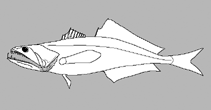
Wervels: 43 - 44. This species is diagnosed from its congeners by the total infraorbital pores 11-13, infraorbital 1 pores five to six (vs. 13-14, rarely 11, infraorbital 1 pores seven to eight); lower jaw short, not extending beyond upper jaw, 63.9-72.7% HL (vs. elongated lower jaw, extending beyond upper jaw, 73.3-77.1% HL in C. asper; 76.0-83.8% HL in C. braueri, 80.8-89.9% HL in C. harteli, 76.8-85.2% HL in C. microcephalus, 72.2-80.0% HL in C. niger, and 72.2-77.0% HL in C. pluriradiatus). It further differs from other species by the blunt snout, and short 21.4-23.9% HL (vs. elongated and pointed 23.0-26.6% HL in C. harteli; 23.7-28.0% HL in C. microcephalus; 22.2-26.6% HL in C. niger); upper jaw 63.9-72.7% HL (vs. 70.0-77.1% HL in C. braueri; 74.3-84.2% HL in C. harteli; and 72.2-80.0% HL in C. niger); from C. braueri, by the absence of teeth on second ceratobranchial (vs. present); from C. harteli by the total vertebrae 43-44 (vs. 47-48), and supraorbital pores 7-8 (vs. six, rarely 7); from C. pluriradiatus and C. asper, by pectoral-fin rays 12-13 (vs. 15-16), no tiny dermal spinules on body in specimens larger than 48.7 mm (vs. spinules present), and fang on premaxillary head 1 (vs. 2) (Ref. 82429).
Body shape (shape guide): fusiform / normal.
Found in the mesopelagic to bathypelagic zones (Ref. 82429).
Levenscyclus en paargedrag
Maturiteit | Voortplanting | Paaien | Eieren | Fecunditeit | Larven
Melo, M.R.S., 2009. Revision of the genus Chiasmodon (Acanthomorpha: Chiasmodontidae), with description of two new species. Copeia 2009(3):583-608. (Ref. 82429)
Status op de Rode Lijst van het IUCN (Ref. 130435: Version 2025-1)
Gevaar voor de mens
Harmless
Gebruik door de mens
Tools
Speciale rapporten
Download XML
Internetbronnen
Estimates based on models
Preferred temperature (Ref.
123201): 2.2 - 4.5, mean 3.1 °C (based on 234 cells).
Fylogenetische diversiteitsindex (Ref.
82804): PD
50 = 0.5078 [Uniqueness, from 0.5 = low to 2.0 = high].
Bayesian length-weight: a=0.01072 (0.00401 - 0.02866), b=3.03 (2.80 - 3.26), in cm total length, based on LWR estimates for this (Sub)family-body shape (Ref.
93245).
Trofisch niveau (Ref.
69278): 3.2 ±0.2 se; based on size and trophs of closest relatives
Fishing Vulnerability (Ref.
59153): Low vulnerability (10 of 100).
🛈