>
Cichliformes (Cichlids, convict blennies) >
Cichlidae (Cichlids) > Pseudocrenilabrinae
Etymology: Melanochromis: Greek, melas, melanos = black + Greek, chromis = a fish, perhaps a perch (Ref. 45335).
Eponymy: This is a toponym referring to Chipoka Island, Lake Malawi, Malawi, the type locality. (Ref. 128868), visit book page.
Environment: milieu / climate zone / distribuzione batimetrica / distribution range
Ecologia
; acqua dolce demersale; pH range: 7.3 - 8.5; dH range: 7 - 18. Tropical; 24°C - 26°C (Ref. 2060); 13°S - 15°S
Africa: endemic to Lake Malawi (Ref. 5663, 89864).
Size / Peso / Age
Maturità: Lm ? range ? - ? cm
Max length : 12.0 cm SL maschio/sesso non determinato; (Ref. 5663)
Short description
Chiavi di identificazione | Morfologia | Morfometria
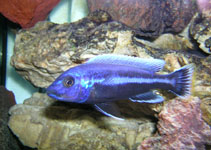
Spine dorsali (totale) : 17 - 18; Raggi dorsali molli (totale) : 8 - 9; Spine anali: 3; Raggi anali molli: 7 - 8. Diagnosis: Females and subadults of Melanochromis chipokae are distinguished from those of all other Melanochromis species by a yellow ground colour and a black submarginal band in the dorsal and anal fins (Ref. 89864). Male M. chipokae in breeding colour have a blue occipital region, a dark-blue/black body with two wide, light-blue horizontal stripes, and a blue dorsal fin with a wide white margin; they differ from males of most Melanochromis species with a similar colour pattern, except M. robustus and M. heterochromis, by the blue occipital region that is black or gray in M. melanopterus, M. vermivorus, M. simulans, M. loriae, M. robustus and M. mossambiquensis (Ref. 89864). Melanochromis chipokae males and females differ from M. robustus by a narrower interorbital width, 17.5-23.3% of head length vas. 26.1-29.6%, and from M. heterochromis by a longer lower jaw, 36.5-38.9% of head length vs. 29.3-34.6% (Ref. 89864).
Body shape (shape guide): fusiform / normal.
It prefers sandy patches among rock (Ref. 5595). In general, only solitary individuals are encountered, wandering through the intermediate habitat searching for larger invertebrates and, perhaps, small fishes (Ref. 89864). It may have suffered over-fishing by collectors of ornamental fishes because this species was rather common in the aquarium hobby more than 20 years ago (Ref. 89864).
Life cycle and mating behavior
Maturità | Riproduzione | Deposizione | Uova | Fecundity | Larve
Female is mouthbrooder.
Maréchal, C., 1991. Melanochromis. p. 258-265. In J. Daget, J.-P. Gosse, G.G. Teugels and D.F.E. Thys van den Audenaerde (eds.) Check-list of the freshwater fishes of Africa (CLOFFA). ISNB, Brussels; MRAC, Tervuren; and ORSTOM, Paris. Vol. 4. (Ref. 5663)
IUCN Red List Status (Ref. 130435: Version 2025-1)
Threat to humans
Harmless
Human uses
Acquario: Commerciale
Strumenti
Special reports
Download XML
Fonti Internet
Estimates based on models
Phylogenetic diversity index (Fonte Biblio.
82804): PD
50 = 0.5000 [Uniqueness, from 0.5 = low to 2.0 = high].
Bayesian length-weight: a=0.01445 (0.00674 - 0.03099), b=2.99 (2.82 - 3.16), in cm total length, based on LWR estimates for this (Sub)family-body shape (Ref.
93245).
Trophic level (Fonte Biblio.
69278): 4.2 ±0.73 se; based on food items.
Resilienza (Fonte Biblio.
120179): Alto, tempo minimo di raddoppiamento della popolazione meno di 15 mesi (tm<1).
Fishing Vulnerability (Ref.
59153): Low vulnerability (10 of 100).
🛈