>
Cichliformes (Cichlids, convict blennies) >
Cichlidae (Cichlids) > Pseudocrenilabrinae
Etymology: Melanochromis: Greek, melas, melanos = black + Greek, chromis = a fish, perhaps a perch (Ref. 45335).
Eponymy: This is a toponym referring to Chipoka Island, Lake Malawi, Malawi, the type locality. (Ref. 128868), visit book page.
Environment: milieu / climate zone / пределы глубины / distribution range
экология
; пресноводный демерсальный; pH range: 7.3 - 8.5; dH range: 7 - 18. Tropical; 24°C - 26°C (Ref. 2060); 13°S - 15°S
Africa: endemic to Lake Malawi (Ref. 5663, 89864).
Size / Вес / Возраст
половая зрелость: Lm ? range ? - ? cm
Max length : 12.0 cm SL самец/пол неопределен; (Ref. 5663)
Краткое описание
определительные ключи | морфология | морфометрия
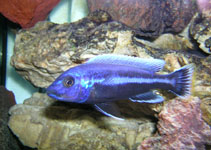
колючие лучи спинного плавника (общее число) : 17 - 18; членистые (мягкие) лучи спинного плавника (общее число) : 8 - 9; колючие лучи анального плавника: 3; членистые (мягкие) лучи анального плавника: 7 - 8. Diagnosis: Females and subadults of Melanochromis chipokae are distinguished from those of all other Melanochromis species by a yellow ground colour and a black submarginal band in the dorsal and anal fins (Ref. 89864). Male M. chipokae in breeding colour have a blue occipital region, a dark-blue/black body with two wide, light-blue horizontal stripes, and a blue dorsal fin with a wide white margin; they differ from males of most Melanochromis species with a similar colour pattern, except M. robustus and M. heterochromis, by the blue occipital region that is black or gray in M. melanopterus, M. vermivorus, M. simulans, M. loriae, M. robustus and M. mossambiquensis (Ref. 89864). Melanochromis chipokae males and females differ from M. robustus by a narrower interorbital width, 17.5-23.3% of head length vas. 26.1-29.6%, and from M. heterochromis by a longer lower jaw, 36.5-38.9% of head length vs. 29.3-34.6% (Ref. 89864).
Body shape (shape guide): fusiform / normal.
It prefers sandy patches among rock (Ref. 5595). In general, only solitary individuals are encountered, wandering through the intermediate habitat searching for larger invertebrates and, perhaps, small fishes (Ref. 89864). It may have suffered over-fishing by collectors of ornamental fishes because this species was rather common in the aquarium hobby more than 20 years ago (Ref. 89864).
Life cycle and mating behavior
половая зрелость | размножение | нерест | икра | Fecundity | личинки
Female is mouthbrooder.
Maréchal, C., 1991. Melanochromis. p. 258-265. In J. Daget, J.-P. Gosse, G.G. Teugels and D.F.E. Thys van den Audenaerde (eds.) Check-list of the freshwater fishes of Africa (CLOFFA). ISNB, Brussels; MRAC, Tervuren; and ORSTOM, Paris. Vol. 4. (Ref. 5663)
Статус Красного Списка МСОП (Ref. 130435: Version 2025-1)
Угроза для людей
Harmless
Использование человеком
аквариум: коммерческий
дополнительная информация
инструменты
Специальные отчеты
Скачать в формате XML
ресурсы в Интернет
Estimates based on models
Phylogenetic diversity index (ссылка
82804): PD
50 = 0.5000 [Uniqueness, from 0.5 = low to 2.0 = high].
Bayesian length-weight: a=0.01445 (0.00674 - 0.03099), b=2.99 (2.82 - 3.16), in cm total length, based on LWR estimates for this (Sub)family-body shape (Ref.
93245).
Trophic level (ссылка
69278): 4.2 ±0.73 se; based on food items.
устойчивость к внешним воздействиям (ссылка
120179): высокий, минимальное время удвоения популяции до 15 месяцев (tm<1).
Fishing Vulnerability (Ref.
59153): Low vulnerability (10 of 100).
🛈