Olocefali (chimere) (chimaeras) >
Chimaeriformes (Chimaeras) >
Chimaeridae (Shortnose chimaeras or ratfishes)
Etymology: Hydrolagus: hydro-, combining form of hydor (Gr.), water; lagos (Gr.), hare, i.e., “water rabbit,” probably referring to three pairs of tooth plates, which tend to protrude from the mouth like a rabbit’s incisors (See ETYFish); colliei: In honor of Alexander Collie (1793‒1835), Scottish surgeon-naturalist aboard HMS Blossom, from which holotype was collected; his notes formed the basis of Lay & Bennett’s description (See ETYFish).
Eponymy: Lieutenant Dr Alexander Collie (1793–1835) was the naval surgeon and naturalist on an expedition (1825–1828) led by Captain Frederick Beechey on ‘HMS Blossom’. [...] (Ref. 128868), visit book page.
More on authors: Lay & Bennett.
Environment: milieu / climate zone / distribuzione batimetrica / distribution range
Ecologia
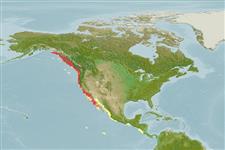
marino batidemersale; distribuzione batimetrica 0 - 913 m (Ref. 6793), usually 50 - 400 m (Ref. 43939). Temperate; 59°N - 8°N, 141°W - 83°W
Northeastern Pacific: west coast of North America from southwestern Alaska to Baja California, Mexico, including the Gulf of California, and Costa Rica.
Length at first maturity / Size / Peso / Age
Maturità: Lm ?, range 19 - ? cm
Max length : 100.0 cm TL maschio/sesso non determinato; (Ref. 96339)
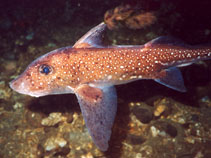
This species is distinguished by the following characters: short and bluntly rounded snout; oral and preopercular lateral line canals not sharing a short common branch from the infraorbital canal; anterior edge of dorsal-fin spine non-serrated; anterior and posterior regions of second dorsal-fin considerably taller than the middle region; pectoral fins when depressed do not reach beyond to origin of pelvic fins; no anal fin; caudal-fin axis horizontal with the fin nearly symmetrical, epaxial
and hypaxial lobes equal sized; coloration brown or reddish brown with small white spots on head and trunk (Ref. 97389).
Body shape (shape guide): elongated; Cross section: angular.
Found near the bottom, from close inshore to about 913 m (Ref. 2850). Abundant in cold waters at moderate depths. Feed on mollusks, crustaceans and fishes (Ref. 37955); also echinoderms and worms (Ref. 28499). The spine can be dangerous and cause a painful wound (Ref. 2850). Fishers are reputed to fear the jaws of the ratfish more than they do the dorsal spine. Its flesh is edible but bland and leaves an unpleasant aftertaste (Ref. 28499). The liver was used as a source of machine oil (Ref. 28499).
Life cycle and mating behavior
Maturità | Riproduzione | Deposizione | Uova | Fecundity | Larve
Distinct pairing during copulation (Ref. 205). The female extrudes two eggs at a time (each contained in a capsule) and may take up to 30 hours to extrude all her egg cases, which then hang from her body on a long filament for another 4 to 6 days. The egg cases end up planted vertically in the mud or just lying with filaments entangled on the bottom. Females extruding egss can be found year-round (Ref. 28499).
Allen, M.J. and G.B. Smith, 1988. Atlas and zoogeography of common fishes in the Bering Sea and northeastern Pacific. NOAA Tech. Rep. NMFS 66, 151 p. (Ref. 6793)
IUCN Red List Status (Ref. 130435: Version 2025-1)
Threat to humans
Traumatogenic (Ref. 4690)
Human uses
Pesca: di nessun interesse; Pesce da pesca sportiva: si; Acquario: Acquari pubblici
Strumenti
Special reports
Download XML
Fonti Internet
Estimates based on models
Preferred temperature (Fonte Biblio.
123201): 5.1 - 9.7, mean 7.5 °C (based on 115 cells).
Phylogenetic diversity index (Fonte Biblio.
82804): PD
50 = 0.5000 [Uniqueness, from 0.5 = low to 2.0 = high].
Bayesian length-weight: a=0.00331 (0.00137 - 0.00798), b=3.07 (2.86 - 3.28), in cm total length, based on LWR estimates for this (Sub)family-body shape (Ref.
93245).
Trophic level (Fonte Biblio.
69278): 3.7 ±0.54 se; based on food items.
Generation time: 5.6 ( na - na) years. Estimated as median ln(3)/K based on 2
growth studies.
Resilienza (Fonte Biblio.
120179): Basso, tempo minimo di raddoppiamento della popolazione 4.5 - 14 anni (K=0.2-0.22; Fec=2).
Fishing Vulnerability (Ref.
59153): Moderate to high vulnerability (50 of 100).
🛈
Climate Vulnerability (Ref.
125649): Moderate to high vulnerability (47 of 100).
🛈
Nutrients (Ref.
124155): Calcium = 14.2 [4.5, 42.2] mg/100g; Iron = 0.301 [0.111, 1.177] mg/100g; Protein = 16.7 [11.1, 19.8] %; Omega3 = 0.508 [0.213, 1.200] g/100g; Selenium = 20.8 [4.5, 56.4] μg/100g; VitaminA = 7.5 [2.3, 24.5] μg/100g; Zinc = 0.38 [0.19, 0.70] mg/100g (wet weight);