



Ladda upp din foton och Videor
Bilder | Google image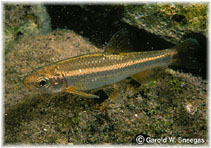 Dionda episcopa
Bild av Sneegas, G.W.
Bilder | Google image
Bild av Sneegas, G.W.
Klassificering / Namn Populärnamn | synonymer | Catalog of Fishes(Släkte, Arter) | ITIS | CoL | WoRMS | Cloffa
> Cypriniformes (Carps) > Leuciscidae (Minnows) > Pogonichthyinae
Etymology: episcopa: Named after Dione, the mother of Venus; episcopa meaning bishop or pope, alluding to John Pope, who led party that collected type (Ref. 79012).
Eponymy: Major-General John Pope (1822–1892) was an American Unionist general in the American Civil War (the binomial is a Latinisation of his surname). [...] (Ref. 128868), visit book page.
More on author: Girard.
Etymology: episcopa: Named after Dione, the mother of Venus; episcopa meaning bishop or pope, alluding to John Pope, who led party that collected type (Ref. 79012).
Eponymy: Major-General John Pope (1822–1892) was an American Unionist general in the American Civil War (the binomial is a Latinisation of his surname). [...] (Ref. 128868), visit book page.
More on author: Girard.
Miljö: miljö / Klimatzon / djupintervall / distributionsområde Ekologi
; sötvatten bentopelagisk; pH range: 7.4 - 8.1; dH range: 7 - 20. Subtropical; 23°C - 25°C (Ref. 12468); 34°N - 25°N
Utbredning Territorier | FAO områden | Ekosystem | Förekomster | Prickkarta | Utplanteringar | Faunafri
North America: Rio Grande drainage above Devils River in Texas, New Mexico and Mexico.
Storlek / Vikt / Ålder
Könsmognad: Lm ? range ? - ? cm
Max length : 7.7 cm TL hane/ej könsbestämd; (Ref. 86798); common length : 5.5 cm TL hane/ej könsbestämd; (Ref. 12193)
Max length : 7.7 cm TL hane/ej könsbestämd; (Ref. 86798); common length : 5.5 cm TL hane/ej könsbestämd; (Ref. 12193)
Adults inhabit rocky pools, sometimes runs, of headwaters, creeks, and small rivers. Often occurs among filamentous algae (Ref. 86798). They feed mainly on algae and other plants (Ref. 5723). Migratory behaviour is undetermined (Ref. 126106).
Livscykel och parningsbeteende Könsmognad | Reproduktion | Lek | Ägg | Fekunditet | Larver
Huvudreferens
Ladda upp dina referenser | referenser | Koordinator | Medarbetare
Page, L.M. and B.M. Burr, 2011. A field guide to freshwater fishes of North America north of Mexico. Boston : Houghton Mifflin Harcourt, 663p. (Ref. 86798)
Status på IUCN:s rödlista (Ref. 130435: Version 2025-2 (Global))
Least Concern (LC) ; Date assessed: 28 November 2011
CITES
Not Evaluated
Hot mot människor
Harmless
Mänskliga användningsområden
FAO - Publication: search | FishSource |
Ytterligare information
Populationsdynamik
Tillväxtparametrar
Max. åldrar / storlekar
Längd-vikt rel.
Längd-längd rel.
Längd-frekvenser
Massakonvertering
Rekrytering
Abundans
Tillväxtparametrar
Max. åldrar / storlekar
Längd-vikt rel.
Längd-längd rel.
Längd-frekvenser
Massakonvertering
Rekrytering
Abundans
Livscykel
Reproduktion
Könsmognad
Mognad/Gills rel.
Fekunditet
Lek
Lekande aggregat
Ägg
Utveckling av ägg
Larver
Larvdynamik
Reproduktion
Könsmognad
Mognad/Gills rel.
Fekunditet
Lek
Lekande aggregat
Ägg
Utveckling av ägg
Larver
Larvdynamik
Anatomi
Gälyta
Hjärna
Otolit
Gälyta
Hjärna
Otolit
Fysiologi
Kroppssammansättning
Näringsämnen
Syreförbrukning
Typ av simning
Simhastighet
Visuella pigment
Ljud från fisk
Sjukdomar & Parasiter
Toxicitet (LC50)
Kroppssammansättning
Näringsämnen
Syreförbrukning
Typ av simning
Simhastighet
Visuella pigment
Ljud från fisk
Sjukdomar & Parasiter
Toxicitet (LC50)
Människorelaterad
Vattenbrukssystem
Vattenbruksprofiler
Avelslinjer
Ciguatera-fall
Frimärken, mynt, diverse.
Vattenbrukssystem
Vattenbruksprofiler
Avelslinjer
Ciguatera-fall
Frimärken, mynt, diverse.
Verktyg
Organisk frågesport | E-bok | Fälthandbok | Längdfördelnings-verktyg | Livshistorie-verktyg | Prickkarta |
Fångst-MSY |
Särskilda rapporter
Kontrollera för underhåll av akvarium | Kontrollera om det finns faktablad om arter | Kontrollera om det finns faktablad om vattenbruk
Ladda ner XML
Internet-källor
AFORO (otoliths) | Aquatic Commons | BHL | Cloffa | Websites from users | Check FishWatcher | CISTI | Catalog of Fishes: Släkte, Arter | DiscoverLife | ECOTOX | FAO - Publication: search | Faunafri | Fishipedia | Fishtrace | GloBI | Google Books | Google Scholar | Google | IGFA World Record | OneZoom | Open Tree of Life | Otolith Atlas of Taiwan Fishes | PubMed | Reef Life Survey | Socotra Atlas | TreeBase | Tree of Life | Wikipedia: Go, sök | World Records Freshwater Fishing | Zoobank | Zoologiskt register
Uppskattningar baserade på modeller
Index för fylogenetisk mångfald (Ref. 82804): PD50 = 0.5156 [Uniqueness, from 0.5 = low to 2.0 = high].
Bayesian length-weight: a=0.00537 (0.00266 - 0.01086), b=3.10 (2.92 - 3.28), in cm total length, based on LWR estimates for this (Sub)family-body shape (Ref. 93245).
Trofisk nivå (Ref. 69278): 2.0 ±0.00 se; based on food items.
Resiliens (Ref. 120179): Hög, lägsta populationsfördubblingstid mindre än 15 månader (Preliminary K or Fecundity.).