



Hoplostethus atlanticus Collett, 1889
Orange roughy
個人による観察記録の追加 Fish Watcher
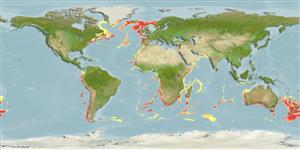
| Native range | All suitable habitat | Point map | Year 2050 |
|
| This map was computer-generated and has not yet been reviewed. |
| Hoplostethus atlanticus AquaMaps Data sources: GBIF OBIS |
分類 / 名前 共通名の | 類義語 | Catalog of Fishes(部類, 種) | ITIS | CoL | WoRMS | Cloffa
> Trachichthyiformes (Roughies) > Trachichthyidae (Slimeheads)
Etymology: Hoplostethus: Greek, hoplon = weapon + Greek, stetho, stethion = brest; literal = to prick a little breast (Ref. 45335).
Etymology: Hoplostethus: Greek, hoplon = weapon + Greek, stetho, stethion = brest; literal = to prick a little breast (Ref. 45335).
環境:環境 / 気候帯 / 深さの範囲 / 分布範囲 生態学
海 深海浮遊性; 海洋回遊性 (Ref. 51243); 深さの範囲 180 - 1809 m (Ref. 6390), usually 400 - 900 m (Ref. 3583). Deep-water; 3°C - 9°C (Ref. 36694); 65°N - 56°S, 84°W - 168°W
分布 領土 | 国連食糧農業機関の区域 | エコシステム | 事件 | 目的のマップ | 導入 | Faunafri
Western Atlantic: Gulf of Maine (Ref. 4784) [in error according to Moore (Fishes of the Gulf of Maine, in press), should be off northern Nova Scotia]. Eastern Atlantic: Iceland to Morocco; Walvis Bay, Namibia to off Durban, South Africa. Indo-Pacific: south-central Indian Ocean and New Zealand. Eastern Pacific: Chile (Ref. 27363). Several stocks may exist as suggested by distinct spawning sites and seasons.
初回成熟時の長さ / サイズ / 重さ / 年齢
成熟: Lm 34.5, range 18 - 32.5 cm
Max length : 75.0 cm TL オス/雌雄の選別がない; (Ref. 36696); common length : 40.0 cm TL オス/雌雄の選別がない; (Ref. 4181); 最大公表体重: 7.0 kg (Ref. 36697); 最大記録サイズ: 149 年 (Ref. 3680)
Max length : 75.0 cm TL オス/雌雄の選別がない; (Ref. 36696); common length : 40.0 cm TL オス/雌雄の選別がない; (Ref. 4181); 最大公表体重: 7.0 kg (Ref. 36697); 最大記録サイズ: 149 年 (Ref. 3680)
簡単な記述 検索表 | 形態学 | 形態計測学
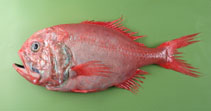
背面の脊椎 (合計) : 4 - 6; 背鰭 (合計) : 15 - 19; 肛門の骨: 3; 臀鰭: 10 - 12. Bright brick-red in color, mouth and gill cavity bluish black (Ref. 4181). Ventral scutes: 19-25.
Body shape (shape guide): short and / or deep.
Body shape (shape guide): short and / or deep.
Inhabits deep, cold waters over steep continental slopes, ocean ridges and sea-mounts. Shallow range of usual occurrence from Ref. 27121. Appears to be dispersed over both rough bottoms and steep, rough grounds where it feeds on crustaceans and fish. In New Zealand, the main prey include mesopelagic and benthopelagic prawns, fish, and squid, with other organisms such as mysids, amphipods and euphausiids occasionally being important (Ref. 9072). Juveniles feed mainly on crustaceans (Ref. 27075, 27076). Grows very slowly and is one of the longest lived fish species known. Based on parasite and trace-element analyses, orange roughy is a sedentary species with little movement between fish-management zones (Ref. 27089). Little is known of the larvae and juveniles which are probably confined to deep water (Ref. 27088). The fishery targets sporadically formed dense spawning and non-spawning aggregations. Marketed fresh and frozen; eaten steamed, fried, microwaved and baked (Ref. 9988). Because of severe overfishing the species has been listed as threatened by the Australian Government in 2006.
ライフサイクルと交尾行動 成熟 | 繁殖 | 放精 | 卵 | 生産力 | 幼生
Orange roughy are synchronous annual spawners (Ref. 7030). They form dense spawning aggregations over sea hills and slopes. Eggs and sperms are shed into the water at the same time. Individual males appear to spawn over a 1-2 week period and females spawn for up to 1 week. Little is known of the larvae and juveniles.
主な参考文献
参考文献のアップロード | 参考文献 | コーディネーター : Moore, Jon A. | 協力者
Maul, G.E., 1986. Trachichthyidae. p. 749-752. In P.J.P. Whitehead, M.-L. Bauchot, J.-C. Hureau, J. Nielsen and E. Tortonese (eds.) Fishes of the north-eastern Atlantic and the Mediterranean. UNESCO, Paris. Vol. 2. (Ref. 4784)
CITES
Not Evaluated
人間に対する脅威
Harmless
人間の用途
水産業: 高い商業の
FAO - 水産業: 着陸, 種の外形; Publication: search | FIRMS - Stock assessments | FishSource | 私達の周りの海
より多くの情報
解剖学
カマ
脳
オトリス
カマ
脳
オトリス
用具
特記事項
XMLをダウンロードして下さい
インターネットの情報源
AFORO (otoliths) | Aquatic Commons | BHL | Cloffa | Websites from users | Check FishWatcher | CISTI | Catalog of Fishes: 部類, 種 | DiscoverLife | ECOTOX | FAO - 水産業: 着陸, 種の外形; Publication: search | Faunafri | Fishipedia | Fishtrace | GloBI | Google Books | Google Scholar | Google | IGFA World Record | 国のデーターベース | OneZoom | Open Tree of Life | Otolith Atlas of Taiwan Fishes | PubMed | Reef Life Survey | RFE Identification | Socotra Atlas | TreeBase | 生命の木 | Wikipedia: 行く, 検索する | World Records Freshwater Fishing | Zoobank | 動物に関する記録
モデルに基づく推定値
好ましい温度 (参照 123201): 3.5 - 8.4, mean 6.6 °C (based on 754 cells).
系統多様性指数 (参照 82804): PD50 = 0.5000 [Uniqueness, from 0.5 = low to 2.0 = high].
Bayesian length-weight: a=0.02239 (0.01610 - 0.03112), b=3.08 (2.99 - 3.17), in cm total length, based on LWR estimates for this species (Ref. 93245).
栄養段階 (参照 69278): 4.3 ±0.1 se; based on diet studies.
回復力 (参照 120179): 非常に低い, 14年以上の倍増期間の最小個体群 (K=0.04-0.06; tm=5-33; tmax=140; Fec=10,000).
Prior r = 0.07, 95% CL = 0.05 - 0.11, Based on 3 full stock assessments.
栄養素 (Ref. 124155): Calcium = 12.4 [4.3, 62.9] mg/100g; Iron = 0.266 [0.095, 0.925] mg/100g; Protein = 17.5 [15.8, 19.2] %; Omega3 = 0.16 [0.05, 0.53] g/100g; Selenium = 20.4 [6.3, 69.4] μg/100g; VitaminA = 26.7 [2.7, 276.6] μg/100g; Zinc = 0.379 [0.183, 0.821] mg/100g (wet weight);