



Hoplostethus atlanticus Collett, 1889
Orange roughy
Добавить Ваши наблюдения в Fish Watcher
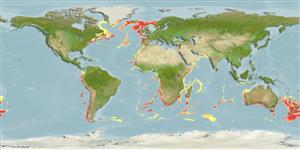
| Native range | All suitable habitat | Point map | Year 2050 |
|
| This map was computer-generated and has not yet been reviewed. |
| Hoplostethus atlanticus AquaMaps Data sources: GBIF OBIS |
Загрузить свой Фото и Видео
изображения | Видео | Изображение на Google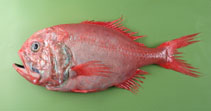 Hoplostethus atlanticus
Изображение сделано Orlov, A.
изображения | Видео | Изображение на Google
Изображение сделано Orlov, A.
Классификация / Имена народные названия | синонимы | Catalog of Fishes(род, виды) | ITIS | CoL | WoRMS | Cloffa
> Trachichthyiformes (Roughies) > Trachichthyidae (Slimeheads)
Etymology: Hoplostethus: Greek, hoplon = weapon + Greek, stetho, stethion = brest; literal = to prick a little breast (Ref. 45335).
Etymology: Hoplostethus: Greek, hoplon = weapon + Greek, stetho, stethion = brest; literal = to prick a little breast (Ref. 45335).
Окружающая среда: среда / климатическая зона / пределы глубины / диапазон распространения экология
морской батипелагический; мигрирует в океане (Ref. 51243); пределы глубины 180 - 1809 m (Ref. 6390), usually 400 - 900 m (Ref. 3583). Deep-water; 3°C - 9°C (Ref. 36694); 65°N - 56°S, 84°W - 168°W
распространение Территории | регионы FAO | Экосистемы | места находок | карта точек | интродукции | Faunafri
Western Atlantic: Gulf of Maine (Ref. 4784) [in error according to Moore (Fishes of the Gulf of Maine, in press), should be off northern Nova Scotia]. Eastern Atlantic: Iceland to Morocco; Walvis Bay, Namibia to off Durban, South Africa. Indo-Pacific: south-central Indian Ocean and New Zealand. Eastern Pacific: Chile (Ref. 27363). Several stocks may exist as suggested by distinct spawning sites and seasons.
Длина при первой зрелости / Размер / Вес / Возраст
половая зрелость: Lm 34.5, range 18 - 32.5 cm
Max length : 75.0 cm TL самец/пол неопределен; (Ref. 36696); common length : 40.0 cm TL самец/пол неопределен; (Ref. 4181); наибольший вес (опубликованные данные): 7.0 kg (Ref. 36697); наибольший возраст (опубликованны данные): 149 годы (Ref. 3680)
Max length : 75.0 cm TL самец/пол неопределен; (Ref. 36696); common length : 40.0 cm TL самец/пол неопределен; (Ref. 4181); наибольший вес (опубликованные данные): 7.0 kg (Ref. 36697); наибольший возраст (опубликованны данные): 149 годы (Ref. 3680)
Краткое описание определительные ключи | морфология | морфометрия
колючие лучи спинного плавника (общее число) : 4 - 6; членистые (мягкие) лучи спинного плавника (общее число) : 15 - 19; колючие лучи анального плавника: 3; членистые (мягкие) лучи анального плавника: 10 - 12. Bright brick-red in color, mouth and gill cavity bluish black (Ref. 4181). Ventral scutes: 19-25.
Body shape (shape guide): short and / or deep.
Body shape (shape guide): short and / or deep.
Inhabits deep, cold waters over steep continental slopes, ocean ridges and sea-mounts. Shallow range of usual occurrence from Ref. 27121. Appears to be dispersed over both rough bottoms and steep, rough grounds where it feeds on crustaceans and fish. In New Zealand, the main prey include mesopelagic and benthopelagic prawns, fish, and squid, with other organisms such as mysids, amphipods and euphausiids occasionally being important (Ref. 9072). Juveniles feed mainly on crustaceans (Ref. 27075, 27076). Grows very slowly and is one of the longest lived fish species known. Based on parasite and trace-element analyses, orange roughy is a sedentary species with little movement between fish-management zones (Ref. 27089). Little is known of the larvae and juveniles which are probably confined to deep water (Ref. 27088). The fishery targets sporadically formed dense spawning and non-spawning aggregations. Marketed fresh and frozen; eaten steamed, fried, microwaved and baked (Ref. 9988). Because of severe overfishing the species has been listed as threatened by the Australian Government in 2006.
Жизненный цикл и брачное поведение половая зрелость | размножение | нерест | икра | Плодовитость | личинки
Orange roughy are synchronous annual spawners (Ref. 7030). They form dense spawning aggregations over sea hills and slopes. Eggs and sperms are shed into the water at the same time. Individual males appear to spawn over a 1-2 week period and females spawn for up to 1 week. Little is known of the larvae and juveniles.
Основная ссылка
Загрузите свои рекомендации | ссылки | координатор : Moore, Jon A. | соавторы
Maul, G.E., 1986. Trachichthyidae. p. 749-752. In P.J.P. Whitehead, M.-L. Bauchot, J.-C. Hureau, J. Nielsen and E. Tortonese (eds.) Fishes of the north-eastern Atlantic and the Mediterranean. UNESCO, Paris. Vol. 2. (Ref. 4784)
CITES
Not Evaluated
Угроза для людей
Harmless
Использование человеком
рыболовство: важный объект промысла
FAO - рыболовство: посадки, Видовой профиль; Publication: search | FIRMS - Stock assessments | FishSource | Море вокруг нас
дополнительная информация
Трофическая экология
Пищевые предметы (добыча)
состав пищи
потребление пищи
Продовольственные пайки
хищники
Пищевые предметы (добыча)
состав пищи
потребление пищи
Продовольственные пайки
хищники
Динамика численности населения
Параметры роста
Макс. возраст / размер
Отношение длины к весу.
Отношение длины к длине.
Размерный состав
Преобразование массы
пополнение
численность
Параметры роста
Макс. возраст / размер
Отношение длины к весу.
Отношение длины к длине.
Размерный состав
Преобразование массы
пополнение
численность
Жизненный цикл
размножение
половая зрелость
Зрелость/Жиры относительно.
Плодовитость
нерест
Нерестовые скопления
икра
Развитие икры
личинки
динамика численности личинок
размножение
половая зрелость
Зрелость/Жиры относительно.
Плодовитость
нерест
Нерестовые скопления
икра
Развитие икры
личинки
динамика численности личинок
Анатомия
жаберная область
Мозг
Отолит
жаберная область
Мозг
Отолит
Физиология
Состав тела
Питательные вещества
Потребление кислорода
Тип плавания
Скорость плавания
Зрительные пигменты
Звук рыбы
Болезни и паразиты
Токсичность (LC50s)
Состав тела
Питательные вещества
Потребление кислорода
Тип плавания
Скорость плавания
Зрительные пигменты
Звук рыбы
Болезни и паразиты
Токсичность (LC50s)
Связанные с человеком
Системы аквакультуры
особенности рыбоводства
степень растяжения
Случаи заболевания сигуатерой
Марки, монеты и прочее.
Системы аквакультуры
особенности рыбоводства
степень растяжения
Случаи заболевания сигуатерой
Марки, монеты и прочее.
инструменты
Электронная книга | полевой определитель | определительные ключи | Длина-Частота | онтогенез | карта точек |
Catch-MSY |
Специальные отчеты
Проверить содержание в аквариумах | Проверить опубликованные видовые данные | Проверить опубликованные данные по аквакультуре
Скачать в формате XML
ресурсы в Интернет
AFORO (otoliths) | Aquatic Commons | BHL | Cloffa | Websites from users | Проверить FishWatcher | CISTI | Catalog of Fishes: род, виды | DiscoverLife | ECOTOX | FAO - рыболовство: посадки, Видовой профиль; Publication: search | Faunafri | Fishipedia | Fishtrace | GloBI | Google Books | Google Scholar | Google | IGFA World Record | национальные базы данных | OneZoom | Open Tree of Life | Otolith Atlas of Taiwan Fishes | PubMed | Reef Life Survey | Определение с помощью Regulatory Fish Encyclopedia | Socotra Atlas | TreeBase | Tree of Life | Wikipedia: Вперёд, поиск | World Records Freshwater Fishing | Zoobank | Зоологическая летопись
Оценки, основанные на моделях
Предпочтительная температура (ссылка 123201): 3.5 - 8.4, mean 6.6 °C (based on 754 cells).
Индекс филогенетического разнообразия (ссылка 82804): PD50 = 0.5000 [Uniqueness, from 0.5 = low to 2.0 = high].
Bayesian length-weight: a=0.02239 (0.01610 - 0.03112), b=3.08 (2.99 - 3.17), in cm total length, based on LWR estimates for this species (Ref. 93245).
Трофический уровень (ссылка 69278): 4.3 ±0.1 se; based on diet studies.
устойчивость к внешним воздействиям (ссылка 120179): очень низкий, минимальное время удвоения популяции более 14 лет (K=0.04-0.06; tm=5-33; tmax=140; Fec=10,000).
Prior r = 0.07, 95% CL = 0.05 - 0.11, Based on 3 full stock assessments.
Питательные вещества (Ref. 124155): Calcium = 12.4 [4.3, 62.9] mg/100g; Iron = 0.266 [0.095, 0.925] mg/100g; Protein = 17.5 [15.8, 19.2] %; Omega3 = 0.16 [0.05, 0.53] g/100g; Selenium = 20.4 [6.3, 69.4] μg/100g; VitaminA = 26.7 [2.7, 276.6] μg/100g; Zinc = 0.379 [0.183, 0.821] mg/100g (wet weight);