>
Mugiliformes (Mullets) >
Mugilidae (Mullets)
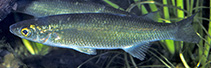
Eponymy: Mr. Petard (forename not known) sent fishes to Castelnau that he had collected from the Richmond River, New South Wales, including the type of this one. (Ref. 128868), visit book page.
More on author: Castelnau.
Environment: milieu / climate zone / profondeur / distribution range
Écologie
marin; eau douce; saumâtre pelagic-neritic; catadrome (Ref. 51243). Subtropical; 9°C - 27°C (Ref. 2906); 26°S - 33°S
Oceania: Georges River northwards to the Burnett River in Australia.
Length at first maturity / Taille / Poids / Âge
Maturité: Lm 38.0, range 36 - 40 cm
Max length : 81.0 cm TL mâle / non sexé; (Ref. 2906); common length : 35.0 cm NG mâle / non sexé; (Ref. 2906); poids max. publié: 7.5 kg (Ref. 2906); âge max. reporté: 14 années (Ref. 44894)
Often occur in small groups in deep pools where stream flow is slow. Inhabit deep, gently flowing sections of rivers. Also occur in estuaries and coastal seas during spawning runs. Tolerant of temperatures between 9° and 27°C. Form small shoals (Ref. 44894). Mainly herbivorous. Feed on filamentous green algae, microscopic plants and animals as well as detritus. Also consume benthic invertebrates. Oviparous, eggs are pelagic and non-adhesive (Ref. 205). Spawn in estuaries or at sea following a downstream migration in summer. Peak spawning activity is in February. Sexual maturity is reached after 4 years at a length of about 30 centimeters. Maximum life span is approximately 14 years (Ref. 44894).
Merrick, J.R. and G.E. Schmida, 1984. Australian freshwater fishes: biology and management. Griffin Press Ltd., South Australia. 409 p. (Ref. 2906)
Statut dans la liste rouge de l'IUCN (Ref. 130435: Version 2025-1)
Menace pour l'homme
Harmless
Utilisations par l'homme
Aquaculture: commercial
Outils
Articles particuliers
Télécharger en XML
Sources Internet
Estimates based on models
Phylogenetic diversity index (Réf.
82804): PD
50 = 1.0000 [Uniqueness, from 0.5 = low to 2.0 = high].
Bayesian length-weight: a=0.01175 (0.00555 - 0.02485), b=2.96 (2.79 - 3.13), in cm total length, based on LWR estimates for this (Sub)family-body shape (Ref.
93245).
Niveau trophique (Réf.
69278): 2.3 ±0.20 se; based on food items.
Résilience (Réf.
120179): Faible, temps minimum de doublement de population : 4,5 à 14 années (tm=4; tmax=14; Fec=1.1 million).
Fishing Vulnerability (Ref.
59153): Moderate to high vulnerability (52 of 100).
🛈