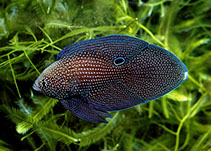
>
Ovalentaria/misc (Various families in series Ovalentaria) >
Plesiopidae (Roundheads) > Plesiopinae
Etymology: Calloplesiops: Greek, kalos, kallos = beautiful + Greek, plesios = near, neighbour + Greek, ops = appearance (Ref. 45335).
More on authors: Fowler & Bean.
Environment: milieu / climate zone / distribuzione batimetrica / distribution range
Ecologia
marino associati a barriera corallina; non migratori, usually 3 - 50 m (Ref. 27115). Tropical
Western Central Pacific: Philippines and Indonesia.
Size / Peso / Age
Maturità: Lm ? range ? - ? cm
Max length : 16.0 cm TL maschio/sesso non determinato; (Ref. 27115)
Secretive species (Ref. 27115). Eggs are guarded by the male parent (Ref. 205).
Life cycle and mating behavior
Maturità | Riproduzione | Deposizione | Uova | Fecundity | Larve
Spawns in cave. Young hatch after about one week (Ref. 27115). Eggs are guarded by the male parent (Ref. 205).
Baensch, H.A. and H. Debelius, 1997. SF457.1 .B3513 1994 Mergus Verlag GmbH, Postfach 86, 49302, Melle, Germany. 1216 p. 3rd edition. (Ref. 27115)
IUCN Red List Status (Ref. 130435: Version 2025-1)
Threat to humans
Harmless
Human uses
Pesca: di nessun interesse; Acquario: Commerciale
Strumenti
Special reports
Download XML
Fonti Internet
Estimates based on models
Phylogenetic diversity index (Fonte Biblio.
82804): PD
50 = 0.7500 [Uniqueness, from 0.5 = low to 2.0 = high].
Bayesian length-weight: a=0.01000 (0.00244 - 0.04107), b=3.04 (2.81 - 3.27), in cm total length, based on all LWR estimates for this body shape (Ref.
93245).
Trophic level (Fonte Biblio.
69278): 3.8 ±0.3 se; based on size and trophs of closest relatives
Resilienza (Fonte Biblio.
120179): Medio, tempo minimo di raddoppiamento della popolazione 1.4 - 4.4 anni (Preliminary K or Fecundity.).
Fishing Vulnerability (Ref.
59153): Low vulnerability (10 of 100).
🛈