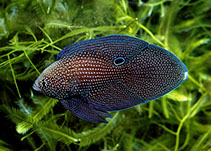
Calloplesiops argus : aquarium

You can sponsor this page

Calloplesiops argus Fowler & Bean, 1930

Upload your photos and videos
Bilder | Google image
Image of Calloplesiops argus
Calloplesiops argus
Picture by Muséum-Aquarium de Nancy/D. Terver

Classification / Names Populärnamn | synonymer | Catalog of Fishes(Släkte, Arter) | ITIS | CoL | WoRMS | Cloffa

> Ovalentaria/misc (Various families in series Ovalentaria) > Plesiopidae (Roundheads) > Plesiopinae
Etymology: Calloplesiops: Greek, kalos, kallos = beautiful + Greek, plesios = near, neighbour + Greek, ops = appearance (Ref. 45335).
More on authors: Fowler & Bean.

Environment: milieu / climate zone / djupintervall / distribution range Ekologi

marina revassocierade; ej vandrande, usually 3 - 50 m (Ref. 27115). Tropical

Utbredning Länder | FAO områden | Ekosystem | Förekomster | Prickkarta | Utplanteringar | Faunafri

Western Central Pacific: Philippines and Indonesia.

Size / Vikt / Age

Könsmognad: Lm ?  range ? - ? cm
Max length : 16.0 cm TL hane/ej könsbestämd; (Ref. 27115)

Biologi     Ordlista (t.ex. epibenthic)

Secretive species (Ref. 27115). Eggs are guarded by the male parent (Ref. 205).

Life cycle and mating behavior Könsmognad | Reproduktion | Lek | Ägg | Fecundity | Larver

Spawns in cave. Young hatch after about one week (Ref. 27115). Eggs are guarded by the male parent (Ref. 205).

Main reference Upload your references | referenser | Koordinator | Medarbetare

Baensch, H.A. and H. Debelius, 1997. SF457.1 .B3513 1994 Mergus Verlag GmbH, Postfach 86, 49302, Melle, Germany. 1216 p. 3rd edition. (Ref. 27115)

IUCN Red List Status (Ref. 130435: Version 2025-1)

  Data deficient (DD) ; Date assessed: 21 April 2022

CITES

Not Evaluated

CMS (Ref. 116361)

Not Evaluated

Threat to humans

  Harmless


Human uses

Fiskeri: saknar intresse; Akvarium: Kommersiell
FAO - Publication: search | FishSource |

Ytterligare information

Trophic ecology
Food items (preys)
Födosammansättning
Födointag
Food rations
Predatorer
Ekologi
Ekologi
Home ranges
Population dynamics
Tillväxtparametrar
Max. ages / sizes
Length-weight rel.
Length-length rel.
Length-frequencies
Mass conversion
Rekrytering
Abundans
Life cycle
Reproduktion
Könsmognad
Maturity/Gills rel.
Fecundity
Lek
Spawning aggregations
Ägg
Egg development
Larver
Larvdynamik
Utbredning
Länder
FAO områden
Ekosystem
Förekomster
Utplanteringar
BRUVS - Videos
Anatomy
Gälyta
Brain
Otolith
Physiology
Body composition
Nutrients
Syreförbrukning
Swimming type
Simhastighet
Visual pigments
Fish sound
Diseases & Parasites
Toxicity (LC50s)
Genetik
Genome
Genetik
Heterozygosity
Ärftlighet
Human related
Aquaculture systems
Vattenbruksprofiler
Avelslinjer
Ciguatera cases
Stamps, coins, misc.
Outreach
Medarbetare
Taxonomy
Populärnamn
synonymer
Morfologi
Morfometri
Bilder
referenser
referenser

Verktyg

Special reports

Download XML

Internet-källor

AFORO (otoliths) | Aquatic Commons | BHL | Cloffa | Websites from users | Check FishWatcher | CISTI | Catalog of Fishes: Släkte, Arter | DiscoverLife | ECOTOX | FAO - Publication: search | Faunafri | Fishipedia | Fishtrace | GloBI | Google Books | Google Scholar | Google | IGFA World Record | OneZoom | Open Tree of Life | Otolith Atlas of Taiwan Fishes | Offentliga akvarier | PubMed | Reef Life Survey | Socotra Atlas | TreeBase | Tree of Life | Wikipedia: Go, sök | Zoobank | Zoological Record

Estimates based on models

Phylogenetic diversity index (Ref. 82804):  PD50 = 0.7500   [Uniqueness, from 0.5 = low to 2.0 = high].
Bayesian length-weight: a=0.01000 (0.00244 - 0.04107), b=3.04 (2.81 - 3.27), in cm total length, based on all LWR estimates for this body shape (Ref. 93245).
Trofisk nivå (Ref. 69278):  3.8   ±0.3 se; based on size and trophs of closest relatives
Resiliens (Ref. 120179):  Mellan, lägsta populationsfördubblingstid 1,4-4,4 år (Preliminary K or Fecundity.).
Fishing Vulnerability (Ref. 59153):  Low vulnerability (10 of 100). 🛈