>
Siluriformes (Catfishes) >
Ariidae (Sea catfishes) > Ariinae
Etymology: Carlarius: First part of the generic name honors Dr. Carl Ferraris, Research Associate at the California Academy of Sciences for his contribution to the knowledge of Siluriformes fishes and continuous support and encouragement throughout the development of this work; the second part is from the frequently used generic name Arius.
Eponymy: Nobody knows who Park – or perhaps, Parke – was. [...] (Ref. 128868), visit book page.
More on author: Günther.
Environment: milieu / Klimaatzone / Diepte / distribution range
Ecologie
marien; brak water demersaal; diepte 50 - 80 m (Ref. 6541). Tropical
Eastern Atlantic: commonly caught in coastal sea-waters from Cap Blanc (Mauritania) to Angola (Ref. 57224). Sporadically to Spanish Sahara and Morocco; enters estuaries and freshwater of rivers (Ref. 3876).
Grootte / Gewicht / Leeftijd
Maturiteit: Lm ? range ? - ? cm
Max length : 75.0 cm TL mannelijk / geslacht onbekend; (Ref. 57224); common length : 40.0 cm TL mannelijk / geslacht onbekend; (Ref. 2683)
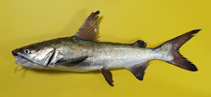
Dorsale stekels (totaal) : 2; Dorsale zachte stralen (totaal) : 7; Anale stekels: 0. Diagnosis: body elongated and rounded; head broad and only slightly flattened above; snout rounded; mouth inferior; maxillary barbels reaching to pectoral fin bases, mandibular ones being shorter: osseous head shield, coarsely rugose, fairly visible through the skin (Ref. 57224). Occipital process moderately broad at base, tapering towards its distal end, with a median keel (Ref. 2683, 57224). Predorsal plate very rugose, short and crescent-shaped; premaxillary teeth villiform forming a plate slightly curved (Ref. 57224). Palatal teeth in single pair of rounded patches, well separated by a space smaller than their diameter (Ref. 57224, 81640). No gill-rakers on the posterior face of the 1st and 2nd arches (Ref. 57224). Total number of anterior gill-rakers on 1st arch: 11-14 (Ref. 57224, 81640). 11-15 gill rakers on the outer side of the entire 2nd arch (Ref. 81640). Dorsal fin short with a long, osseous serrated spine preceded by a very short one; dorsal and pectoral fins with a strong serrated, erectile spine; adipose fin well developed; caudal fin forked with long pointed lobes (Ref. 57224).
Coloration: olive brown above, belly whitish (Ref. 57224).
Body shape (shape guide): fusiform / normal.
Marine species commonly found along the continental coast; often entering adjacent estuaries and freshwater rivers (Ref. 3876). Feeds on fish and shrimps (Ref. 28587). Males practise buccal incubation (Ref. 57224). Dorsal and pectoral serrated spines are venomous and can cause very painful wounds (Ref. 43448).
Levenscyclus en paargedrag
Maturiteit | Voortplanting | Paaien | Eieren | Fecunditeit | Larven
Schneider, W., 1990. FAO species identification sheets for fishery purposes. Field guide to the commercial marine resources of the Gulf of Guinea. Prepared and published with the support of the FAO Regional Office for Africa. Rome: FAO. 268 p. (Ref. 2683)
Status op de Rode Lijst van het IUCN (Ref. 130435: Version 2025-1)
Gevaar voor de mens
Traumatogenic (Ref. 58010)
Gebruik door de mens
Visserij: commercieel
Tools
Speciale rapporten
Download XML
Internetbronnen
Estimates based on models
Preferred temperature (Ref.
123201): 17.7 - 20.4, mean 19.3 °C (based on 15 cells).
Fylogenetische diversiteitsindex (Ref.
82804): PD
50 = 0.5625 [Uniqueness, from 0.5 = low to 2.0 = high].
Bayesian length-weight: a=0.00891 (0.00523 - 0.01518), b=3.10 (2.95 - 3.25), in cm total length, based on LWR estimates for this species & (Sub)family-body (Ref.
93245).
Trofisch niveau (Ref.
69278): 4.1 ±0.70 se; based on food items.
Generation time: 6.4 ( na - na) years. Estimated as median ln(3)/K based on 1
growth studies.
Weerstandsvermogen (Ref.
120179): Gemiddeld, minimale populatieverdubbelingstijd 1,4-4,4 jaar (K=0.17).
Fishing Vulnerability (Ref.
59153): Moderate to high vulnerability (51 of 100).
🛈