>
Siluriformes (Catfishes) >
Ariidae (Sea catfishes) > Ariinae
Etymology: Carlarius: First part of the generic name honors Dr. Carl Ferraris, Research Associate at the California Academy of Sciences for his contribution to the knowledge of Siluriformes fishes and continuous support and encouragement throughout the development of this work; the second part is from the frequently used generic name Arius.
Eponymy: Nobody knows who Park – or perhaps, Parke – was. [...] (Ref. 128868), visit book page.
More on author: Günther.
Environment: milieu / climate zone / تغييرات عمق / distribution range
بوم شناسي
دريايي; لب شور نزديك كف زي; تغييرات عمق 50 - 80 m (Ref. 6541). Tropical
Eastern Atlantic: commonly caught in coastal sea-waters from Cap Blanc (Mauritania) to Angola (Ref. 57224). Sporadically to Spanish Sahara and Morocco; enters estuaries and freshwater of rivers (Ref. 3876).
Size / Weight / سن
بلوغ: Lm ? range ? - ? cm
Max length : 75.0 cm TL جنس نر / بدون خواص جنسي; (Ref. 57224); common length : 40.0 cm TL جنس نر / بدون خواص جنسي; (Ref. 2683)
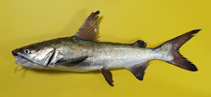
خارهاي باله پشتي (کل) : 2; شعاع نرم باله پشتي (کل) : 7; خارهاي باله مخرجي: 0. Diagnosis: body elongated and rounded; head broad and only slightly flattened above; snout rounded; mouth inferior; maxillary barbels reaching to pectoral fin bases, mandibular ones being shorter: osseous head shield, coarsely rugose, fairly visible through the skin (Ref. 57224). Occipital process moderately broad at base, tapering towards its distal end, with a median keel (Ref. 2683, 57224). Predorsal plate very rugose, short and crescent-shaped; premaxillary teeth villiform forming a plate slightly curved (Ref. 57224). Palatal teeth in single pair of rounded patches, well separated by a space smaller than their diameter (Ref. 57224, 81640). No gill-rakers on the posterior face of the 1st and 2nd arches (Ref. 57224). Total number of anterior gill-rakers on 1st arch: 11-14 (Ref. 57224, 81640). 11-15 gill rakers on the outer side of the entire 2nd arch (Ref. 81640). Dorsal fin short with a long, osseous serrated spine preceded by a very short one; dorsal and pectoral fins with a strong serrated, erectile spine; adipose fin well developed; caudal fin forked with long pointed lobes (Ref. 57224).
Coloration: olive brown above, belly whitish (Ref. 57224).
Body shape (shape guide): fusiform / normal.
Marine species commonly found along the continental coast; often entering adjacent estuaries and freshwater rivers (Ref. 3876). Feeds on fish and shrimps (Ref. 28587). Males practise buccal incubation (Ref. 57224). Dorsal and pectoral serrated spines are venomous and can cause very painful wounds (Ref. 43448).
Life cycle and mating behavior
بلوغ | تولید مثل | تخم ریزی | تخم ها | Fecundity | توزاد ( لارو)
Schneider, W., 1990. FAO species identification sheets for fishery purposes. Field guide to the commercial marine resources of the Gulf of Guinea. Prepared and published with the support of the FAO Regional Office for Africa. Rome: FAO. 268 p. (Ref. 2683)
وضعيت در فهرست قرمز IUCN (Ref. 130435: Version 2025-1)
خطر برای انسان ها
Traumatogenic (Ref. 58010)
استفاده انسانی
ماهي گيري – شيلات: تجاري
ابزارها
گزارش های ويژه
بارگيری XML
منابع اينترنتي
Estimates based on models
Preferred temperature (مرجع
123201): 17.7 - 20.4, mean 19.3 °C (based on 15 cells).
Phylogenetic diversity index (مرجع
82804): PD
50 = 0.5625 [Uniqueness, from 0.5 = low to 2.0 = high].
Bayesian length-weight: a=0.00891 (0.00523 - 0.01518), b=3.10 (2.95 - 3.25), in cm total length, based on LWR estimates for this species & (Sub)family-body (Ref.
93245).
Trophic level (مرجع
69278): 4.1 ±0.70 se; based on food items.
Generation time: 6.4 ( na - na) years. Estimated as median ln(3)/K based on 1
growth studies.
جهندگی (مرجع
120179): متوسط, كمينه زمان لازم براي دو برابر شدن جمعيت 4/1 – 4/4 سال (K=0.17).
Fishing Vulnerability (Ref.
59153): Moderate to high vulnerability (51 of 100).
🛈