>
Eupercaria/misc (Various families in series Eupercaria) >
Scaridae (Parrotfishes) > Scarinae
Etymology: Scarus: Greek, skaros = a fish described by anciente writers as a parrot fish; 1601 (Ref. 45335).
More on author: Valenciennes.
Environment: milieu / climate zone / Tiefenbereich / distribution range
Ökologie
seewasser riff-verbunden; tiefenbereich 1 - 30 m (Ref. 86942). Tropical; 30°N - 32°S
Western Pacific: Thailand to New Caledonia, north to the Ryukyu Islands, south to Perth and New South Wales in Australia. Recently recorded from Tonga (Ref. 53797).
Size / Gewicht / Alter
Geschlechtsreife: Lm ? range ? - ? cm
Max length : 40.0 cm SL Männchen/unbestimmt; (Ref. 2935); common length : 20.0 cm SL Männchen/unbestimmt; (Ref. 2935)
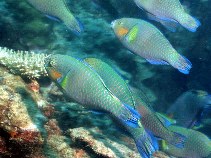
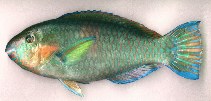
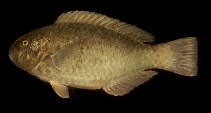
Rückenflossenstacheln (insgesamt) : 9; Rückenflossenweichstrahlen (insgesamt) : 10; Afterflossenstacheln: 3; Afterflossenweichstrahlen: 9. This species is distinguished by the following features: 5-7 (usually 6) median predorsal scales; 3 scale rows on cheek 1(5-7), 2(5-7), 3(1-4); pectoral-fin rays 13-15 (usually 14); conical teeth on side of dental plate, none in female and usually 2 on upper and 0-1 on lower of dental plates for terminal male; lips nearly covering dental plates; caudal fin slightly rounded to truncate in female and emarginate in terminal male. Colour of patch covering cheek and gill cover of male orange, wavy band/lines on snout and cheek, pectoral fins pale green; female grey or grey-brown with 2 pale stripes on belly (Ref. 9793, 90102).
Body shape (shape guide): fusiform / normal.
Found in silty coastal and offshore areas to 20 m deep (Ref. 90102). Inhabits rocky and coral reefs from tidal pools to at least 10 m deep. Form schools with 30 to 40 individuals. Grazes on benthic algae and corals (Ref. 2935). Reproductively active terminal males become bicolored (Ref. 37816).
Life cycle and mating behavior
Geschlechtsreife | Fortpflanzung | Ablaichen | Eier | Fecundity | Larven
Oviparous, distinct pairing during breeding (Ref. 205).
Randall, J.E. and J.H. Choat, 1980. Two new parrotfishes of the genus Scarus from the Central and South Pacific, with further examples of sexual dichromatism. Zool. J. Linn. Soc. 70:383-419. (Ref. 2689)
IUCN Rote Liste Status (Ref. 130435: Version 2025-1)
Bedrohung für Menschen
Harmless
Nutzung durch Menschen
Fischereien: kommerziell
Tools
Zusatzinformationen
Download XML
Internet Quellen
Estimates based on models
Preferred temperature (Ref.
123201): 24.8 - 29.3, mean 28.5 °C (based on 2763 cells).
Phylogenetic diversity index (Ref.
82804): PD
50 = 0.5000 [Uniqueness, from 0.5 = low to 2.0 = high].
Bayesian length-weight: a=0.01514 (0.01004 - 0.02282), b=3.07 (2.95 - 3.19), in cm total length, based on LWR estimates for this species & Genus-body shape (Ref.
93245).
Trophic level (Ref.
69278): 2.0 ±0.0 se; based on diet studies.
Generation time: 5.0 ( na - na) years. Estimated as median ln(3)/K based on 1
growth studies.
Widerstandsfähigkeit (Ref.
120179): mittel, Verdopplung der Population dauert 1,4 - 4,4 Jahre. (Preliminary K or Fecundity.).
Fishing Vulnerability (Ref.
59153): Moderate vulnerability (39 of 100).
🛈
Nutrients (Ref.
124155): Calcium = 33.4 [20.9, 54.9] mg/100g; Iron = 0.653 [0.439, 1.029] mg/100g; Protein = 18.4 [16.3, 20.2] %; Omega3 = 0.0847 [, ] g/100g; Selenium = 17.2 [10.0, 29.8] μg/100g; VitaminA = 67.9 [19.6, 226.2] μg/100g; Zinc = 2.36 [1.74, 3.13] mg/100g (wet weight);