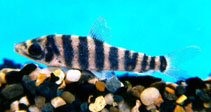
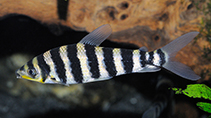
Klassifizierung / Names
Namen | Synonyme | Catalog of Fishes(Gattung, Arten) | ITIS | CoL | WoRMS | Cloffa
Environment: milieu / climate zone / Tiefenbereich / distribution range
Ökologie
; süßwasser benthopelagisch; pH range: 5.5 - 7.5; dH range: 2 - 20. Tropical; 22°C - 26°C (Ref. 1672)
South America: Amazon River basin.
Length at first maturity / Size / Gewicht / Alter
Geschlechtsreife: Lm ?, range 15 - ? cm
Max length : 37.0 cm TL Männchen/unbestimmt; (Ref. 111518)
Adults occur in rocky areas of rapidly flowing waters. Feed on worms, crustaceans, insects and plant matter (Ref. 7020), and fish. Oviparous (Ref. 205). Distinct pairs breed on densely grown weedy places (Ref. 205). Breeding takes place from December to May. Sexually mature at 15 cm (Ref. 12225).
Oviparous. Distinct pairs breed on densely grown weedy places (Ref. 205). Males tend to stay where the nests are located (Ref. 205).
Garavello, J.C. and H.A. Britski, 2003. Anostomidae (Headstanders). p. 71-84. In R.E. Reis, S.O. Kullander and C.J. Ferraris, Jr. (eds.) Checklist of the Freshwater Fishes of South and Central America. Porto Alegre: EDIPUCRS, Brasil. (Ref. 36801)
IUCN Rote Liste Status (Ref. 130435: Version 2025-1)
Bedrohung für Menschen
Harmless
Nutzung durch Menschen
Fischereien: weniger kommerziell; Aquarium: Kommerziell
Tools
Zusatzinformationen
Download XML
Internet Quellen
Estimates based on models
Phylogenetic diversity index (Ref.
82804): PD
50 = 0.5000 [Uniqueness, from 0.5 = low to 2.0 = high].
Bayesian length-weight: a=0.01023 (0.00652 - 0.01607), b=3.08 (2.95 - 3.21), in cm total length, based on LWR estimates for this species & Genus-body shape (Ref.
93245).
Trophic level (Ref.
69278): 3.0 ±0.34 se; based on food items.
Widerstandsfähigkeit (Ref.
120179): mittel, Verdopplung der Population dauert 1,4 - 4,4 Jahre. (Preliminary K or Fecundity.).
Fishing Vulnerability (Ref.
59153): Low to moderate vulnerability (27 of 100).
🛈