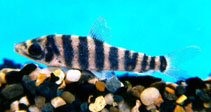
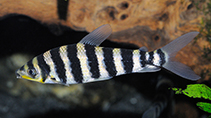
Environment: milieu / climate zone / rango de profundidad / distribution range
Ecología
; agua dulce bentopelágico; pH range: 5.5 - 7.5; dH range: 2 - 20. Tropical; 22°C - 26°C (Ref. 1672)
South America: Amazon River basin.
Length at first maturity / Tamaño / Peso / Age
Madurez: Lm ?, range 15 - ? cm
Max length : 37.0 cm TL macho / no sexado; (Ref. 111518)
Adults occur in rocky areas of rapidly flowing waters. Feed on worms, crustaceans, insects and plant matter (Ref. 7020), and fish. Oviparous (Ref. 205). Distinct pairs breed on densely grown weedy places (Ref. 205). Breeding takes place from December to May. Sexually mature at 15 cm (Ref. 12225).
Life cycle and mating behavior
Madurez | Reproducción | Puesta | Huevos | Fecundidad | Larva
Oviparous. Distinct pairs breed on densely grown weedy places (Ref. 205). Males tend to stay where the nests are located (Ref. 205).
Garavello, J.C. and H.A. Britski, 2003. Anostomidae (Headstanders). p. 71-84. In R.E. Reis, S.O. Kullander and C.J. Ferraris, Jr. (eds.) Checklist of the Freshwater Fishes of South and Central America. Porto Alegre: EDIPUCRS, Brasil. (Ref. 36801)
IUCN Red List Status (Ref. 130435: Version 2025-1)
Threat to humans
Harmless
Human uses
Pesquerías: escaso valor comercial; Acuario: Comercial
Herramientas
Special reports
Download XML
Fuentes de Internet
Estimates based on models
Phylogenetic diversity index (Referencia
82804): PD
50 = 0.5000 [Uniqueness, from 0.5 = low to 2.0 = high].
Bayesian length-weight: a=0.01023 (0.00652 - 0.01607), b=3.08 (2.95 - 3.21), in cm total length, based on LWR estimates for this species & Genus-body shape (Ref.
93245).
Nivel trófico (Referencia
69278): 3.0 ±0.34 se; based on food items.
Resiliencia (Referencia
120179): Medio, población duplicada en un tiempo mínimo de 1.4-4.4 años (Preliminary K or Fecundity.).
Fishing Vulnerability (Ref.
59153): Low to moderate vulnerability (27 of 100).
🛈