



Hochladen Photos und videos
Google Bild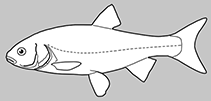 No image available for this species;
drawing shows typical species in Leuciscidae.
Google Bild
drawing shows typical species in Leuciscidae.
Klassifizierung / Names Namen | Synonyme | Catalog of Fishes(Gattung, Arten) | ITIS | CoL | WoRMS | Cloffa
> Cypriniformes (Carps) > Leuciscidae (Minnows) > Leuciscinae
Etymology: orpheus: The name orpheus means a legendary Thracian musician and poet, son of the Thracian river-god Oiagros and of the Muse Calliopte.
Eponymy: This is not a true eponym as it refers to Orpheus, the legendary Thracian musician and poet, son of King Oeagrus (or, in some versions, the god Apollo) and the Muse Calliope. The name reflects the dace’s occurrence in Thrace, Greece. (Ref. 128868), visit book page.
More on authors: Kottelat & Economidis.
Etymology: orpheus: The name orpheus means a legendary Thracian musician and poet, son of the Thracian river-god Oiagros and of the Muse Calliopte.
Eponymy: This is not a true eponym as it refers to Orpheus, the legendary Thracian musician and poet, son of King Oeagrus (or, in some versions, the god Apollo) and the Muse Calliope. The name reflects the dace’s occurrence in Thrace, Greece. (Ref. 128868), visit book page.
More on authors: Kottelat & Economidis.
Umwelt: Milieu / Klimazone / Tiefenbereich / Verbreitungsgebiet Ökologie
; süßwasser pelagisch. Subtropical
Verbreitung Territorien | FAO Gebiete | Ökosysteme | Vorkommen | Punkt Karte | Einführungen | Faunafri
Eurasia: Maritza to Struma drainages in Greece, Bulgaria and Turkey.
Größe / Gewicht / Alter
Kurzbeschreibung Bestimmungsschlüssel | Morphologie | Morphometrie
Differs from its congeners in Balkan Peninsula by having the following characters: origin of dorsal fin above pelvic base; dorso-hypural distance reaching between eye and nostril when reported forward from dorsal origin; free margin of flank scales faintly marked, not much contrasted against rest of scale, which is also pigmented; scale pocket dark brown; anal fin with blackish membranes and hyaline rays; head length equal to or slightly greater than body depth; mouth subterminal, upper lip conspicuously projecting beyond lower jaw, sometimes including tip of lower jaw; 44-46 + 2 scales on lateral line; dorsal fin and anal fin with 8½ branched rays; posterior margin of anal convex; in stretched anal of individuals larger than about 10 cm SL, distance between tips of first and last branched rays ( with the fin stretched out) 1.0-1.3 times caudal peduncle depth; and head length 26-29% SL (Ref. 59043).
Body shape (shape guide): fusiform / normal.
Body shape (shape guide): fusiform / normal.
Occurs in small to larger streams and rivers with standing water to moderate current (Ref. 57141). Found mainly in pools (Ref. 57141). Feeds in the water column and in the upper layers on fallen terrestrial insects but it is otherwise omnivorous (Ref. 57141). Spawns in shallow areas with gravel bottom. Some populations are under threat due to water abstraction in dry season (Ref. 59043).
Lebenszyklus und Paarungsverhalten Geschlechtsreife | Fortpflanzung | Ablaichen | Eier | Fruchtbarkeit | Larven
Hauptreferenz
Laden Sie Ihre Referenzen hoch | Referenzen | Koordinator | Partner
Kottelat, M. and P.S. Economidis, 2006. Squalius orpheus, a new species of cyprinid fish from Evros drainage, Greece (Teleostei: Cyprinidae). Ichthyol. Explor. Freshwat. 17(2):181-186. (Ref. 57141)
IUCN Rote Liste Status (Ref. 130435: Version 2025-2 (Global))
nicht bedroht (LC) ; Date assessed: 14 December 2023
CITES
Not Evaluated
Bedrohung für Menschen
Harmless
Nutzung durch Menschen
FAO - Publication: search | FishSource |
Mehr Information
Trophische Ökologie
Lebensmittel (Beutetiere)
Nahrungszusammensetzung
Nahrungsaufnahme
Lebensmittelrationen
Räuber
Lebensmittel (Beutetiere)
Nahrungszusammensetzung
Nahrungsaufnahme
Lebensmittelrationen
Räuber
Ökologie
Ökologie
Ökologie
Populationsdynamik
Wachstumsparameter
Max. Alter/Größen
Länge-Gewicht-Rel.
Länge-Länge-Verhältnis.
Längenhäufigkeiten
Massenkonvertierung
Rekrutierung
Dichte
Wachstumsparameter
Max. Alter/Größen
Länge-Gewicht-Rel.
Länge-Länge-Verhältnis.
Längenhäufigkeiten
Massenkonvertierung
Rekrutierung
Dichte
Lebenszyklus
Fortpflanzung
Geschlechtsreife
Reifung/Kiemen rel.
Fruchtbarkeit
Ablaichen
Laichaggregationen
Eier
Eientwicklung
Larven
Larven Pop.Dyn.
Fortpflanzung
Geschlechtsreife
Reifung/Kiemen rel.
Fruchtbarkeit
Ablaichen
Laichaggregationen
Eier
Eientwicklung
Larven
Larven Pop.Dyn.
Anatomie
Kiemenoberfläche
Gehirn
Otolith
Kiemenoberfläche
Gehirn
Otolith
Physiologie
Körperliche Zusammensetzung
Nährstoffe
Sauerstoffverbrauch
Schwimmart
Schwimmgeschwindigkeit
Visuelle Pigmente
Fischgeräusche
Krankheiten und Parasiten
Toxizität (LC50s)
Körperliche Zusammensetzung
Nährstoffe
Sauerstoffverbrauch
Schwimmart
Schwimmgeschwindigkeit
Visuelle Pigmente
Fischgeräusche
Krankheiten und Parasiten
Toxizität (LC50s)
Genetik
Genom
Genetik
Heterozygotie
Vererbbarkeit
Genetische Vielfalt
Genom
Genetik
Heterozygotie
Vererbbarkeit
Genetische Vielfalt
Menschenbezogen
Aquakultur-Systeme
Aquakultur Profile
Zuchtlinien
Ciguatera-Fälle
Briefmarken, Münzen, Verschiedenes.
Aquakultur-Systeme
Aquakultur Profile
Zuchtlinien
Ciguatera-Fälle
Briefmarken, Münzen, Verschiedenes.
Tools
Zusatzinformationen
Download XML
Zusammenfassung | Punktdaten | Namen | Photos
Internet Quellen
AFORO (otoliths) | Aquatic Commons | BHL | Cloffa | Websites from users | FishWatcher Einträge suchen | CISTI | Catalog of Fishes: Gattung, Arten | DiscoverLife | ECOTOX | FAO - Publication: search | Faunafri | Fishipedia | Fishtrace | GloBI | Google Books | Google Scholar | Google | IGFA World Record | Nationale Datenbanken | OneZoom | Open Tree of Life | Otolith Atlas of Taiwan Fishes | PubMed | Reef Life Survey | Socotra Atlas | TreeBase | Tree of Life | Wikipedia: Gehe zu, Suchen | World Records Freshwater Fishing | Zoobank | Zoologischer Rekord
Schätzungen auf der Grundlage von Modellen
Phylogenetischer Diversitätsindex (Ref. 82804): PD50 = 0.5000 [Uniqueness, from 0.5 = low to 2.0 = high].
Bayesian length-weight: a=0.00692 (0.00433 - 0.01106), b=3.09 (2.95 - 3.23), in cm total length, based on LWR estimates for this species & Genus-body shape (Ref. 93245).
Trophische Ebene (Ref. 69278): 3.3 ±0.4 se; based on size and trophs of closest relatives
Widerstandsfähigkeit (Ref. 120179): mittel, Verdopplung der Population dauert 1,4 - 4,4 Jahre. (Preliminary K or Fecundity.).