



Adicionar o seu Fotografias e vídeos
Imagem do Google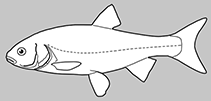 No image available for this species;
drawing shows typical species in Leuciscidae.
Imagem do Google
drawing shows typical species in Leuciscidae.
Classificação / Nomes Nomes comuns | Sinónimos | Catalog of Fishes(Género, Espécies) | ITIS | CoL | WoRMS | Cloffa
> Cypriniformes (Carps) > Leuciscidae (Minnows) > Leuciscinae
Etymology: orpheus: The name orpheus means a legendary Thracian musician and poet, son of the Thracian river-god Oiagros and of the Muse Calliopte.
Eponymy: This is not a true eponym as it refers to Orpheus, the legendary Thracian musician and poet, son of King Oeagrus (or, in some versions, the god Apollo) and the Muse Calliope. The name reflects the dace’s occurrence in Thrace, Greece. (Ref. 128868), visit book page.
More on authors: Kottelat & Economidis.
Etymology: orpheus: The name orpheus means a legendary Thracian musician and poet, son of the Thracian river-god Oiagros and of the Muse Calliopte.
Eponymy: This is not a true eponym as it refers to Orpheus, the legendary Thracian musician and poet, son of King Oeagrus (or, in some versions, the god Apollo) and the Muse Calliope. The name reflects the dace’s occurrence in Thrace, Greece. (Ref. 128868), visit book page.
More on authors: Kottelat & Economidis.
Ambiente: milieu / zona climática / intervalo de profundidade / gama de distribuição Ecologia
; Água doce pelágico(a,os,as). Subtropical
Distribuição Territórios | Áreas FAO | Ecossistemas | Ocorrências | Mapa dos pontos | Introduções | Faunafri
Eurasia: Maritza to Struma drainages in Greece, Bulgaria and Turkey.
Tamanho / Peso / Idade
Descrição breve Chaves de identificação | Morfologia | Morfometria
Differs from its congeners in Balkan Peninsula by having the following characters: origin of dorsal fin above pelvic base; dorso-hypural distance reaching between eye and nostril when reported forward from dorsal origin; free margin of flank scales faintly marked, not much contrasted against rest of scale, which is also pigmented; scale pocket dark brown; anal fin with blackish membranes and hyaline rays; head length equal to or slightly greater than body depth; mouth subterminal, upper lip conspicuously projecting beyond lower jaw, sometimes including tip of lower jaw; 44-46 + 2 scales on lateral line; dorsal fin and anal fin with 8½ branched rays; posterior margin of anal convex; in stretched anal of individuals larger than about 10 cm SL, distance between tips of first and last branched rays ( with the fin stretched out) 1.0-1.3 times caudal peduncle depth; and head length 26-29% SL (Ref. 59043).
Body shape (shape guide): fusiform / normal.
Body shape (shape guide): fusiform / normal.
Occurs in small to larger streams and rivers with standing water to moderate current (Ref. 57141). Found mainly in pools (Ref. 57141). Feeds in the water column and in the upper layers on fallen terrestrial insects but it is otherwise omnivorous (Ref. 57141). Spawns in shallow areas with gravel bottom. Some populations are under threat due to water abstraction in dry season (Ref. 59043).
Ciclo de vida e comportamento de acasalamento Maturidade | Reprodução | Desova | Ovos | Fecundidade | Larvas
Referência principal
Carregar as suas referências | Referências | Coordenador | Colaboradores
Kottelat, M. and P.S. Economidis, 2006. Squalius orpheus, a new species of cyprinid fish from Evros drainage, Greece (Teleostei: Cyprinidae). Ichthyol. Explor. Freshwat. 17(2):181-186. (Ref. 57141)
Categoria na Lista Vermelha da IUCN (Ref. 130435: Version 2025-2 (Global))
Preocupação menor (LC) ; Date assessed: 14 December 2023
CITES
Not Evaluated
Ameaça para o homem
Harmless
Utilização humana
FAO - Publication: search | FishSource |
Mais informação
Ecologia Trófica
Produtos alimentares (presas)
Composição da dieta
Consumo alimentar
Rações alimentares
Predadores
Produtos alimentares (presas)
Composição da dieta
Consumo alimentar
Rações alimentares
Predadores
Ecologia
Ecologia
Ecologia
Dinâmica das populações
Parâmetros de crescimento
Idades / tamanhos máximos
Comprimento-peso rel.
Comprimento-comprimento rel.
Frequência de comprimento
Conversão de massa
Recrutamento
Abundância
Parâmetros de crescimento
Idades / tamanhos máximos
Comprimento-peso rel.
Comprimento-comprimento rel.
Frequência de comprimento
Conversão de massa
Recrutamento
Abundância
Ciclo de vida
Reprodução
Maturidade
Maturidade/Rel. das guelras
Fecundidade
Desova
Agregações de desova
Ovos
Desenvolvimento dos ovos
Larvas
Dinâmica larvar
Reprodução
Maturidade
Maturidade/Rel. das guelras
Fecundidade
Desova
Agregações de desova
Ovos
Desenvolvimento dos ovos
Larvas
Dinâmica larvar
Anatomia
Área branquial
Cérebro
Otólitos
Área branquial
Cérebro
Otólitos
Fisiologia
Composição corporal
Nutrientes
Consumo de oxigénio
Tipo de natação
Velocidade de natação
Pigmentos visuais
Som de peixe
Doenças e Parasitas
Toxicidade (LC50s)
Composição corporal
Nutrientes
Consumo de oxigénio
Tipo de natação
Velocidade de natação
Pigmentos visuais
Som de peixe
Doenças e Parasitas
Toxicidade (LC50s)
Genética
genoma
Genética
Heterozigotia
Hereditariedade
Diversidade genética
genoma
Genética
Heterozigotia
Hereditariedade
Diversidade genética
Relacionado com o ser humano
Sistemas de aquacultura
Perfis para aquacultura
Estirpes
Casos de Ciguatera
Selos, moedas, diversos.
Sistemas de aquacultura
Perfis para aquacultura
Estirpes
Casos de Ciguatera
Selos, moedas, diversos.
Ferramentas
E-book | Guia de campo | Ferramenta auxiliar de frequências de comprimento | Ferramenta sobre a história de vida | Mapa dos pontos |
Captura-MSY |
Relatórios especiais
Descarregue XML
Fontes da internet
AFORO (otoliths) | Aquatic Commons | BHL | Cloffa | Websites from users | Consultar FishWatcher | CISTI | Catalog of Fishes: Género, Espécies | DiscoverLife | ECOTOX | FAO - Publication: search | Faunafri | Fishipedia | Fishtrace | GloBI | Google Books | Google Scholar | Google | IGFA World Record | Bases de dados nacionais | OneZoom | Open Tree of Life | Otolith Atlas of Taiwan Fishes | PubMed | Reef Life Survey | Socotra Atlas | TreeBase | Árvore da vida | Wikipedia: ir para, procurar | World Records Freshwater Fishing | Zoobank | Registo zoológico
Estimativas baseadas em modelos
Índice de diversidade filogenética (Ref. 82804): PD50 = 0.5000 [Uniqueness, from 0.5 = low to 2.0 = high].
Bayesian length-weight: a=0.00692 (0.00433 - 0.01106), b=3.09 (2.95 - 3.23), in cm total length, based on LWR estimates for this species & Genus-body shape (Ref. 93245).
Nível Trófico (Ref. 69278): 3.3 ±0.4 se; based on size and trophs of closest relatives
Resiliência (Ref. 120179): Médio, tempo mínimo de duplicação da população 1,4 - 4,4 anos (Preliminary K or Fecundity.).