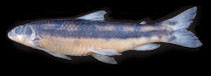
Klassifizierung / Names
Namen | Synonyme | Catalog of Fishes(Gattung, Arten) | ITIS | CoL | WoRMS | Cloffa
>
Characiformes (Characins) >
Parodontidae (Scrapetooths)
Etymology: Apareiodon: Greek, a = without + Greek, pareia, -as = cheek + Greek, odous = teeth (Ref. 45335); vladii: Named for Vladimir Pavan Margarido (Vladi).
Eponymy: Dr Vladimir ‘Vladi’ Pavan Margarido is a Brazilian biologist. [...] (Ref. 128868), visit book page.
Environment: milieu / climate zone / Tiefenbereich / distribution range
Ökologie
; süßwasser benthopelagisch. Tropical
South America: Brazil.
Size / Gewicht / Alter
Geschlechtsreife: Lm ? range ? - ? cm
Max length : 11.3 cm SL Männchen/unbestimmt; (Ref. 57026)
Kurzbeschreibung
Bestimmungsschlüssel | Morphologie | Morphometrie
Diagnosis. Distinguished from A. piracicabae with whom it shares the coloration pattern of no dark vertical bands and/or blotches extending below the lateral-line region, but differs in the premaxillary form, which is more pointed, median cusp largest (vs. straight cutting border or slightly rounded edge) and one maxillary tooth (vs. 2). The new species has a longer anal-fin, its length 4.8 to 6.0 (5.7) times in SL, as well as the lower number of post-anus scales 1-3 (2) (vs. A. hasemani, with anal-fin length 6.4 to 8.0 (7.2) times in SL and 3.5-5 (4.5) post-anus scales) (Ref. 57026).
Body shape (shape guide): elongated.
Life cycle and mating behavior
Geschlechtsreife | Fortpflanzung | Ablaichen | Eier | Fecundity | Larven
Pavanelli, C.S., 2006. New species of Apareiodon (Teleostei: Characiformes: Parodontidae) from th Rio Piquiri, Upper Rio Paraná, Brazil. Copeia 2006(1):89-95. (Ref. 57026)
IUCN Rote Liste Status (Ref. 130435: Version 2025-1)
Bedrohung für Menschen
Harmless
Nutzung durch Menschen
Tools
Zusatzinformationen
Download XML
Internet Quellen
Estimates based on models
Phylogenetic diversity index (Ref.
82804): PD
50 = 0.5000 [Uniqueness, from 0.5 = low to 2.0 = high].
Bayesian length-weight: a=0.00661 (0.00296 - 0.01475), b=3.11 (2.92 - 3.30), in cm total length, based on LWR estimates for this (Sub)family-body shape (Ref.
93245).
Widerstandsfähigkeit (Ref.
120179): mittel, Verdopplung der Population dauert 1,4 - 4,4 Jahre. (Preliminary K or Fecundity.).
Fishing Vulnerability (Ref.
59153): Low vulnerability (10 of 100).
🛈