This website uses cookies to enhance your browsing experience and ensure the functionality of our site. For more detailed information about the types of cookies we use and how we protect your privacy, please visit our Privacy Information page..
×
Cookie Settings
This website uses different types of cookies to enhance your experience. Please select your preferences below:
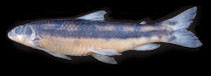
Diagnosis. Distinguished from A. piracicabae with whom it shares the coloration pattern of no dark vertical bands and/or blotches extending below the lateral-line region, but differs in the premaxillary form, which is more pointed, median cusp largest (vs. straight cutting border or slightly rounded edge) and one maxillary tooth (vs. 2). The new species has a longer anal-fin, its length 4.8 to 6.0 (5.7) times in SL, as well as the lower number of post-anus scales 1-3 (2) (vs. A. hasemani, with anal-fin length 6.4 to 8.0 (7.2) times in SL and 3.5-5 (4.5) post-anus scales) (Ref. 57026). Body shape (shape guide): elongated.
Life cycle and mating behavior 成熟 | 繁殖 | 放精 | 卵 | 生産力 | 幼生
Pavanelli, C.S., 2006. New species of Apareiodon (Teleostei: Characiformes: Parodontidae) from th Rio Piquiri, Upper Rio Paraná, Brazil. Copeia 2006(1):89-95. (Ref. 57026)
Phylogenetic diversity index (参照 82804): PD50 = 0.5000 [Uniqueness, from 0.5 = low to 2.0 = high].
Bayesian length-weight: a=0.00661 (0.00296 - 0.01475), b=3.11 (2.92 - 3.30), in cm total length, based on LWR estimates for this (Sub)family-body shape (Ref. 93245).
回復力 (参照 120179): 手段, 1.4年~4.4年の倍増期間の最小個体群 (Preliminary K or Fecundity.).
Fishing Vulnerability (Ref. 59153): Low vulnerability (10 of 100). 🛈