



Hexanchus griseus (Bonnaterre, 1788)
Bluntnose sixgill shark
Adicionar sua observação em Fish Watcher
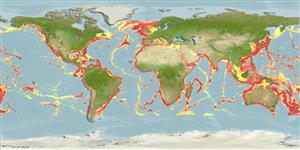
| Native range | All suitable habitat | Point map | Year 2050 |
|
| This map was computer-generated and has not yet been reviewed. |
| Hexanchus griseus AquaMaps Data sources: GBIF OBIS |
Carregue seu(sua) Fotos e vídeos
Fotos | vídeos | Selos, moedas, diversos. | Imagem do Google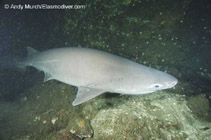 Hexanchus griseus
Foto de Murch, A.
Fotos | vídeos | Selos, moedas, diversos. | Imagem do Google
Foto de Murch, A.
Classificação / Nomes Nomes comuns | Sinônimos | Catalog of Fishes(Gênero, Espécies) | ITIS | CoL | WoRMS | Cloffa
Elasmobranchii (tubarões e raias) (sharks and rays) > Hexanchiformes (Frill and cow sharks) > Hexanchidae (Cow sharks)
Etymology: Hexanchus: hex (Gr.), six; anchus, etymology unclear, perhaps anchos (Gr.), choke or throttle, referring to how six gill openings of H. griseus extend down onto the throat (See ETYFish); griseus: Medieval Latin for gray, reflecting the French vernacular “Le Griset,” referring to its dark-gray coloration (See ETYFish).
More on author: Bonnaterre.
Etymology: Hexanchus: hex (Gr.), six; anchus, etymology unclear, perhaps anchos (Gr.), choke or throttle, referring to how six gill openings of H. griseus extend down onto the throat (See ETYFish); griseus: Medieval Latin for gray, reflecting the French vernacular “Le Griset,” referring to its dark-gray coloration (See ETYFish).
More on author: Bonnaterre.
Meio ambiente: milieu / Zona climática / intervalo de profundidade / faixa de distribuição Ecologia
marinhas batidemersal; oceanódromo (Ref. 87829); intervalo de profundidade 0 - 2500 m (Ref. 132203), usually 180 - 1100 m (Ref. 45445). Subtropical; 6°C - 10°C (Ref. 125614); 65°N - 48°S, 180°W - 180°E
Distribuição Territórios | Áreas da FAO | Ecossistemas | Ocorrências | Mapa de pontos | Introduções | Faunafri
Circumglobal with patchy distribution and possibly absent from Arctic and Antarctic. Highly migratory species.
Comprimento de primeira maturação / Tamanho / Peso / Idade
Maturidade: Lm 441.0, range 400 - 482 cm
Max length : 600 cm TL macho/indeterminado; (Ref. 124786); common length : 300 cm TL macho/indeterminado; (Ref. 5217); peso máx. publicado: 590.0 kg (Ref. 27436)
Max length : 600 cm TL macho/indeterminado; (Ref. 124786); common length : 300 cm TL macho/indeterminado; (Ref. 5217); peso máx. publicado: 590.0 kg (Ref. 27436)
Descrição suscinta Chaves de identificação | Morfologia | Morfometria
Espinhos dorsais (total) : 0; Espinhos anais: 0. A heavily-bodied, broad-headed sixgill shark, mouth ventral with 6 rows of lower, bladelike, comb-shaped teeth on each side (Ref. 247). Snout broadly rounded, body fusiform (Ref. 6871). Anal fin smaller than dorsal fin (Ref. 6871). Brown or grey above, paler below, with a light stripe along side (Ref. 26346). Fins with white edges (Ref. 6574). Live specimens with fluorescent green eyes (Ref. 6871). Six gill slits are very long (Ref. 35388).
Body shape (shape guide): elongated.
Body shape (shape guide): elongated.
Depth range reported at 0m-2500m (Ref. 125614). A deepwater species of the outer continental and insular shelves and upper slopes (Ref. 6871, 75154), islands, seamounts and mid-ocean ridges (Ref. 125614). Near bottom, occasionally pelagic, adults usually below 91 m (Ref. 58302). Juveniles may be found close inshore (Ref. 6871), while nursery areas are in very shallow waters (Ref. 125614). Found on the bottom by day, moving to the surface at night to feed, and where it may take longlines set for other species (Ref. 45445). Depth distribution related to growth and temperature, with juveniles having most shallow records and from colder, poleward regions (Ref. 58302). Generally occurs at a bottom temperature of 6 to 10°C (Ref. 125614). Feeds on a wide range of marine organisms, including other sharks, rays, chimaeras, bony fish, squids, crabs, shrimps, carrion, and even seals (Ref. 26969). Large sharks (at least 2m) take cetaceans and seals. Viviparous, very large litters of 47-108 pups (Ref. 125614). Give birth to almost 100 young (Ref. 35388). Young and adults may be segregated, with the young using inshore nursery grounds. Possibly long-lived (Ref. 125614). Is a eurytrophic predator that is capable of exploiting a wide range of prey species and habitats (Ref. 26969). A vertical migrant, it may sit on the bottom by day, and rise to the surface at night to feed (Ref. 247). It occurs alone or in groups. Adults are more sensitive to light than the juveniles and less seen in clear shallow waters, but more prevalent at night or areas with dense plankton blooms (Ref. 125614). It is locally common in bycatch and target fisheries for food, fishmeal and oil, and in sports fisheries, but vulnerable to overfishing and requires careful management (Ref. 125614). Marketed fresh, frozen, or dried salted (Ref. 247). Not known to have attacked people without provocation (Ref. 247).
Ciclo de vida ou comportamento de acasalamento Maturidade | Reprodução | Desova | Ovos | Fecundidade | Larvas
Viviparous, very large litters of 47-108 pups (Ref. 125614). Size at birth 60-75 cm (Ref. 26346). Distinct pairing with embrace (Ref. 205).
Referência principal
Carregar suas referências | Referências | Coordenador : Compagno, Leonard J.V. | Colaboradores
Ebert, D.A., S. Fowler and M. Dando, 2021. Sharks of the World: A complete guide. Princeton University Press, 607 p. (Ref. 125614)
Status na Lista Vermelha da UICN (Ref. 130435: Version 2025-2 (Global))
Quase ameaçada (NT) (A2bd); Date assessed: 21 November 2019
CITES
Not Evaluated
Ameaça para os humanos
Other (Ref. 4690)
Uso pelos humanos
Pescarias: espécies comerciais; peixe esportivo: sim
FAO - pescarias: desembarques, perfil da espécie; Publication: search | FIRMS - Stock assessments | FishSource | Sea Around Us
Mais informação
Ecologia Trófica
Itens alimentares (presas)
Composição da dieta
Consumo alimentar
Rações alimentares
Predadores
Itens alimentares (presas)
Composição da dieta
Consumo alimentar
Rações alimentares
Predadores
Dinâmica populacional
Parâmetros de crescimento
Idade máxima / tamanhos
Relação comprimento-peso.
Relação comprimento-comprimento.
Frequências de comprimento
Conversão de massa
Recrutamento
Abundância
Parâmetros de crescimento
Idade máxima / tamanhos
Relação comprimento-peso.
Relação comprimento-comprimento.
Frequências de comprimento
Conversão de massa
Recrutamento
Abundância
Ciclo de vida
Reprodução
Maturidade
Maturidade/Rel. das guelras
Fecundidade
Desova
Agregações de desova
Ovos
Desenvolvimento dos ovos
Larvas
Dinâmica larval
Reprodução
Maturidade
Maturidade/Rel. das guelras
Fecundidade
Desova
Agregações de desova
Ovos
Desenvolvimento dos ovos
Larvas
Dinâmica larval
Fisiologia
Composição corporal
Nutrientes
Consumo de oxigênio
Tipo de natação
Velocidade de natação
Pigmentos visuais
Som de peixe
Doenças e Parasitas
Toxicidade (LC50s)
Composição corporal
Nutrientes
Consumo de oxigênio
Tipo de natação
Velocidade de natação
Pigmentos visuais
Som de peixe
Doenças e Parasitas
Toxicidade (LC50s)
Relacionado a humanos
Sistemas de aquicultura
Perfis para aquacultura
Estirpes
Casos de Ciguatera
Selos, moedas, diversos.
Sistemas de aquicultura
Perfis para aquacultura
Estirpes
Casos de Ciguatera
Selos, moedas, diversos.
Ferramentas
Livro eletrônico | Guia de campo | Chaves de identificação | Ferramenta auxiliar de frequências de comprimento | Ferramenta sobre a história de vida | Mapa de pontos |
Catch-MSY |
Relatórios especiais
Checar Manutenção em Aquário | Checar Planilhas de Fatos sobre as Espécies | Checar Planilhas de Fatos sobre Aquicultura
Baixar XML
Fontes da internet
AFORO (otoliths) | Aquatic Commons | BHL | Cloffa | Websites from users | Checar Observador de Peixes (FishWatcher) | CISTI | Catalog of Fishes: Gênero, Espécies | DiscoverLife | DORIS | ECOTOX | FAO - pescarias: desembarques, perfil da espécie; Publication: search | Faunafri | Fishipedia | Fishtrace | GloBI | Google Books | Google Scholar | Google | IGFA World Record | Bases de dados nacionais | OceanAdapt | OneZoom | Open Tree of Life | Otolith Atlas of Taiwan Fishes | PubMed | Reef Life Survey | Socotra Atlas | TreeBase | Árvore da vida | Wikipedia: Ir para, procura | World Records Freshwater Fishing | Registro zoológico
Estimativas baseadas em modelos
Temperatura preferida (Ref. 123201): 3.6 - 15.7, mean 8.1 °C (based on 3800 cells).
Índice de diversidade filogenética (Ref. 82804): PD50 = 0.6641 [Uniqueness, from 0.5 = low to 2.0 = high].
Bayesian length-weight: a=0.00081 (0.00049 - 0.00135), b=3.23 (3.08 - 3.38), in cm total length, based on LWR estimates for this species & (Sub)family-body (Ref. 93245).
Nível Trófico (Ref. 69278): 4.5 ±0.2 se; based on diet studies.
Resiliência (Ref. 120179): Baixo, tempo mínimo de duplicação da população 4,5 - 14 anos (Fec= 22-108).
Nutrientes (Ref. 124155): Calcium = 8.75 [2.27, 47.99] mg/100g; Iron = 0.664 [0.163, 2.072] mg/100g; Protein = 19.5 [17.5, 21.5] %; Omega3 = 0.24 [0.10, 0.59] g/100g; Selenium = 79.6 [24.5, 261.1] μg/100g; VitaminA = 3.68 [0.99, 13.90] μg/100g; Zinc = 0.324 [0.155, 0.615] mg/100g (wet weight);