Klassifizierung / Names
Namen | Synonyme | Catalog of Fishes(Gattung, Arten) | ITIS | CoL | WoRMS | Cloffa
>
Scombriformes (Mackerels) >
Chiasmodontidae (Snaketooth fishes)
Etymology: Pseudoscopelus: Greek, pseudes = false + Greek, skopelos = a lantern fish (Ref. 45335). Lütken did not recognize the presence of photophores on the body, confusing them with pores, but referred to a genus of lanternfish (Scopelus now Myctophum) when he named the genus (Ref. 85782); bothrorrhinos: Name derived from the Greek 'bothros' (trench or pit) and 'rhinos' (nose or snout), in reference to the concave tip of the snout.
Environment: milieu / climate zone / Tiefenbereich / distribution range
Ökologie
seewasser bathypelagisch; tiefenbereich 0 - 1200 m (Ref. 75982). Tropical
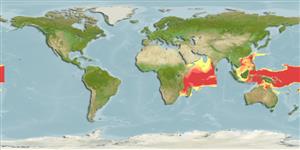
Indo-Pacific: off the Comoros Islands, Indonesia, Papua New Guinea and off Gilbert Islands.
Size / Gewicht / Alter
Geschlechtsreife: Lm ? range ? - ? cm
Max length : 5.5 cm SL Männchen/unbestimmt; (Ref. 75982)
Kurzbeschreibung
Bestimmungsschlüssel | Morphologie | Morphometrie
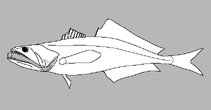
Rückenflossenstacheln (insgesamt) : 7; Rückenflossenweichstrahlen (insgesamt) : 22 - 24; Wirbelzahl: 35 - 36. Distinguished from all other species of Pseudoscopelus by the possession of longitudinal preopercular photophores, extending dorsally to the middle of the preopercle. Differs further from all congeners, except Pseudoscopelus scutatus, by the following characters: concave snout; presence of supraventral-fin photophores; absence of pectoral-fin photophores, pectoral-fin axillary photophores, ventral-fin photophores and ventral-fin axillary photophores; preventral-fin photophores and postventral-fin photophores continuous; and distal radials of the first dorsal fin developed on a plate-like structure (Ref. 75982).
Body shape (shape guide): elongated.
Life cycle and mating behavior
Geschlechtsreife | Fortpflanzung | Ablaichen | Eier | Fecundity | Larven
Melo, M.R.S., H.J. Walker Jr. and C. Klepadlo, 2007. Two new species of Pseudoscopelus (Teleostei: Chiasmodontidae), with a new diagnosis for the genus. Zootaxa 1605:33-46. (Ref. 75982)
IUCN Rote Liste Status (Ref. 130435: Version 2025-1)
Nutzung durch Menschen
Tools
Zusatzinformationen
Download XML
Internet Quellen
Estimates based on models
Preferred temperature (Ref.
123201): 8.1 - 20, mean 11.8 °C (based on 202 cells).
Phylogenetic diversity index (Ref.
82804): PD
50 = 0.5000 [Uniqueness, from 0.5 = low to 2.0 = high].
Bayesian length-weight: a=0.00389 (0.00180 - 0.00842), b=3.12 (2.94 - 3.30), in cm total length, based on all LWR estimates for this body shape (Ref.
93245).
Trophic level (Ref.
69278): 3.4 ±0.2 se; based on size and trophs of closest relatives
Fishing Vulnerability (Ref.
59153): Low vulnerability (10 of 100).
🛈