Elasmobranchii (tubarões e raias) (sharks and rays) >
Rajiformes (Skates and rays) >
Rajidae (Skates)
Etymology: Dipturus: Greek, di = two + Greek, pteryx = fin (Ref. 45335); argentinensis: The specific epitet argentinensis is named in reference to the Argentine Sea where the type
material was collected.
Environment: milieu / Zona climática / intervalo de profundidade / distribution range
Ecologia
marinhas bentopelágico; intervalo de profundidade 87 - 142 m (Ref. 79571). Temperate; 6°C - 9°C (Ref. 79571)
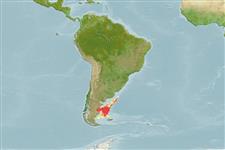
Southwest Atlantic: Argentina, Patagonia.
Tamanho / Peso / Idade
Maturidade: Lm ? range ? - ? cm
Max length : 93.5 cm TL macho/indeterminado; (Ref. 79571)
Descrição suscinta
Chaves de identificação | Morfologia | Morfometria
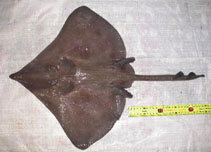
This species is distinguished by the following set of characters: the dorsal surface of disc is brown purplish with no distinct ocelli or blotches margined with dark brown on pectoral and pelvic fins; the upper surface of the disc smooth except few small spinules scattered on tip of snout; presence of ocular thorns and absence of scapular thorns; single nuchal thorn may be either present or absent; one median row of 10 to 24 small caudal thorns; the dorsal and caudal fins scattered with very few spinules; 1-2 interdorsal thorns; tail relatively long and thin, approximately half the total length; ventral surface of disc as dark as the upper side, smooth except few small spinules scattered on tip of snout; interbranchial space with no prickles (Ref. 79571).
Body shape (shape guide): other; Cross section: flattened.
According to the capture localities of the type specimens, Dipturus argentinensis appears to have a restricted range distribution occurring in the central and southern Patagonian region on the southwest Atlantic. No recorded specimens have been reported northwards 45º S. The region where the type specimens of the Argentine skate were collected is dominated by sub-Antarctic cold-temperate waters with low salinity. These waters have a predominantly NNE flow and form the Patagonian Current (Brandhorst & Castello 1971). Range temperatures and salinities of the localities where the specimens were collected were 5.9-9.38ºC, and 33.24-33.64 ups, respectively. These physical characteristics agree with the Magellanic Biogeographic Province where the specimens have been captured (Ref. 79571).
Ciclo de vida ou comportamento de acasalamento
Maturidade | Reprodução | Desova | Ovos | Fecundidade | Larvas
Díaz de Astarloa, J.M., E Mabragaña, R. Hanner and D.E. Figueroa, 2008. Morphological and molecular evidence for a new species of longnose skate (Rajiformes: Rajidae: Dipturus) from Argentinean waters based on DNA barcoding. Zootaxa 1921:35-46. (Ref. 79571)
Status na Lista Vermelha da UICN (Ref. 130435: Version 2025-1)
Ameaça para os humanos
Harmless
Uso pelos humanos
Pescarias: sem interesse
Ferramentas
Relatórios especiais
Baixar XML
Fontes da internet
Estimates based on models
Preferred temperature (Ref.
123201): 4.1 - 9.6, mean 7.6 °C (based on 55 cells).
Índice de diversidade filogenética (Ref.
82804): PD
50 = 0.5000 [Uniqueness, from 0.5 = low to 2.0 = high].
Bayesian length-weight: a=0.00282 (0.00131 - 0.00604), b=3.25 (3.08 - 3.42), in cm total length, based on LWR estimates for this Genus-body shape (Ref.
93245).
Nível Trófico (Ref.
69278): 3.9 ±0.6 se; based on size and trophs of closest relatives
Resiliência (Ref.
120179): Baixo, tempo mínimo de duplicação da população 4,5 - 14 anos (Preliminary K or Fecundity.).
Fishing Vulnerability (Ref.
59153): High vulnerability (57 of 100).
🛈