Elasmobranquios (tiburones y rayas) (sharks and rays) >
Rajiformes (Skates and rays) >
Rajidae (Skates)
Etymology: Dipturus: Greek, di = two + Greek, pteryx = fin (Ref. 45335); argentinensis: The specific epitet argentinensis is named in reference to the Argentine Sea where the type
material was collected.
Environment: milieu / climate zone / rango de profundidad / distribution range
Ecología
marino bentopelágico; rango de profundidad 87 - 142 m (Ref. 79571). Temperate; 6°C - 9°C (Ref. 79571)
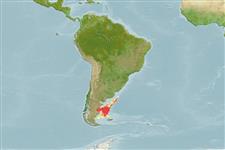
Southwest Atlantic: Argentina, Patagonia.
Tamaño / Peso / Age
Madurez: Lm ? range ? - ? cm
Max length : 93.5 cm TL macho / no sexado; (Ref. 79571)
Short description
Claves de identificación | Morfología | Morfometría
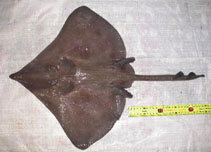
This species is distinguished by the following set of characters: the dorsal surface of disc is brown purplish with no distinct ocelli or blotches margined with dark brown on pectoral and pelvic fins; the upper surface of the disc smooth except few small spinules scattered on tip of snout; presence of ocular thorns and absence of scapular thorns; single nuchal thorn may be either present or absent; one median row of 10 to 24 small caudal thorns; the dorsal and caudal fins scattered with very few spinules; 1-2 interdorsal thorns; tail relatively long and thin, approximately half the total length; ventral surface of disc as dark as the upper side, smooth except few small spinules scattered on tip of snout; interbranchial space with no prickles (Ref. 79571).
Body shape (shape guide): other; Cross section: flattened.
According to the capture localities of the type specimens, Dipturus argentinensis appears to have a restricted range distribution occurring in the central and southern Patagonian region on the southwest Atlantic. No recorded specimens have been reported northwards 45º S. The region where the type specimens of the Argentine skate were collected is dominated by sub-Antarctic cold-temperate waters with low salinity. These waters have a predominantly NNE flow and form the Patagonian Current (Brandhorst & Castello 1971). Range temperatures and salinities of the localities where the specimens were collected were 5.9-9.38ºC, and 33.24-33.64 ups, respectively. These physical characteristics agree with the Magellanic Biogeographic Province where the specimens have been captured (Ref. 79571).
Life cycle and mating behavior
Madurez | Reproducción | Puesta | Huevos | Fecundidad | Larva
Díaz de Astarloa, J.M., E Mabragaña, R. Hanner and D.E. Figueroa, 2008. Morphological and molecular evidence for a new species of longnose skate (Rajiformes: Rajidae: Dipturus) from Argentinean waters based on DNA barcoding. Zootaxa 1921:35-46. (Ref. 79571)
IUCN Red List Status (Ref. 130435: Version 2025-1)
Threat to humans
Harmless
Human uses
Pesquerías: sin interés
Herramientas
Special reports
Download XML
Fuentes de Internet
Estimates based on models
Preferred temperature (Referencia
123201): 4.1 - 9.6, mean 7.6 °C (based on 55 cells).
Phylogenetic diversity index (Referencia
82804): PD
50 = 0.5000 [Uniqueness, from 0.5 = low to 2.0 = high].
Bayesian length-weight: a=0.00282 (0.00131 - 0.00604), b=3.25 (3.08 - 3.42), in cm total length, based on LWR estimates for this Genus-body shape (Ref.
93245).
Nivel trófico (Referencia
69278): 3.9 ±0.6 se; based on size and trophs of closest relatives
Resiliencia (Referencia
120179): Bajo, población duplicada en un tiempo mínimo de 4.5-14 años (Preliminary K or Fecundity.).
Fishing Vulnerability (Ref.
59153): High vulnerability (57 of 100).
🛈