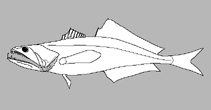
Классификация / Names
народные названия | синонимы | Catalog of Fishes(род, виды) | ITIS | CoL | WoRMS | Cloffa
>
Scombriformes (Mackerels) >
Chiasmodontidae (Snaketooth fishes)
Etymology: Pseudoscopelus: Greek, pseudes = false + Greek, skopelos = a lantern fish (Ref. 45335). Lütken did not recognize the presence of photophores on the body, confusing them with pores, but referred to a genus of lanternfish (Scopelus now Myctophum) when he named the genus (Ref. 85782); cordilluminatus: Name from Latin ‘cordis’ meaning heart and ‘luminosus’ for full of light, referring to the heart-shaped ‘saf’.
Issue
This species is synonym ofPseudoscopelus scriptus Lütken, 1892 in Eschmeyer (CofF ver. Jan. 2012: Ref. 89336) following (Prokofiev, 2011). Waiting for the publication.
Environment: milieu / climate zone / пределы глубины / distribution range
экология
морской батипелагический; пределы глубины 537 - 1164 m (Ref. 85782). Deep-water
Eastern South and Central Atlantic, from Middle Atlantic to off Angola; from 20º W to 12º W, 0º to 9º S. Indo-West Pacific, from off Oman to Indonesia; from 57º E to 125º E, 10º N to 5º S.
Size / Вес / Возраст
половая зрелость: Lm ? range ? - ? cm
Max length : 9.7 cm SL самец/пол неопределен; (Ref. 85782)
Краткое описание
определительные ключи | морфология | морфометрия
позвонки: 35 - 36. This species of the Pseudoscopelus scriptus species group is distinguished by the unique dentition pattern of the premaxilla: mesial series in rows of 2-3 teeth, with first and second teeth much smaller than innermost tooth (vs. single row in P. pierbartus and P. obtusifrons; and teeth gradually increasing in size in P. cephalus, P. sagamianus, and P. scriptus). It is further distinguished from P. scriptus with anal-fin photophores (or saf) extending anteriorly beyond and around anus (vs. saf not extending anteriorly to anus); from P. cephalus by vertebral count (total vertebrae 35-36, precaudal 18-19 vs. 31, 14 in P. cephalus ); from P. sagamianus by melanophores inside mouth restricted to tooth insertion region (vs. internal area of mouth and gill arches completely black) (Ref. 85782).
Body shape (shape guide): elongated.
A meso- to bathypelagic, from 537 to 1164 m (mean 954 m) (Ref. 85782).
Life cycle and mating behavior
половая зрелость | размножение | нерест | икра | Fecundity | личинки
Melo, M.R.S., 2010. A revision of the genus Pseudoscopelus Lütken (Chiasmodontidae: Acanthomorphata) with descriptions of three new species. Zootaxa 2710:1-78. (Ref. 85782)
Статус Красного Списка МСОП (Ref. 130435: Version 2025-1)
Угроза для людей
Harmless
Использование человеком
дополнительная информация
инструменты
Специальные отчеты
Скачать в формате XML
ресурсы в Интернет
Estimates based on models
Preferred temperature (ссылка
123201): 1.6 - 4.1, mean 2.1 °C (based on 23 cells).
Phylogenetic diversity index (ссылка
82804): PD
50 = 0.5000 [Uniqueness, from 0.5 = low to 2.0 = high].
Bayesian length-weight: a=0.00389 (0.00180 - 0.00842), b=3.12 (2.94 - 3.30), in cm total length, based on all LWR estimates for this body shape (Ref.
93245).
Trophic level (ссылка
69278): 3.5 ±0.2 se; based on size and trophs of closest relatives
Fishing Vulnerability (Ref.
59153): Low vulnerability (10 of 100).
🛈