



Trachycorystes menezesi Britski & Akama, 2011
Envoyez vos Photos et vidéos
Images Google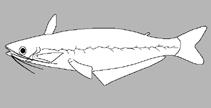 No image available for this species;
drawing shows typical species in Auchenipteridae.
Images Google
drawing shows typical species in Auchenipteridae.
Classification / Noms Noms communs | Synonymes | Catalog of Fishes(Genre, Espèce) | ITIS | CoL | WoRMS | Cloffa
> Siluriformes (Catfishes) > Auchenipteridae (Driftwood catfishes) > Auchenipterinae
Etymology: Trachycorystes: Greek, trachys, -eia, -ys = rough + Greek, chorystes, -ou = a soldier with helmet (Ref. 45335); menezesi: Named for Naércio A. Menezes who participated in the INPA expedition of 1976, when the new species was collected for the first time, and for his major contributions to the scientific knowledge of the ichthyofauna of the Neotropics.
Eponymy: Professor Dr Naércio Aquino Menezes (d: 1937) is a Brazilian zoologist who is Professor, Department of Zoology, Institute of Biosciences, University of São Paulo and at Museu de Zoologia da Universidade de São Paulo. [...] (Ref. 128868), visit book page.
Etymology: Trachycorystes: Greek, trachys, -eia, -ys = rough + Greek, chorystes, -ou = a soldier with helmet (Ref. 45335); menezesi: Named for Naércio A. Menezes who participated in the INPA expedition of 1976, when the new species was collected for the first time, and for his major contributions to the scientific knowledge of the ichthyofauna of the Neotropics.
Eponymy: Professor Dr Naércio Aquino Menezes (d: 1937) is a Brazilian zoologist who is Professor, Department of Zoology, Institute of Biosciences, University of São Paulo and at Museu de Zoologia da Universidade de São Paulo. [...] (Ref. 128868), visit book page.
Environnement : milieu / zone climatique / profondeur / gamme de distribution Écologie
; eau douce benthopélagique. Tropical
Distribution Territoires | Zones FAO | Écosystèmes | Occurrences | Carte par point | Introductions | Faunafri
South America: Rio Aripuanã (Madeira drainage) and its tributaries above the
falls of Dardanelos and Andorinhas in Mato Grosso State, Brazil.
Taille / Poids / Âge
Description synthétique Clés d'identification | Morphologie | Morphométrie
Épines dorsales (Total) : 1; Rayons mous dorsaux (Total) : 6; Rayons mous anaux: 19 - 22; Vertèbres: 41. Diagnosed from Trachycorystes trachycorystes by having the following characters: jaws equal in length (vs. lower jaw longer, prognathous in Trachycorystes trachycorystes); skull roof covered by thick integument concealing bony sculptures (vs. skull roof covered by thin integument, bony sculptures visible); inner mental barbel thin and very short, not reaching base of outer mental barbel (vs. inner mental barbel thicker, extending to or beyond base of outer mental barbel); dorsal-fin spine serrated only along posterior margin (vs. dorsal-fin spine serrated only along anterior margin); caudal fin weakly forked (vs. emarginate); gas bladder simple, without diverticula (vs. gas bladder with
three posterior diverticula, one medial and paired posterolateral) (Ref. 87314).
Found in abundance in tributaries of the rio Aripuanã, such as igarapé do Aeroporto and igarapé Genipapo, clear water creeks two or three m wide and up to 0.6 m deep, with forested margins and sandy bottoms where fallen trunks, branches and vegetal detritus were abundant. Collected using deep nets and by displacing the submerged debris, the natural hiding-places of the species. Feeds on fish, various insects as well a scorpion and a crustacean (Ref. 87314).
Cycle de vie et comportement reproducteur Maturité | Reproduction | Frai | Œufs | Fécondité | Larves
Référence principale
Téléchargez vos références | Références | Coordinateur : Ferraris, Jr., Carl J. | Collaborateurs
Britski, H.A. and A. Akama, 2011. New species of Trachycorystes Bleeker, with comments on other species of the genus (Ostariophysi: Siluriformes: Auchenipteridae). Neotrop. Ichthyol. 9(2):273-279. (Ref. 87314)
Statut dans la liste rouge de l'IUCN (Ref. 130435: Version 2025-2 (Global))
Préoccupation mineure (LC) ; Date assessed: 07 November 2018
CITES
Not Evaluated
Menace pour l'homme
Harmless
Utilisations par l'homme
FAO - Publication: search | FishSource |
Plus d'informations
Écologie trophique
Aliments (proies)
Composition du régime alimentaire
Consommation alimentaire
Rations alimentaires
Prédateurs
Aliments (proies)
Composition du régime alimentaire
Consommation alimentaire
Rations alimentaires
Prédateurs
Écologie
Écologie
Écologie
Dynamique des populations
Paramètres de croissance
Âges / tailles maximales
Longueur-poids rel.
Rel. longueur-longueur.
Fréquences de longueurs
Conversion de masse
Recrutement
Abondance
Paramètres de croissance
Âges / tailles maximales
Longueur-poids rel.
Rel. longueur-longueur.
Fréquences de longueurs
Conversion de masse
Recrutement
Abondance
Cycle de vie
Reproduction
Maturité
Maturité/épines rel.
Fécondité
Frai
Agrégats de frai
Œufs
Développement de l'œuf
Larves
Dynamique des populations larvaires
Reproduction
Maturité
Maturité/épines rel.
Fécondité
Frai
Agrégats de frai
Œufs
Développement de l'œuf
Larves
Dynamique des populations larvaires
Anatomie
Surface branchiale
Cerveau
Otolithe
Surface branchiale
Cerveau
Otolithe
Physiologie
Composition corporelle
Nutriments
Consommation d'oxygène
Type de natation
Vitesse de nage
Pigments visuels
Son de poisson
Maladies et parasites
Toxicité (CL50)
Composition corporelle
Nutriments
Consommation d'oxygène
Type de natation
Vitesse de nage
Pigments visuels
Son de poisson
Maladies et parasites
Toxicité (CL50)
Génétique
génôme
Génétique
Hétérozygotie
Héritabilité
Diversité génétique
génôme
Génétique
Hétérozygotie
Héritabilité
Diversité génétique
Liées à l'homme
Systèmes d'aquaculture
Profils d'aquaculture
Souches
Cas de ciguatera
Timbres, pièces de monnaie, divers
Systèmes d'aquaculture
Profils d'aquaculture
Souches
Cas de ciguatera
Timbres, pièces de monnaie, divers
Outils
E-book | Guide de terrain | Générateur de fréquences de longueur | Outil de dynamique de population | Carte par point |
Capture-MSY |
Articles particuliers
Télécharger en XML
Sources Internet
AFORO (otoliths) | Aquatic Commons | BHL | Cloffa | Websites from users | FishWatcher | CISTI | Catalog of Fishes: Genre, Espèce | DiscoverLife | ECOTOX | FAO - Publication: search | Faunafri | Fishipedia | Fishtrace | GloBI | Google Books | Google Scholar | Google | IGFA World Record | OneZoom | Open Tree of Life | Otolith Atlas of Taiwan Fishes | PubMed | Reef Life Survey | Socotra Atlas | TreeBase | Arbre de Vie | Wikipedia: aller à, chercher | World Records Freshwater Fishing | Zoobank | Zoological Record
Estimations basées sur des modèles
Indice de diversité phylogénétique (Réf. 82804): PD50 = 0.7500 [Uniqueness, from 0.5 = low to 2.0 = high].
Bayesian length-weight: a=0.00871 (0.00408 - 0.01859), b=3.03 (2.85 - 3.21), in cm total length, based on LWR estimates for this (Sub)family-body shape (Ref. 93245).
Niveau trophique (Réf. 69278): 3.4 ±0.4 se; based on size and trophs of closest relatives
Résilience (Réf. 120179): Haut, temps minimum de doublement de population inférieur à 15 mois (Preliminary K or Fecundity.).