



Trachycorystes menezesi Britski & Akama, 2011
Carica il tuo foto e Video
Google image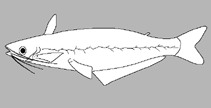 No image available for this species;
drawing shows typical species in Auchenipteridae.
Google image
drawing shows typical species in Auchenipteridae.
Classificazione / Nomi Nomi Comuni | Sinonimi | Catalog of Fishes(Genere, Specie) | ITIS | CoL | WoRMS | Cloffa
> Siluriformes (Catfishes) > Auchenipteridae (Driftwood catfishes) > Auchenipterinae
Etymology: Trachycorystes: Greek, trachys, -eia, -ys = rough + Greek, chorystes, -ou = a soldier with helmet (Ref. 45335); menezesi: Named for Naércio A. Menezes who participated in the INPA expedition of 1976, when the new species was collected for the first time, and for his major contributions to the scientific knowledge of the ichthyofauna of the Neotropics.
Eponymy: Professor Dr Naércio Aquino Menezes (d: 1937) is a Brazilian zoologist who is Professor, Department of Zoology, Institute of Biosciences, University of São Paulo and at Museu de Zoologia da Universidade de São Paulo. [...] (Ref. 128868), visit book page.
Etymology: Trachycorystes: Greek, trachys, -eia, -ys = rough + Greek, chorystes, -ou = a soldier with helmet (Ref. 45335); menezesi: Named for Naércio A. Menezes who participated in the INPA expedition of 1976, when the new species was collected for the first time, and for his major contributions to the scientific knowledge of the ichthyofauna of the Neotropics.
Eponymy: Professor Dr Naércio Aquino Menezes (d: 1937) is a Brazilian zoologist who is Professor, Department of Zoology, Institute of Biosciences, University of São Paulo and at Museu de Zoologia da Universidade de São Paulo. [...] (Ref. 128868), visit book page.
Ambiente: milieu / zona climatica / distribuzione batimetrica / gamma di distribuzione Ecologia
; acqua dolce benthopelagico. Tropical
Distribuzione Territories | Aree FAO | Ecosistemi | Presenze | Mappa dei ritrovamenti | Introduzioni | Faunafri
South America: Rio Aripuanã (Madeira drainage) and its tributaries above the
falls of Dardanelos and Andorinhas in Mato Grosso State, Brazil.
Dimensione / Peso / Età
Breve descrizione Chiavi di identificazione | Morfologia | Morfometria
Spine dorsali (totale) : 1; Raggi dorsali molli (totale) : 6; Raggi anali molli: 19 - 22; Vertebre: 41. Diagnosed from Trachycorystes trachycorystes by having the following characters: jaws equal in length (vs. lower jaw longer, prognathous in Trachycorystes trachycorystes); skull roof covered by thick integument concealing bony sculptures (vs. skull roof covered by thin integument, bony sculptures visible); inner mental barbel thin and very short, not reaching base of outer mental barbel (vs. inner mental barbel thicker, extending to or beyond base of outer mental barbel); dorsal-fin spine serrated only along posterior margin (vs. dorsal-fin spine serrated only along anterior margin); caudal fin weakly forked (vs. emarginate); gas bladder simple, without diverticula (vs. gas bladder with
three posterior diverticula, one medial and paired posterolateral) (Ref. 87314).
Found in abundance in tributaries of the rio Aripuanã, such as igarapé do Aeroporto and igarapé Genipapo, clear water creeks two or three m wide and up to 0.6 m deep, with forested margins and sandy bottoms where fallen trunks, branches and vegetal detritus were abundant. Collected using deep nets and by displacing the submerged debris, the natural hiding-places of the species. Feeds on fish, various insects as well a scorpion and a crustacean (Ref. 87314).
Ciclo vitale e comportamento di accoppiamento Maturità | Riproduzione | Deposizione | Uova | Fecondità | Larve
Riferimento principale
Caricare le referenze | Bibliografia | Coordinatore : Ferraris, Jr., Carl J. | Collaboratori
Britski, H.A. and A. Akama, 2011. New species of Trachycorystes Bleeker, with comments on other species of the genus (Ostariophysi: Siluriformes: Auchenipteridae). Neotrop. Ichthyol. 9(2):273-279. (Ref. 87314)
Stato della Lista Rossa IUCN (Ref. 130435: Version 2025-2 (Global))
Least Concern (LC) ; Date assessed: 07 November 2018
CITES
Not Evaluated
Minaccia per l'uomo
Harmless
Usi umani
FAO - Publication: search | FishSource |
Informazioni ulteriori
Ecologia trofica
Articoli alimentari (prede)
Alimentazione
Consumo di cibo
Razioni alimentari
Predatori
Articoli alimentari (prede)
Alimentazione
Consumo di cibo
Razioni alimentari
Predatori
Ecologia
Ecologia
Ecologia
Dinamica della popolazione
Parametri di crescita
Età massima / dimensioni massime
Rapporto lunghezza-peso.
Lunghezza-lunghezza rel.
Lunghezza-frequenze
Conversione di massa
Reclutamento
Abbondanza
Parametri di crescita
Età massima / dimensioni massime
Rapporto lunghezza-peso.
Lunghezza-lunghezza rel.
Lunghezza-frequenze
Conversione di massa
Reclutamento
Abbondanza
Ciclo di vita
Riproduzione
Maturità
Maturità/Gli occhielli sono relativi.
Fecondità
Deposizione
Aggregazioni riproduttive
Uova
Sviluppo delle uova
Larve
Dinamica popolazioni larvali
Riproduzione
Maturità
Maturità/Gli occhielli sono relativi.
Fecondità
Deposizione
Aggregazioni riproduttive
Uova
Sviluppo delle uova
Larve
Dinamica popolazioni larvali
Anatomia
Area branchiale
Cervello
Otolite
Area branchiale
Cervello
Otolite
Fisiologia
Composizione corporea
Nutrienti
Consumo di ossigeno
Tipo di nuoto
Velocità di nuoto
Pigmenti visivi
Suono del pesce
Malattie e parassiti
Tossicità (LC50)
Composizione corporea
Nutrienti
Consumo di ossigeno
Tipo di nuoto
Velocità di nuoto
Pigmenti visivi
Suono del pesce
Malattie e parassiti
Tossicità (LC50)
Genetica
Genome
Genetica
Eterozigosi
Ereditarietà
Diversità genetica
Genome
Genetica
Eterozigosi
Ereditarietà
Diversità genetica
Legato all'uomo
Sistemi di acquacoltura
Profili di acquacoltura
Varietà
Casi di Ciguatera
Francobolli, monete, materiale vario.
Sistemi di acquacoltura
Profili di acquacoltura
Varietà
Casi di Ciguatera
Francobolli, monete, materiale vario.
Strumenti
Libro elettronico | Giuda pratica | Generatore frequenze di lunghezza | Strumento Parametri Biologici | Mappa dei ritrovamenti |
Cattura-MSY |
Rapporti speciali
Controllo della manutenzione dell'acquario | Verificare la presenza di schede informative sulle specie | Verifica delle schede informative sull'acquacoltura
Scarica XML
Fonti Internet
AFORO (otoliths) | Aquatic Commons | BHL | Cloffa | Websites from users | Check FishWatcher | CISTI | Catalog of Fishes: Genere, Specie | DiscoverLife | ECOTOX | FAO - Publication: search | Faunafri | Fishipedia | Fishtrace | GloBI | Google Books | Google Scholar | Google | IGFA World Record | OneZoom | Open Tree of Life | Otolith Atlas of Taiwan Fishes | PubMed | Reef Life Survey | Socotra Atlas | TreeBase | Tree of Life | Wikipedia: Go, ricerca | World Records Freshwater Fishing | Zoobank | Record zoologico
Stime basate su modelli
Indice di diversità filogenetica (Fonte Biblio. 82804): PD50 = 0.7500 [Uniqueness, from 0.5 = low to 2.0 = high].
Bayesian length-weight: a=0.00871 (0.00408 - 0.01859), b=3.03 (2.85 - 3.21), in cm total length, based on LWR estimates for this (Sub)family-body shape (Ref. 93245).
Livello trofico (Fonte Biblio. 69278): 3.4 ±0.4 se; based on size and trophs of closest relatives
Resilienza (Fonte Biblio. 120179): Alto, tempo minimo di raddoppiamento della popolazione meno di 15 mesi (Preliminary K or Fecundity.).