



Rhinobatos whitei Last, Corrigan & Naylor, 2014
Philippine guitarfish
Hochladen Photos und videos
Google Bild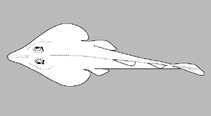 No image available for this species;
drawing shows typical species in Rhinobatidae.
Google Bild
drawing shows typical species in Rhinobatidae.
Klassifizierung / Names Namen | Synonyme | Catalog of Fishes(Gattung, Arten) | ITIS | CoL | WoRMS | Cloffa
Elasmobranchii (Haie und Rochen) (sharks and rays) > Rhinopristiformes (Shovelnose rays) > Rhinobatidae (Guitarfishes)
Etymology: Rhinobatos: Greek, rhinos = nose + Greek, batis, -idos = a ray (Raja sp.) (Ref. 45335); whitei: Named for Dr. William White for his contributions to the taxonomic and biological knowledge of sharks and rays of the Western Central Pacific.
Eponymy: Dr William Toby White (d: 1977) is an Australian ichthyologist whose particular interests are speciation and biodiversity of sharks and rays and fishery management in developing countries. [...] (Ref. 128868), visit book page.
Etymology: Rhinobatos: Greek, rhinos = nose + Greek, batis, -idos = a ray (Raja sp.) (Ref. 45335); whitei: Named for Dr. William White for his contributions to the taxonomic and biological knowledge of sharks and rays of the Western Central Pacific.
Eponymy: Dr William Toby White (d: 1977) is an Australian ichthyologist whose particular interests are speciation and biodiversity of sharks and rays and fishery management in developing countries. [...] (Ref. 128868), visit book page.
Umwelt: Milieu / Klimazone / Tiefenbereich / Verbreitungsgebiet Ökologie
seewasser demersal. Tropical; 13°N - 8°N, 120°E - 125°E (Ref. 114953)
Verbreitung Territorien | FAO Gebiete | Ökosysteme | Vorkommen | Punkt Karte | Einführungen | Faunafri
Western Pacific: Philippines.
Größe / Gewicht / Alter
Geschlechtsreife: Lm ? range ? - ? cm
Max length : 72.0 cm TL Männchen/unbestimmt; (Ref. 97528); 84.4 cm TL (female)
Max length : 72.0 cm TL Männchen/unbestimmt; (Ref. 97528); 84.4 cm TL (female)
Kurzbeschreibung Bestimmungsschlüssel | Morphologie | Morphometrie
This species is distinguished by the following set of adult characters: wedge-shaped disc with moderately concave anterior snout margin, width 31-35% TL, disc length 1.3-1.4 times width; snout length 3.0-3.4 times interspiracular distance, 3.9-5.2 times interorbital width; orbit medium-sized, 1.4-1.7 times spiracle length; notrils weakly oblique, length 1.3-1.6 times internarial distance; preoral length 6.8-7.8 times internarial distance; anterior nasal flaps which are penetrating slightly into internarial space but well separated at their insertion; posterior nasal flaps broad; spiracles large with two folds, outermost fold distinctly longer than inner fold; ridges of rostral cartilage almost parallel, converging slightly anteriorly but not constricted medially; anterior cartilage is subtriangular; distance between fifth gill slits 3.0-3.4 times in ventral head length; prebranchial sensory pore patch distinct, extending to just behind first gill slit; distinct postscapular sensory canal, with exposed lateral pores, grooved; thorn patches on supraorbit, nuchal and scapular regions, and dorsal midline rudimentary, non-conspicuous; in males, pelvic-fin inner margin longer than its base and in females subequal; interdorsal distance 2.6-3.2 times length of first dorsal-fin base; dorsal caudal margin 2.1-2.6 times preventral margin; upper jaw with ca. 65-92 tooth rows; post-synarcual centra, 173-179; nasal lamellae, 50-53; in adults dorsal surface brownish, covered with diffuse orange and dusky blotches, and indistinct pale spots; melanophores pronounced on dorsal surface, and dorsal fins largely pale anteriorly, darker posteriorly with a blackish blotch above the free rear tip when fresh (Ref. 97528).
Cross section: flattened.
Cross section: flattened.
Males mature at ca. 56 cm TL, females slightly larger. Unknown life history (Ref. 114953).
Lebenszyklus und Paarungsverhalten Geschlechtsreife | Fortpflanzung | Ablaichen | Eier | Fruchtbarkeit | Larven
Hauptreferenz
Laden Sie Ihre Referenzen hoch | Referenzen | Koordinator : McEachran, John | Partner
Last, P.R., S. Corrigan and G. Naylor, 2014. Rhinobatos whitei, a new shovelnose ray (Batoidea: Rhinobatidae) from the Philippine Archipelago. Zootaxa 3872(1):31-47. (Ref. 97528)
IUCN Rote Liste Status (Ref. 130435: Version 2025-2 (Global))
vom Aussterben bedroht (CR) (A2d); Date assessed: 12 May 2020
Bedrohung für Menschen
Harmless
Nutzung durch Menschen
Fischereien: kommerziell
FAO - Publication: search | FishSource |
Mehr Information
Trophische Ökologie
Lebensmittel (Beutetiere)
Nahrungszusammensetzung
Nahrungsaufnahme
Lebensmittelrationen
Räuber
Lebensmittel (Beutetiere)
Nahrungszusammensetzung
Nahrungsaufnahme
Lebensmittelrationen
Räuber
Ökologie
Ökologie
Ökologie
Populationsdynamik
Wachstumsparameter
Max. Alter/Größen
Länge-Gewicht-Rel.
Länge-Länge-Verhältnis.
Längenhäufigkeiten
Massenkonvertierung
Rekrutierung
Dichte
Wachstumsparameter
Max. Alter/Größen
Länge-Gewicht-Rel.
Länge-Länge-Verhältnis.
Längenhäufigkeiten
Massenkonvertierung
Rekrutierung
Dichte
Lebenszyklus
Fortpflanzung
Geschlechtsreife
Reifung/Kiemen rel.
Fruchtbarkeit
Ablaichen
Laichaggregationen
Eier
Eientwicklung
Larven
Larven Pop.Dyn.
Fortpflanzung
Geschlechtsreife
Reifung/Kiemen rel.
Fruchtbarkeit
Ablaichen
Laichaggregationen
Eier
Eientwicklung
Larven
Larven Pop.Dyn.
Anatomie
Kiemenoberfläche
Gehirn
Otolith
Kiemenoberfläche
Gehirn
Otolith
Physiologie
Körperliche Zusammensetzung
Nährstoffe
Sauerstoffverbrauch
Schwimmart
Schwimmgeschwindigkeit
Visuelle Pigmente
Fischgeräusche
Krankheiten und Parasiten
Toxizität (LC50s)
Körperliche Zusammensetzung
Nährstoffe
Sauerstoffverbrauch
Schwimmart
Schwimmgeschwindigkeit
Visuelle Pigmente
Fischgeräusche
Krankheiten und Parasiten
Toxizität (LC50s)
Genetik
Genom
Genetik
Heterozygotie
Vererbbarkeit
Genetische Vielfalt
Genom
Genetik
Heterozygotie
Vererbbarkeit
Genetische Vielfalt
Menschenbezogen
Aquakultur-Systeme
Aquakultur Profile
Zuchtlinien
Ciguatera-Fälle
Briefmarken, Münzen, Verschiedenes.
Aquakultur-Systeme
Aquakultur Profile
Zuchtlinien
Ciguatera-Fälle
Briefmarken, Münzen, Verschiedenes.
Tools
Zusatzinformationen
Download XML
Zusammenfassung | Punktdaten | Namen | Photos
Internet Quellen
AFORO (otoliths) | Aquatic Commons | BHL | Cloffa | Websites from users | FishWatcher Einträge suchen | CISTI | Catalog of Fishes: Gattung, Arten | DiscoverLife | ECOTOX | FAO - Publication: search | Faunafri | Fishipedia | Fishtrace | GloBI | Google Books | Google Scholar | Google | IGFA World Record | OneZoom | Open Tree of Life | Otolith Atlas of Taiwan Fishes | PubMed | Reef Life Survey | Socotra Atlas | TreeBase | Tree of Life | Wikipedia: Gehe zu, Suchen | World Records Freshwater Fishing | Zoobank | Zoologischer Rekord
Schätzungen auf der Grundlage von Modellen
Phylogenetischer Diversitätsindex (Ref. 82804): PD50 = 0.5000 [Uniqueness, from 0.5 = low to 2.0 = high].
Bayesian length-weight: a=0.00295 (0.00150 - 0.00581), b=3.13 (2.96 - 3.30), in cm total length, based on LWR estimates for this (Sub)family-body shape (Ref. 93245).
Trophische Ebene (Ref. 69278): 3.7 ±0.4 se; based on size and trophs of closest relatives
Widerstandsfähigkeit (Ref. 120179): niedrig, Verdopplung der Population dauert 4,5 - 14 Jahre. (Preliminary low fecundity).