



Rhinobatos whitei Last, Corrigan & Naylor, 2014
Philippine guitarfish
Adicionar o seu Fotografias e vídeos
Imagem do Google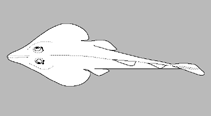 No image available for this species;
drawing shows typical species in Rhinobatidae.
Imagem do Google
drawing shows typical species in Rhinobatidae.
Classificação / Nomes Nomes comuns | Sinónimos | Catalog of Fishes(Género, Espécies) | ITIS | CoL | WoRMS | Cloffa
Elasmobranchii (tubarões e raias) (sharks and rays) > Rhinopristiformes (Shovelnose rays) > Rhinobatidae (Guitarfishes)
Etymology: Rhinobatos: Greek, rhinos = nose + Greek, batis, -idos = a ray (Raja sp.) (Ref. 45335); whitei: Named for Dr. William White for his contributions to the taxonomic and biological knowledge of sharks and rays of the Western Central Pacific.
Eponymy: Dr William Toby White (d: 1977) is an Australian ichthyologist whose particular interests are speciation and biodiversity of sharks and rays and fishery management in developing countries. [...] (Ref. 128868), visit book page.
Etymology: Rhinobatos: Greek, rhinos = nose + Greek, batis, -idos = a ray (Raja sp.) (Ref. 45335); whitei: Named for Dr. William White for his contributions to the taxonomic and biological knowledge of sharks and rays of the Western Central Pacific.
Eponymy: Dr William Toby White (d: 1977) is an Australian ichthyologist whose particular interests are speciation and biodiversity of sharks and rays and fishery management in developing countries. [...] (Ref. 128868), visit book page.
Ambiente: milieu / zona climática / intervalo de profundidade / gama de distribuição Ecologia
marinhas demersal. Tropical; 13°N - 8°N, 120°E - 125°E (Ref. 114953)
Distribuição Territórios | Áreas FAO | Ecossistemas | Ocorrências | Mapa dos pontos | Introduções | Faunafri
Western Pacific: Philippines.
Tamanho / Peso / Idade
Maturidade: Lm ? range ? - ? cm
Max length : 72.0 cm TL macho/indeterminado; (Ref. 97528); 84.4 cm TL (female)
Max length : 72.0 cm TL macho/indeterminado; (Ref. 97528); 84.4 cm TL (female)
Descrição breve Chaves de identificação | Morfologia | Morfometria
This species is distinguished by the following set of adult characters: wedge-shaped disc with moderately concave anterior snout margin, width 31-35% TL, disc length 1.3-1.4 times width; snout length 3.0-3.4 times interspiracular distance, 3.9-5.2 times interorbital width; orbit medium-sized, 1.4-1.7 times spiracle length; notrils weakly oblique, length 1.3-1.6 times internarial distance; preoral length 6.8-7.8 times internarial distance; anterior nasal flaps which are penetrating slightly into internarial space but well separated at their insertion; posterior nasal flaps broad; spiracles large with two folds, outermost fold distinctly longer than inner fold; ridges of rostral cartilage almost parallel, converging slightly anteriorly but not constricted medially; anterior cartilage is subtriangular; distance between fifth gill slits 3.0-3.4 times in ventral head length; prebranchial sensory pore patch distinct, extending to just behind first gill slit; distinct postscapular sensory canal, with exposed lateral pores, grooved; thorn patches on supraorbit, nuchal and scapular regions, and dorsal midline rudimentary, non-conspicuous; in males, pelvic-fin inner margin longer than its base and in females subequal; interdorsal distance 2.6-3.2 times length of first dorsal-fin base; dorsal caudal margin 2.1-2.6 times preventral margin; upper jaw with ca. 65-92 tooth rows; post-synarcual centra, 173-179; nasal lamellae, 50-53; in adults dorsal surface brownish, covered with diffuse orange and dusky blotches, and indistinct pale spots; melanophores pronounced on dorsal surface, and dorsal fins largely pale anteriorly, darker posteriorly with a blackish blotch above the free rear tip when fresh (Ref. 97528).
Cross section: flattened.
Cross section: flattened.
Males mature at ca. 56 cm TL, females slightly larger. Unknown life history (Ref. 114953).
Ciclo de vida e comportamento de acasalamento Maturidade | Reprodução | Desova | Ovos | Fecundidade | Larvas
Referência principal
Carregar as suas referências | Referências | Coordenador : McEachran, John | Colaboradores
Last, P.R., S. Corrigan and G. Naylor, 2014. Rhinobatos whitei, a new shovelnose ray (Batoidea: Rhinobatidae) from the Philippine Archipelago. Zootaxa 3872(1):31-47. (Ref. 97528)
Categoria na Lista Vermelha da IUCN (Ref. 130435: Version 2025-2 (Global))
Criticamente ameaçada (CR) (A2d); Date assessed: 12 May 2020
Ameaça para o homem
Harmless
Utilização humana
Pescarias: espécies comerciais
FAO - Publication: search | FishSource |
Mais informação
Ecologia Trófica
Produtos alimentares (presas)
Composição da dieta
Consumo alimentar
Rações alimentares
Predadores
Produtos alimentares (presas)
Composição da dieta
Consumo alimentar
Rações alimentares
Predadores
Ecologia
Ecologia
Ecologia
Dinâmica das populações
Parâmetros de crescimento
Idades / tamanhos máximos
Comprimento-peso rel.
Comprimento-comprimento rel.
Frequência de comprimento
Conversão de massa
Recrutamento
Abundância
Parâmetros de crescimento
Idades / tamanhos máximos
Comprimento-peso rel.
Comprimento-comprimento rel.
Frequência de comprimento
Conversão de massa
Recrutamento
Abundância
Ciclo de vida
Reprodução
Maturidade
Maturidade/Rel. das guelras
Fecundidade
Desova
Agregações de desova
Ovos
Desenvolvimento dos ovos
Larvas
Dinâmica larvar
Reprodução
Maturidade
Maturidade/Rel. das guelras
Fecundidade
Desova
Agregações de desova
Ovos
Desenvolvimento dos ovos
Larvas
Dinâmica larvar
Anatomia
Área branquial
Cérebro
Otólitos
Área branquial
Cérebro
Otólitos
Fisiologia
Composição corporal
Nutrientes
Consumo de oxigénio
Tipo de natação
Velocidade de natação
Pigmentos visuais
Som de peixe
Doenças e Parasitas
Toxicidade (LC50s)
Composição corporal
Nutrientes
Consumo de oxigénio
Tipo de natação
Velocidade de natação
Pigmentos visuais
Som de peixe
Doenças e Parasitas
Toxicidade (LC50s)
Genética
genoma
Genética
Heterozigotia
Hereditariedade
Diversidade genética
genoma
Genética
Heterozigotia
Hereditariedade
Diversidade genética
Relacionado com o ser humano
Sistemas de aquacultura
Perfis para aquacultura
Estirpes
Casos de Ciguatera
Selos, moedas, diversos.
Sistemas de aquacultura
Perfis para aquacultura
Estirpes
Casos de Ciguatera
Selos, moedas, diversos.
Ferramentas
E-book | Guia de campo | Ferramenta auxiliar de frequências de comprimento | Ferramenta sobre a história de vida | Mapa dos pontos |
Captura-MSY |
Relatórios especiais
Descarregue XML
Fontes da internet
AFORO (otoliths) | Aquatic Commons | BHL | Cloffa | Websites from users | Consultar FishWatcher | CISTI | Catalog of Fishes: Género, Espécies | DiscoverLife | ECOTOX | FAO - Publication: search | Faunafri | Fishipedia | Fishtrace | GloBI | Google Books | Google Scholar | Google | IGFA World Record | OneZoom | Open Tree of Life | Otolith Atlas of Taiwan Fishes | PubMed | Reef Life Survey | Socotra Atlas | TreeBase | Árvore da vida | Wikipedia: ir para, procurar | World Records Freshwater Fishing | Zoobank | Registo zoológico
Estimativas baseadas em modelos
Índice de diversidade filogenética (Ref. 82804): PD50 = 0.5000 [Uniqueness, from 0.5 = low to 2.0 = high].
Bayesian length-weight: a=0.00295 (0.00150 - 0.00581), b=3.13 (2.96 - 3.30), in cm total length, based on LWR estimates for this (Sub)family-body shape (Ref. 93245).
Nível Trófico (Ref. 69278): 3.7 ±0.4 se; based on size and trophs of closest relatives
Resiliência (Ref. 120179): Baixo, tempo mínimo de duplicação da população 4,5 - 14 anos (Preliminary low fecundity).