



Microlepidogaster discus Martins, Rosa & Langeani, 2014
Adicionar o seu Fotografias e vídeos
Imagem do Google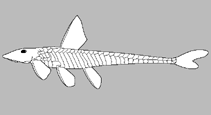 No image available for this species;
drawing shows typical species in Loricariidae.
Imagem do Google
drawing shows typical species in Loricariidae.
Classificação / Nomes Nomes comuns | Sinónimos | Catalog of Fishes(Género, Espécies) | ITIS | CoL | WoRMS | Cloffa
> Siluriformes (Catfishes) > Loricariidae (Armored catfishes) > Hypoptopomatinae
Etymology: Microlepidogaster: Greek, mikros = small + Greek, lepis = scale + Greek, gaster = stomach (Ref. 45335); discus: From the Latin discus, meaning flat circular plate, in reference to the first reduced and round plates in the mid-ventral lateral series, a diagnostic feature of the species. A noun in apposition.
Etymology: Microlepidogaster: Greek, mikros = small + Greek, lepis = scale + Greek, gaster = stomach (Ref. 45335); discus: From the Latin discus, meaning flat circular plate, in reference to the first reduced and round plates in the mid-ventral lateral series, a diagnostic feature of the species. A noun in apposition.
Ambiente: milieu / zona climática / intervalo de profundidade / gama de distribuição Ecologia
; Água doce demersal. Tropical
Distribuição Territórios | Áreas FAO | Ecossistemas | Ocorrências | Mapa dos pontos | Introduções | Faunafri
South America: Rio Jequitinhonha in southeastern Brazil.
Tamanho / Peso / Idade
Descrição breve Chaves de identificação | Morfologia | Morfometria
Raios dorsais moles (total) : 9; Raios anais moles: 6; Vértebras: 31. Microlepidogaster discus is distinguished from other species of the genus Microlepidogaster by having the following characters: the ventral laminar expansions of cleithrum and coracoid bearing only 1-30 odontodes restricted to the area near the pectoral-fin insertion (vs. 50-120 odontodes, generally more than 100, extending to the middle portion of pectoral girdle); the anterior plates of mid-ventral lateral series reduced, not ventrally elongated, the first or the second markedly round (vs. anterior plates of mid-ventral lateral series large, curved and elongated, similar to most of the other anterior plates of the series); pectoral-fin unbranched ray distinctly divided distally, with 7-15 ossified segments reaching almost half of its length (vs. ossified segments absent, or when present less than seven, restricted to the tip of the ray); and accessory process on first epibranchial present (vs. absent). It differs also from all congeners, except for M. dimorpha, by having the anterior portion of compound supraneural plus first dorsal-fin proximal radial contacting the neural spine of the seventh vertebra (vs. eighth or ninth vertebra in M. perforatus, ninth vertebra in M. arachas, and 10th or 11th vertebra in M. longicolla). It can be diagnosed from M. perforatus and M. dimorpha by having pointed odontodes at the anterior portion of rostral plates (vs. rounded leaf-shaped odontodes); from M. longicolla and M. perforatus by having the mid-dorsal lateral series of plates surpassing the vertical through dorsal-fin length (vs. mid-dorsal lateral series reduced, reaching the vertical through dorsal-fin base, and never surpassing the dorsal-fin length); and from M. perforatus by having the median series of lateral plates complete, reaching the end of the caudal peduncle (vs. median series of lateral plates terminating two plates before the end of the caudal peduncle) and by the presence of an iris operculum (vs. absence) (Ref. 97523).
Body shape (shape guide): elongated.
Body shape (shape guide): elongated.
Facultative air-breathing in the genus (Ref. 126274); Observed to fold their lips longitudinally, partially or totally, with right and left halves, including the barbels, contacting at midline when handled during sampling (Ref. 97523).
Ciclo de vida e comportamento de acasalamento Maturidade | Reprodução | Desova | Ovos | Fecundidade | Larvas
Referência principal
Carregar as suas referências | Referências | Coordenador : Fisch-Muller, Sonia | Colaboradores
Martins, F.O., A.C. Rosa and F. Langeani, 2014. Microlepidogaster discus, a new species of Hypoptopomatinae (Siluriformes: Loricariidae) from the rio Jequitinhonha basin, southern Brazil. Zootaxa 3873(5):560-570. (Ref. 97523)
CITES
Not Evaluated
Ameaça para o homem
Harmless
Utilização humana
FAO - Publication: search | FishSource |
Mais informação
Ecologia Trófica
Produtos alimentares (presas)
Composição da dieta
Consumo alimentar
Rações alimentares
Predadores
Produtos alimentares (presas)
Composição da dieta
Consumo alimentar
Rações alimentares
Predadores
Dinâmica das populações
Parâmetros de crescimento
Idades / tamanhos máximos
Comprimento-peso rel.
Comprimento-comprimento rel.
Frequência de comprimento
Conversão de massa
Recrutamento
Abundância
Parâmetros de crescimento
Idades / tamanhos máximos
Comprimento-peso rel.
Comprimento-comprimento rel.
Frequência de comprimento
Conversão de massa
Recrutamento
Abundância
Ciclo de vida
Reprodução
Maturidade
Maturidade/Rel. das guelras
Fecundidade
Desova
Agregações de desova
Ovos
Desenvolvimento dos ovos
Larvas
Dinâmica larvar
Reprodução
Maturidade
Maturidade/Rel. das guelras
Fecundidade
Desova
Agregações de desova
Ovos
Desenvolvimento dos ovos
Larvas
Dinâmica larvar
Anatomia
Área branquial
Cérebro
Otólitos
Área branquial
Cérebro
Otólitos
Fisiologia
Composição corporal
Nutrientes
Consumo de oxigénio
Tipo de natação
Velocidade de natação
Pigmentos visuais
Som de peixe
Doenças e Parasitas
Toxicidade (LC50s)
Composição corporal
Nutrientes
Consumo de oxigénio
Tipo de natação
Velocidade de natação
Pigmentos visuais
Som de peixe
Doenças e Parasitas
Toxicidade (LC50s)
Genética
genoma
Genética
Heterozigotia
Hereditariedade
Diversidade genética
genoma
Genética
Heterozigotia
Hereditariedade
Diversidade genética
Relacionado com o ser humano
Sistemas de aquacultura
Perfis para aquacultura
Estirpes
Casos de Ciguatera
Selos, moedas, diversos.
Sistemas de aquacultura
Perfis para aquacultura
Estirpes
Casos de Ciguatera
Selos, moedas, diversos.
Ferramentas
E-book | Guia de campo | Ferramenta auxiliar de frequências de comprimento | Ferramenta sobre a história de vida | Mapa dos pontos |
Captura-MSY |
Relatórios especiais
Descarregue XML
Fontes da internet
AFORO (otoliths) | Aquatic Commons | BHL | Cloffa | Websites from users | Consultar FishWatcher | CISTI | Catalog of Fishes: Género, Espécies | DiscoverLife | ECOTOX | FAO - Publication: search | Faunafri | Fishipedia | Fishtrace | GloBI | Google Books | Google Scholar | Google | IGFA World Record | OneZoom | Open Tree of Life | Otolith Atlas of Taiwan Fishes | PubMed | Reef Life Survey | Socotra Atlas | TreeBase | Árvore da vida | Wikipedia: ir para, procurar | World Records Freshwater Fishing | Zoobank | Registo zoológico
Estimativas baseadas em modelos
Índice de diversidade filogenética (Ref. 82804): PD50 = 0.5039 [Uniqueness, from 0.5 = low to 2.0 = high].
Bayesian length-weight: a=0.00977 (0.00434 - 0.02202), b=3.06 (2.87 - 3.25), in cm total length, based on LWR estimates for this (Sub)family-body shape (Ref. 93245).
Resiliência (Ref. 120179): Elevada, tempo mínimo de duplicação da população menor que 15 meses (Preliminary K or Fecundity.).