



Microlepidogaster discus Martins, Rosa & Langeani, 2014
Sube tu fotos y Vídeos
Google image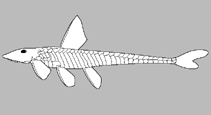 No image available for this species;
drawing shows typical species in Loricariidae.
Google image
drawing shows typical species in Loricariidae.
Clasificación / Nombres Nombres comunes | Sinónimos | Catalog of Fishes(Género, Especie) | ITIS | CoL | WoRMS | Cloffa
> Siluriformes (Catfishes) > Loricariidae (Armored catfishes) > Hypoptopomatinae
Etymology: Microlepidogaster: Greek, mikros = small + Greek, lepis = scale + Greek, gaster = stomach (Ref. 45335); discus: From the Latin discus, meaning flat circular plate, in reference to the first reduced and round plates in the mid-ventral lateral series, a diagnostic feature of the species. A noun in apposition.
Etymology: Microlepidogaster: Greek, mikros = small + Greek, lepis = scale + Greek, gaster = stomach (Ref. 45335); discus: From the Latin discus, meaning flat circular plate, in reference to the first reduced and round plates in the mid-ventral lateral series, a diagnostic feature of the species. A noun in apposition.
Entorno: milieu / zona climática / rango de profundidad / gama de distribución Ecología
; agua dulce demersal. Tropical
Distribución Territorios | Áreas FAO | Ecosistemas | Ocurrencias, apariciones | Mapa de puntos | Introducciones | Faunafri
South America: Rio Jequitinhonha in southeastern Brazil.
Tamaño / Peso / Edad
Descripción breve Claves de identificación | Morfología | Morfometría
Radios blandos dorsales (total) : 9; Radios blandos anales: 6; Vértebra: 31. Microlepidogaster discus is distinguished from other species of the genus Microlepidogaster by having the following characters: the ventral laminar expansions of cleithrum and coracoid bearing only 1-30 odontodes restricted to the area near the pectoral-fin insertion (vs. 50-120 odontodes, generally more than 100, extending to the middle portion of pectoral girdle); the anterior plates of mid-ventral lateral series reduced, not ventrally elongated, the first or the second markedly round (vs. anterior plates of mid-ventral lateral series large, curved and elongated, similar to most of the other anterior plates of the series); pectoral-fin unbranched ray distinctly divided distally, with 7-15 ossified segments reaching almost half of its length (vs. ossified segments absent, or when present less than seven, restricted to the tip of the ray); and accessory process on first epibranchial present (vs. absent). It differs also from all congeners, except for M. dimorpha, by having the anterior portion of compound supraneural plus first dorsal-fin proximal radial contacting the neural spine of the seventh vertebra (vs. eighth or ninth vertebra in M. perforatus, ninth vertebra in M. arachas, and 10th or 11th vertebra in M. longicolla). It can be diagnosed from M. perforatus and M. dimorpha by having pointed odontodes at the anterior portion of rostral plates (vs. rounded leaf-shaped odontodes); from M. longicolla and M. perforatus by having the mid-dorsal lateral series of plates surpassing the vertical through dorsal-fin length (vs. mid-dorsal lateral series reduced, reaching the vertical through dorsal-fin base, and never surpassing the dorsal-fin length); and from M. perforatus by having the median series of lateral plates complete, reaching the end of the caudal peduncle (vs. median series of lateral plates terminating two plates before the end of the caudal peduncle) and by the presence of an iris operculum (vs. absence) (Ref. 97523).
Body shape (shape guide): elongated.
Body shape (shape guide): elongated.
Facultative air-breathing in the genus (Ref. 126274); Observed to fold their lips longitudinally, partially or totally, with right and left halves, including the barbels, contacting at midline when handled during sampling (Ref. 97523).
Ciclo vital y comportamiento de apareamiento Madurez | Reproducción | Puesta | Huevos | Fecundidad | Larva
Referencia principal
Suba sus referencias | Referencias | Coordinador : Fisch-Muller, Sonia | Colaboradores
Martins, F.O., A.C. Rosa and F. Langeani, 2014. Microlepidogaster discus, a new species of Hypoptopomatinae (Siluriformes: Loricariidae) from the rio Jequitinhonha basin, southern Brazil. Zootaxa 3873(5):560-570. (Ref. 97523)
CITES
Not Evaluated
Amenaza para el ser humano
Harmless
Usos humanos
FAO - Publication: search | FishSource |
Más información
Ecología Trófica
Alimentos (presas)
Composición de la dieta
consumo de alimento
Raciones de comida
Despredadores
Alimentos (presas)
Composición de la dieta
consumo de alimento
Raciones de comida
Despredadores
Dinámica de la población
Coeficiente del crecimiento para
Edades / tallas máximas
Longitud-peso rel.
Longitud-longitud rel.
Longitud-frecuencias
Conversión de masas
Reclutamiento
Abundancia
Coeficiente del crecimiento para
Edades / tallas máximas
Longitud-peso rel.
Longitud-longitud rel.
Longitud-frecuencias
Conversión de masas
Reclutamiento
Abundancia
Ciclo de vida
Reproducción
Madurez
Madurez/Gills rel.
Fecundidad
Puesta
Agregaciones de desove
Huevos
Desarrollo de los huevos
Larva
Dinámica larvaria
Reproducción
Madurez
Madurez/Gills rel.
Fecundidad
Puesta
Agregaciones de desove
Huevos
Desarrollo de los huevos
Larva
Dinámica larvaria
Distribución
Territorios
Áreas FAO
Ecosistemas
Ocurrencias, apariciones
Introducciones
BRUVS - Vídeos
Territorios
Áreas FAO
Ecosistemas
Ocurrencias, apariciones
Introducciones
BRUVS - Vídeos
Anatomía
Superficie branquial
Cerebro
Otolito
Superficie branquial
Cerebro
Otolito
Fisiología
Composición corporal
Nutrientes
Consumo del oxígeno
Tipo de natación
Velocidad de natación
Pigmentos visuales
Sonido de peces
Enfermedades y parásitos
Toxicidad (CL50)
Composición corporal
Nutrientes
Consumo del oxígeno
Tipo de natación
Velocidad de natación
Pigmentos visuales
Sonido de peces
Enfermedades y parásitos
Toxicidad (CL50)
Genética
Genoma
Genética
Heterocigosidad
heritabilidad
Diversidad genética
Genoma
Genética
Heterocigosidad
heritabilidad
Diversidad genética
Relacionados con el ser humano
Sistemas de acuicultura
Perfiles de acuicultura
Razas
Ciguatera cases
Sellos, monedas, varios
Sistemas de acuicultura
Perfiles de acuicultura
Razas
Ciguatera cases
Sellos, monedas, varios
Herramientas
Libro electrónico | Guía de campo | Asistente para frecuencias de tallas | Herramienta de ciclo de vida | Mapa de puntos |
Catch-MSY |
Informes especiales
Comprobar el mantenimiento del acuario | Buscar fichas sobre especies | Consulte las hojas informativas sobre acuicultura
Descargar XML
Fuentes de Internet
AFORO (otoliths) | Aquatic Commons | BHL | Cloffa | Websites from users | Check FishWatcher | CISTI | Catalog of Fishes: Género, Especie | DiscoverLife | ECOTOX | FAO - Publication: search | Faunafri | Fishipedia | Fishtrace | GloBI | Google Books | Google Scholar | Google | IGFA World Record | OneZoom | Open Tree of Life | Otolith Atlas of Taiwan Fishes | PubMed | Reef Life Survey | Socotra Atlas | TreeBase | Árbol de la vida | Wikipedia: Go, búsqueda | World Records Freshwater Fishing | Zoobank | Expediente Zoológico
Estimaciones basadas en modelos
Índice de diversidad filogenética (Referencia 82804): PD50 = 0.5039 [Uniqueness, from 0.5 = low to 2.0 = high].
Bayesian length-weight: a=0.00977 (0.00434 - 0.02202), b=3.06 (2.87 - 3.25), in cm total length, based on LWR estimates for this (Sub)family-body shape (Ref. 93245).
Resiliencia (Referencia 120179): Alto, población duplicada en un tiempo mínimo inferior a 15 meses (Preliminary K or Fecundity.).