分類 / Names
俗名 | 同種異名 | Catalog of Fishes(屬, 種) | ITIS | CoL | WoRMS | Cloffa
Teleostei >
Cichliformes (Cichlids, convict blennies)
鱸形目 (Cichlids, convict blennies) >
Cichlidae (Cichlids)
慈鯛科魚類 (Cichlids) > Cichlinae
Etymology: Heros: Greek, heros = hero (Ref. 45335); liberifer: Derived from the Latin words liberi (= children) and ferre (= to carry) in reference to the oral incubation, a reproductive behaviour, which is apparently unique in the genus. A noun in apposition.
Environment: milieu / climate zone / 深度上下限 / distribution range
生態學
; 淡水 底中水層性; pH range: 4.1 - 6.1. 27°C - ?
分布
國家 | FAO區域 | 生態系 | 發現紀錄 | 分布圖 | 簡介 | Faunafri
South America: Rio Orinoco basin.
大小 / 重量 / 年齡
成熟度: Lm ? range ? - ? cm
Max length : 16.4 cm SL 雄魚/尚未辨別雌雄; (Ref. 114589)
簡短描述
檢索表 | 型態特徵 | 形態測量圖
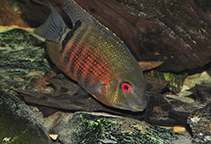
背棘 (總數) : 15 - 16; 背的軟條 (總數) : 12 - 13; 臀棘: 6 - 7; 臀鰭軟條: 10 - 11; 脊椎骨: 17. Heros liberifer can be diagnosed from all its congeners by having the following characters: a pattern of several horizontal series of bright red dots on the lower half of the body sides (vs. absence of rows of red dots); distinct caudal spot in adult specimens (vs. caudal spot usually merged with bar 2 in adult specimens); and tiny dark dots on operculum and cheeks in adult males (vs. large dots or a vermicular pattern). It differs from adult specimens of the frequently syntopic Heros severus by narrow (vs. thick) lips, bar 4, which is not shortened, but extends from the anal fi n base onto the base of the dorsal fin (vs. bar 4 extending only slightly above the lower lateral line), by the first two anterior hemal spines, which are broader and partially connected (vs. the first three hemal spines connected), and a bright red (vs. brown to dark reddish) iris in live specimens (Ref. 114589).
Body shape (shape guide): elongated.
This species is adapted to lentic environment with flooded forest habitats as the typical biotopes. It has no narrow habitat requirement as it is observed not only in clearwater and extreme blackwater habitats, but also in whitewater habitats. It can thrive in a wide range of physico-chemical environmental conditions (pH 4.1-6.1; conductivity 4-15 μS/cm). It spawns in the flooded riparian forest during the flood season. At the start of the dry season, it leaves the riparian forests, which mostly dry up, and spends the low-water season among submerged logs, trunks and branches. During the low-water season, it usually seeks shelter in the crevices and gaps found between the boulders (Ref. 114589).
Life cycle and mating behavior
成熟度 | 繁殖 | 產卵場 | 卵 | 孕卵數 | 仔魚
Deposits eggs on vertical or sometimes on a horizontal surface. Hatching takes place approximately forty hours after spawning at 27° C water temperature. Both parents pick up the larvae to brood them orally (Ref. 114589).
Staeck, W. and I. Schindler, 2015. Description of a new Heros species (Teleostei, Cichlidae) from the Rio Orinoco drainage and notes on Heros severus Heckel, 1840. Bull. Fish Biol. 15(1/2):121-136. (Ref. 114589)
IUCN 瀕危狀態 (Ref. 130435: Version 2025-1)
無危 (LC) ; Date assessed: 28 October 2020
人類使用
工具
特別的報告
下載 XML
網路資源
Estimates based on models
Phylogenetic diversity index (參考文獻
82804): PD
50 = 0.5312 [Uniqueness, from 0.5 = low to 2.0 = high].
Bayesian length-weight: a=0.03020 (0.01346 - 0.06774), b=3.03 (2.84 - 3.22), in cm total length, based on LWR estimates for this (Sub)family-body shape (Ref.
93245).
營養階層 (參考文獻
69278): 2.8 ±0.4 se; based on size and trophs of closest relatives
回復力 (參考文獻
120179): 高度, 族群倍增時間少於 15個月 (Preliminary K or Fecundity.).
Fishing Vulnerability (Ref.
59153): Low vulnerability (10 of 100).
🛈