



Carica il tuo foto e Video
Immagini | Google image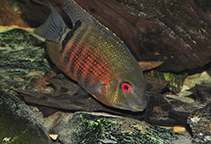 Heros liberifer
Male Immagine di Negrini, M.
Immagini | Google image
Male Immagine di Negrini, M.
Classificazione / Nomi Nomi Comuni | Sinonimi | Catalog of Fishes(Genere, Specie) | ITIS | CoL | WoRMS | Cloffa
> Cichliformes (Cichlids, convict blennies) > Cichlidae (Cichlids) > Cichlinae
Etymology: Heros: Greek, heros = hero (Ref. 45335); liberifer: Derived from the Latin words liberi (= children) and ferre (= to carry) in reference to the oral incubation, a reproductive behaviour, which is apparently unique in the genus. A noun in apposition.
Etymology: Heros: Greek, heros = hero (Ref. 45335); liberifer: Derived from the Latin words liberi (= children) and ferre (= to carry) in reference to the oral incubation, a reproductive behaviour, which is apparently unique in the genus. A noun in apposition.
Ambiente: milieu / zona climatica / distribuzione batimetrica / gamma di distribuzione Ecologia
; acqua dolce benthopelagico; pH range: 4.1 - 6.1. Tropical; 27°C - ?
Distribuzione Territories | Aree FAO | Ecosistemi | Presenze | Mappa dei ritrovamenti | Introduzioni | Faunafri
South America: Rio Orinoco basin.
Dimensione / Peso / Età
Breve descrizione Chiavi di identificazione | Morfologia | Morfometria
Spine dorsali (totale) : 15 - 16; Raggi dorsali molli (totale) : 12 - 13; Spine anali: 6 - 7; Raggi anali molli: 10 - 11; Vertebre: 17. Heros liberifer can be diagnosed from all its congeners by having the following characters: a pattern of several horizontal series of bright red dots on the lower half of the body sides (vs. absence of rows of red dots); distinct caudal spot in adult specimens (vs. caudal spot usually merged with bar 2 in adult specimens); and tiny dark dots on operculum and cheeks in adult males (vs. large dots or a vermicular pattern). It differs from adult specimens of the frequently syntopic Heros severus by narrow (vs. thick) lips, bar 4, which is not shortened, but extends from the anal fi n base onto the base of the dorsal fin (vs. bar 4 extending only slightly above the lower lateral line), by the first two anterior hemal spines, which are broader and partially connected (vs. the first three hemal spines connected), and a bright red (vs. brown to dark reddish) iris in live specimens (Ref. 114589).
Body shape (shape guide): elongated.
Body shape (shape guide): elongated.
This species is adapted to lentic environment with flooded forest habitats as the typical biotopes. It has no narrow habitat requirement as it is observed not only in clearwater and extreme blackwater habitats, but also in whitewater habitats. It can thrive in a wide range of physico-chemical environmental conditions (pH 4.1-6.1; conductivity 4-15 μS/cm). It spawns in the flooded riparian forest during the flood season. At the start of the dry season, it leaves the riparian forests, which mostly dry up, and spends the low-water season among submerged logs, trunks and branches. During the low-water season, it usually seeks shelter in the crevices and gaps found between the boulders (Ref. 114589).
Ciclo vitale e comportamento di accoppiamento Maturità | Riproduzione | Deposizione | Uova | Fecondità | Larve
Deposits eggs on vertical or sometimes on a horizontal surface. Hatching takes place approximately forty hours after spawning at 27° C water temperature. Both parents pick up the larvae to brood them orally (Ref. 114589).
Riferimento principale
Caricare le referenze | Bibliografia | Coordinatore : Kullander, Sven O. | Collaboratori
Staeck, W. and I. Schindler, 2015. Description of a new Heros species (Teleostei, Cichlidae) from the Rio Orinoco drainage and notes on Heros severus Heckel, 1840. Bull. Fish Biol. 15(1/2):121-136. (Ref. 114589)
Stato della Lista Rossa IUCN (Ref. 130435: Version 2025-2 (Global))
Least Concern (LC) ; Date assessed: 28 October 2020
CITES
Not Evaluated
Minaccia per l'uomo
Harmless
Usi umani
FAO - Publication: search | FishSource |
Informazioni ulteriori
Ecologia trofica
Articoli alimentari (prede)
Alimentazione
Consumo di cibo
Razioni alimentari
Predatori
Articoli alimentari (prede)
Alimentazione
Consumo di cibo
Razioni alimentari
Predatori
Dinamica della popolazione
Parametri di crescita
Età massima / dimensioni massime
Rapporto lunghezza-peso.
Lunghezza-lunghezza rel.
Lunghezza-frequenze
Conversione di massa
Reclutamento
Abbondanza
Parametri di crescita
Età massima / dimensioni massime
Rapporto lunghezza-peso.
Lunghezza-lunghezza rel.
Lunghezza-frequenze
Conversione di massa
Reclutamento
Abbondanza
Ciclo di vita
Riproduzione
Maturità
Maturità/Gli occhielli sono relativi.
Fecondità
Deposizione
Aggregazioni riproduttive
Uova
Sviluppo delle uova
Larve
Dinamica popolazioni larvali
Riproduzione
Maturità
Maturità/Gli occhielli sono relativi.
Fecondità
Deposizione
Aggregazioni riproduttive
Uova
Sviluppo delle uova
Larve
Dinamica popolazioni larvali
Anatomia
Area branchiale
Cervello
Otolite
Area branchiale
Cervello
Otolite
Fisiologia
Composizione corporea
Nutrienti
Consumo di ossigeno
Tipo di nuoto
Velocità di nuoto
Pigmenti visivi
Suono del pesce
Malattie e parassiti
Tossicità (LC50)
Composizione corporea
Nutrienti
Consumo di ossigeno
Tipo di nuoto
Velocità di nuoto
Pigmenti visivi
Suono del pesce
Malattie e parassiti
Tossicità (LC50)
Genetica
Genome
Genetica
Eterozigosi
Ereditarietà
Diversità genetica
Genome
Genetica
Eterozigosi
Ereditarietà
Diversità genetica
Legato all'uomo
Sistemi di acquacoltura
Profili di acquacoltura
Varietà
Casi di Ciguatera
Francobolli, monete, materiale vario.
Sistemi di acquacoltura
Profili di acquacoltura
Varietà
Casi di Ciguatera
Francobolli, monete, materiale vario.
Strumenti
Libro elettronico | Giuda pratica | Generatore frequenze di lunghezza | Strumento Parametri Biologici | Mappa dei ritrovamenti |
Cattura-MSY |
Rapporti speciali
Controllo della manutenzione dell'acquario | Verificare la presenza di schede informative sulle specie | Verifica delle schede informative sull'acquacoltura
Scarica XML
Fonti Internet
AFORO (otoliths) | Aquatic Commons | BHL | Cloffa | Websites from users | Check FishWatcher | CISTI | Catalog of Fishes: Genere, Specie | DiscoverLife | ECOTOX | FAO - Publication: search | Faunafri | Fishipedia | Fishtrace | GloBI | Google Books | Google Scholar | Google | IGFA World Record | OneZoom | Open Tree of Life | Otolith Atlas of Taiwan Fishes | PubMed | Reef Life Survey | Socotra Atlas | TreeBase | Tree of Life | Wikipedia: Go, ricerca | World Records Freshwater Fishing | Zoobank | Record zoologico
Stime basate su modelli
Indice di diversità filogenetica (Fonte Biblio. 82804): PD50 = 0.5312 [Uniqueness, from 0.5 = low to 2.0 = high].
Bayesian length-weight: a=0.03020 (0.01328 - 0.06866), b=3.03 (2.84 - 3.22), in cm total length, based on LWR estimates for this (Sub)family-body shape (Ref. 93245).
Livello trofico (Fonte Biblio. 69278): 2.8 ±0.4 se; based on size and trophs of closest relatives
Resilienza (Fonte Biblio. 120179): Alto, tempo minimo di raddoppiamento della popolazione meno di 15 mesi (Preliminary K or Fecundity.).