



Carica il tuo foto e Video
Google image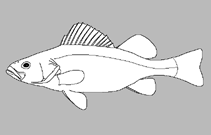 No image available for this species;
drawing shows typical species in Percidae.
Google image
drawing shows typical species in Percidae.
Classificazione / Nomi Nomi Comuni | Sinonimi | Catalog of Fishes(Genere, Specie) | ITIS | CoL | WoRMS | Cloffa
> Perciformes/Percoidei (Perchs) > Percidae (Perches) > Etheostomatinae
Etymology: Percina: Latin, diminutive of perch = perch (Ref. 45335).
Etymology: Percina: Latin, diminutive of perch = perch (Ref. 45335).
Ambiente: milieu / zona climatica / distribuzione batimetrica / gamma di distribuzione Ecologia
; acqua dolce benthopelagico. Temperate
Distribuzione Territories | Aree FAO | Ecosistemi | Presenze | Mappa dei ritrovamenti | Introduzioni | Faunafri
North America: Duck River system and Whiteoak Creek, Western Highland Rim in Tennessee, USA.
Dimensione / Peso / Età
Maturità: Lm ? range ? - ? cm
Max length : 13.7 cm SL maschio/sesso non determinato; (Ref. 116752); 13.4 cm SL (female)
Max length : 13.7 cm SL maschio/sesso non determinato; (Ref. 116752); 13.4 cm SL (female)
Breve descrizione Chiavi di identificazione | Morfologia | Morfometria
Spine dorsali (totale) : 14 - 18; Raggi dorsali molli (totale) : 14 - 17; Raggi anali molli: 11 - 13. Percina apina can be distinguished by having the following characters: dorsum with about 11 dark saddles that are interspersed with vermiculated patches of pigment that extend to the side of the body; 7 to 9 dark, large round or oval shaped lateral blotches along the side of the body that are typically wider than high; anterior-most blotches are just posterior of the operculum and are smaller in size, as is the most posterior blotch, which is often confluent with a distinct caudal spot; a moderate to diffuse suborbital bar of pigment; males in nuptial condition with a gold-green background color with an overall duskiness and a blue-green iridescence on the cheeks and side of the body; first dorsal fin with an intense orange submarginal band distal to a narrow yellow band of coloration with a wide and basal band comprising uniform streaks of brown-orange pigment; distal margin of the second dorsal fin lightly pigmented with a proximate band of dusky orange coloration and a tessellated basal margin; caudal fin with light bands of pigment and the distal margin slightly pigmented in nuptial males; nuptial males with anal fin yellowgold distally with a basal peppering of dark pigment; males in nuptial condition with membranes of the pelvic fin filled with jet-black pigment, and the pectoral fin membranes slightly peppered with dark pigment (Ref. 116752).
Body shape (shape guide): elongated.
Body shape (shape guide): elongated.
Habitats of this species differ between reproductive and non-reproductive periods. Both sexes in in reproductive condition were most often found in swift runs of depths about one meter or less with predominant gravel and cobble substrates. On many occasions, adult males were collected in shallow, swift riffles with gravel bottoms during late April to early June. In summer months, adult males and females occurred in swift runs and in pool areas with substrates free of silt. Subadults were only encountered in pool habitats and were usually accompanied by adult females (Ref. 116752).
Ciclo vitale e comportamento di accoppiamento Maturità | Riproduzione | Deposizione | Uova | Fecondità | Larve
Riferimento principale
Caricare le referenze | Bibliografia | Coordinatore | Collaboratori
Near, T.J., J.W. Simmons, J.M. Mollish, M.A. Correa, E. Benavides, R.C. Harrington and B.P. Keck, 2017. A new species of longperch endemic to Tennessee (Percidae: Etheostomatinae: Percina). Bulletin of the Peabody Museum of Natural History 58(2):287-309. (Ref. 116752)
CITES
Not Evaluated
Minaccia per l'uomo
Harmless
Usi umani
FAO - Publication: search | FishSource |
Informazioni ulteriori
Ecologia trofica
Articoli alimentari (prede)
Alimentazione
Consumo di cibo
Razioni alimentari
Predatori
Articoli alimentari (prede)
Alimentazione
Consumo di cibo
Razioni alimentari
Predatori
Dinamica della popolazione
Parametri di crescita
Età massima / dimensioni massime
Rapporto lunghezza-peso.
Lunghezza-lunghezza rel.
Lunghezza-frequenze
Conversione di massa
Reclutamento
Abbondanza
Parametri di crescita
Età massima / dimensioni massime
Rapporto lunghezza-peso.
Lunghezza-lunghezza rel.
Lunghezza-frequenze
Conversione di massa
Reclutamento
Abbondanza
Ciclo di vita
Riproduzione
Maturità
Maturità/Gli occhielli sono relativi.
Fecondità
Deposizione
Aggregazioni riproduttive
Uova
Sviluppo delle uova
Larve
Dinamica popolazioni larvali
Riproduzione
Maturità
Maturità/Gli occhielli sono relativi.
Fecondità
Deposizione
Aggregazioni riproduttive
Uova
Sviluppo delle uova
Larve
Dinamica popolazioni larvali
Anatomia
Area branchiale
Cervello
Otolite
Area branchiale
Cervello
Otolite
Fisiologia
Composizione corporea
Nutrienti
Consumo di ossigeno
Tipo di nuoto
Velocità di nuoto
Pigmenti visivi
Suono del pesce
Malattie e parassiti
Tossicità (LC50)
Composizione corporea
Nutrienti
Consumo di ossigeno
Tipo di nuoto
Velocità di nuoto
Pigmenti visivi
Suono del pesce
Malattie e parassiti
Tossicità (LC50)
Genetica
Genome
Genetica
Eterozigosi
Ereditarietà
Diversità genetica
Genome
Genetica
Eterozigosi
Ereditarietà
Diversità genetica
Legato all'uomo
Sistemi di acquacoltura
Profili di acquacoltura
Varietà
Casi di Ciguatera
Francobolli, monete, materiale vario.
Sistemi di acquacoltura
Profili di acquacoltura
Varietà
Casi di Ciguatera
Francobolli, monete, materiale vario.
Strumenti
Libro elettronico | Giuda pratica | Generatore frequenze di lunghezza | Strumento Parametri Biologici | Mappa dei ritrovamenti |
Cattura-MSY |
Rapporti speciali
Controllo della manutenzione dell'acquario | Verificare la presenza di schede informative sulle specie | Verifica delle schede informative sull'acquacoltura
Scarica XML
Fonti Internet
AFORO (otoliths) | Aquatic Commons | BHL | Cloffa | Websites from users | Check FishWatcher | CISTI | Catalog of Fishes: Genere, Specie | DiscoverLife | ECOTOX | FAO - Publication: search | Faunafri | Fishipedia | Fishtrace | GloBI | Google Books | Google Scholar | Google | IGFA World Record | OneZoom | Open Tree of Life | Otolith Atlas of Taiwan Fishes | PubMed | Reef Life Survey | Socotra Atlas | TreeBase | Tree of Life | Wikipedia: Go, ricerca | World Records Freshwater Fishing | Zoobank | Record zoologico
Stime basate su modelli
Indice di diversità filogenetica (Fonte Biblio. 82804): PD50 = 0.5000 [Uniqueness, from 0.5 = low to 2.0 = high].
Bayesian length-weight: a=0.00575 (0.00268 - 0.01234), b=3.13 (2.95 - 3.31), in cm total length, based on LWR estimates for this (Sub)family-body shape (Ref. 93245).
Livello trofico (Fonte Biblio. 69278): 3.5 ±0.5 se; based on size and trophs of closest relatives
Resilienza (Fonte Biblio. 120179): Medio, tempo minimo di raddoppiamento della popolazione 1.4 - 4.4 anni (Preliminary K or Fecundity.).