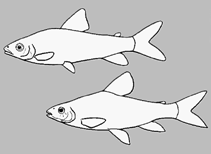
>
Characiformes (Characins) >
Anostomidae (Headstanders)
Etymology: Leporinus: Latin, lepus, leporis = rabbit (Ref. 45335); torrenticola: Derived from the Latin adjective torrens, meaning rushing waters, and incola, meaning inhabitant, in reference to the preference of Leporinus torrenticola for fast flowing waters.
Environment: milieu / climate zone / kisaran kedalaman / distribution range
Ekologi
; air tawar bentopelagis. Tropical
South America: middle rio Xingu and its main tributaries, the rio Iriri and rio Curuá, Pará state, Brazil.
Size / Weight / umur
Kematangan: Lm ? range ? - ? cm
Max length : 14.5 cm TL jantan/; (Ref. 126097); Berat maksimum terpublikasi: 33.96 g (Ref. 126097)
deskripsi pendek
Kunci identifiaksi (pengenalan) | Morfologi | Morfometrik
duri punggung lunak (Keseluruhan (total)) : 12; Sirip dubur lunak: 10; vertebrata, bertulang belakang: 37. Leporinus torrenticola can be diagnosed from all other species of anostomids except Hypomasticus julii, H. megalepis, H. pachycheilus, Leporinus gomesi, L. granti, L. multimaculatus, L. nijsseni, and L. santosi by the possessing one dark blotch on midline of anterior portion of the flank (between opercle and pelvic-fin origin) surrounded by five to seven dark blotches (vs. anterior portion of flank with dark longitudinal stripes, or with dark transversal bars, or with dark blotches not forming the aforementioned pattern). Leporinus torrenticola differs from Hypomasticus julii, H. pachycheilus, Leporinus gomesi, L. granti, L. nijsseni, and L. santosi, by possessing three teeth on premaxilla (vs. four), and subinferior mouth (vs. inferior in Hypomasticus julii and H. pachycheilus, and terminal in Leporinus gomesi, L. granti, L. nijsseni, and L. santosi); and from H. megalepis by having 37-40 lateral-line scales (vs. 33 -35), and from L. multimaculatus by having 16 scale rows around caudal peduncle (vs. 12) (Ref. 117595).
Body shape (shape guide): fusiform / normal.
Prefers to inhabit moderate to fast flowing waters of the rapids of the rio Xingu and rio Iriri, where it is often collected alongside specimens of Hypomasticus julii. Considered omnivorous, feeding mainly on aquatic insects, filamentous algae and Podostemaceae (Ref. 117595).
Life cycle and mating behavior
Kematangan | Reproduksi, perkembang biakan | Pemijahan | telur-telur | Fecundity | Larva
Birindelli, J.O., T.F. Teixeira and H.A. Britski, 2016. Two new species of Leporinus Agassiz, 1929 (Characiformes: Anostomidae) from tributaries of the lower Amazon basin in Brazil. Zootaxa 4178(1):97-115. (Ref. 117595)
Status IUCN Red List (Ref. 130435: Version 2025-1)
ancaman kepada manusia
Harmless
penggunaan manusia
Alat, peralatan
laporan khas
muat turun XML
Sumber internet
Estimates based on models
Phylogenetic diversity index (Acuan
82804): PD
50 = 0.5000 [Uniqueness, from 0.5 = low to 2.0 = high].
Bayesian length-weight: a=0.00955 (0.00573 - 0.01590), b=3.05 (2.91 - 3.19), in cm total length, based on LWR estimates for this species & Genus-body shape (Ref.
93245).
Trophic level (Acuan
69278): 2.5 ±0.1 se; based on size and trophs of closest relatives
Daya lenting (Acuan
120179): Tinggi, Waktu penggandaan populasi minimum kurang dari 15 bulan (Preliminary K or Fecundity.).
Fishing Vulnerability (Ref.
59153): Low vulnerability (10 of 100).
🛈