>
Characiformes (Characins) >
Anostomidae (Headstanders)
Etymology: Leporinus: Latin, lepus, leporis = rabbit (Ref. 45335); torrenticola: Derived from the Latin adjective torrens, meaning rushing waters, and incola, meaning inhabitant, in reference to the preference of Leporinus torrenticola for fast flowing waters.
Environment: milieu / Zona climática / intervalo de profundidade / distribution range
Ecologia
; Água doce bentopelágico. Tropical
South America: middle rio Xingu and its main tributaries, the rio Iriri and rio Curuá, Pará state, Brazil.
Tamanho / Peso / Idade
Maturidade: Lm ? range ? - ? cm
Max length : 14.5 cm TL macho/indeterminado; (Ref. 126097); peso máx. publicado: 33.96 g (Ref. 126097)
Descrição suscinta
Chaves de identificação | Morfologia | Morfometria
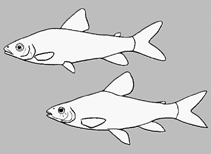
Raios dorsais (total) : 12; Raios anais : 10; Vértebras: 37. Leporinus torrenticola can be diagnosed from all other species of anostomids except Hypomasticus julii, H. megalepis, H. pachycheilus, Leporinus gomesi, L. granti, L. multimaculatus, L. nijsseni, and L. santosi by the possessing one dark blotch on midline of anterior portion of the flank (between opercle and pelvic-fin origin) surrounded by five to seven dark blotches (vs. anterior portion of flank with dark longitudinal stripes, or with dark transversal bars, or with dark blotches not forming the aforementioned pattern). Leporinus torrenticola differs from Hypomasticus julii, H. pachycheilus, Leporinus gomesi, L. granti, L. nijsseni, and L. santosi, by possessing three teeth on premaxilla (vs. four), and subinferior mouth (vs. inferior in Hypomasticus julii and H. pachycheilus, and terminal in Leporinus gomesi, L. granti, L. nijsseni, and L. santosi); and from H. megalepis by having 37-40 lateral-line scales (vs. 33 -35), and from L. multimaculatus by having 16 scale rows around caudal peduncle (vs. 12) (Ref. 117595).
Body shape (shape guide): fusiform / normal.
Prefers to inhabit moderate to fast flowing waters of the rapids of the rio Xingu and rio Iriri, where it is often collected alongside specimens of Hypomasticus julii. Considered omnivorous, feeding mainly on aquatic insects, filamentous algae and Podostemaceae (Ref. 117595).
Ciclo de vida ou comportamento de acasalamento
Maturidade | Reprodução | Desova | Ovos | Fecundidade | Larvas
Birindelli, J.O., T.F. Teixeira and H.A. Britski, 2016. Two new species of Leporinus Agassiz, 1929 (Characiformes: Anostomidae) from tributaries of the lower Amazon basin in Brazil. Zootaxa 4178(1):97-115. (Ref. 117595)
Status na Lista Vermelha da UICN (Ref. 130435: Version 2025-1)
Ameaça para os humanos
Harmless
Uso pelos humanos
Ferramentas
Relatórios especiais
Baixar XML
Fontes da internet
Estimates based on models
Índice de diversidade filogenética (Ref.
82804): PD
50 = 0.5000 [Uniqueness, from 0.5 = low to 2.0 = high].
Bayesian length-weight: a=0.00955 (0.00573 - 0.01590), b=3.05 (2.91 - 3.19), in cm total length, based on LWR estimates for this species & Genus-body shape (Ref.
93245).
Nível Trófico (Ref.
69278): 2.5 ±0.1 se; based on size and trophs of closest relatives
Resiliência (Ref.
120179): Elevada, tempo mínimo de duplicação da população menor que 15 meses (Preliminary K or Fecundity.).
Fishing Vulnerability (Ref.
59153): Low vulnerability (10 of 100).
🛈