



Galaxias tantangara Raadik, 2014
Stocky Galaxias
Envoyez vos Photos et vidéos
Images Google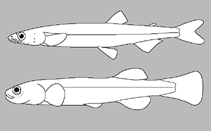 No image available for this species;
drawing shows typical species in Galaxiidae.
Images Google
drawing shows typical species in Galaxiidae.
Classification / Noms Noms communs | Synonymes | Catalog of Fishes(Genre, Espèce) | ITIS | CoL | WoRMS | Cloffa
> Galaxiiformes (Southern smelts) > Galaxiidae (Galaxiids) > Galaxiinae
Etymology: Galaxias: Greek, galaxias, ou = a kind of fish (Ref. 45335); tantangara: Named fro its type locality, a small alpine stream, a tributary of the upper Murrumbidgee River draining from Mount Tantangara; noun in apposition.
Etymology: Galaxias: Greek, galaxias, ou = a kind of fish (Ref. 45335); tantangara: Named fro its type locality, a small alpine stream, a tributary of the upper Murrumbidgee River draining from Mount Tantangara; noun in apposition.
Environnement : milieu / zone climatique / profondeur / gamme de distribution Écologie
; eau douce benthopélagique; non migrateur; profondeur 0 - 1 m (Ref. 98815). Subtropical
Distribution Territoires | Zones FAO | Écosystèmes | Occurrences | Carte par point | Introductions | Faunafri
Oceania: Australia.
Taille / Poids / Âge
Maturité: Lm ? range ? - ? cm
Max length : 10.3 cm FL mâle / non sexé; (Ref. 98815); poids max. publié: 13.00 g (Ref. 98815)
Max length : 10.3 cm FL mâle / non sexé; (Ref. 98815); poids max. publié: 13.00 g (Ref. 98815)
Description synthétique Clés d'identification | Morphologie | Morphométrie
Rayons mous dorsaux (Total) : 8 - 11; Rayons mous anaux: 10 - 12; Vertèbres: 53 - 56. This species is distinguished from its congeners within the Galaxias olidus complex by the following characters: low mean total gill raker count of 10; body stocky and deep through vent and pectoral fin base (12.6-15.6 and 14.9-17.9 % SL); deep caudal peduncle (8.5-10.2 % SL); head obtuse to slightly bulbous in lateral profile and moderately deep (41.4-48.2 % HL) but wide (63.4-72.8 % HL); gape wide (40.2-51.0 % HL and 59.6-72.2 % HW); eye profiles often not visible laterally from ventral view; nostrils are short, not visible from ventral view; caudal fin weakly emarginate to truncate, about as long or slightly longer than caudal peduncle, vertical width of expanded rays usually equal to body depth through the pectoral fin base; caudal peduncle flanges are long, reaching more than half distance to anal fin base; anal fin long (16.3 % SL); most posterior extent of mouth 0.8 eye diameter below ventral margin of eye; dorsal midline is usually flattened anteriorly from above or slightly posterior to pectoral fin bases; no raised lamellae from ventral surface of rays of paired fins; anal fin origin usually under 0.73 distance posteriorly along dorsal fin base; pyloric caeca usually 2, occasionally 1, relatively thin and long (4.7 % SL); gill rakers are short to very short; no distinct black bars along lateral line (Ref. 98815).
Cross section: oval.
Cross section: oval.
Facultative air-breathing in the genus (Ref. 126274); A freshwater fish that is unable to undertake diadromous migrations. Recorded from a small (0.8 m average width and 0.1 m in average depth), cold, clear and fast flowing alpine creek, flowing through an open forest of Eucalyptus, low shrubs and tussock grass, and which is often snow covered during winter. Flow consisted predominantly of riffle and glide, with smaller amounts of cascades. Substrate composed of bedrock, boulder, and cobble, with smaller amounts of pebble and gravel, and sections of silt. Instream cover provided mainly by rock and by bank and vegetation overhang, and pools averaged 0.3 m in depth. Recorded at a density of 1.8 fish/m2 and the only native fish so far recorded from within its range (Ref. 98815).
Cycle de vie et comportement reproducteur Maturité | Reproduction | Frai | Œufs | Fécondité | Larves
Référence principale
Téléchargez vos références | Références | Coordinateur : Berra, Tim M. | Collaborateurs
Raadik, T.A., 2014. Fifteen from one: a revision of the Galaxias olidus Günther, 1866 complex (Teleostei, Galaxiidae) in south-eastern Australia recognises three previously described taxa and describes 12 new species. Zootaxa 3898(1):001-198. (Ref. 98815)
Statut dans la liste rouge de l'IUCN (Ref. 130435: Version 2025-2 (Global))
Niveau de menace critique (CR) (B1ab(ii,iii,v)+2ab(ii,iii,v)); Date assessed: 13 February 2019
CITES
Not Evaluated
Menace pour l'homme
Harmless
Utilisations par l'homme
FAO - Publication: search | FishSource |
Plus d'informations
Écologie trophique
Aliments (proies)
Composition du régime alimentaire
Consommation alimentaire
Rations alimentaires
Prédateurs
Aliments (proies)
Composition du régime alimentaire
Consommation alimentaire
Rations alimentaires
Prédateurs
Écologie
Écologie
Écologie
Dynamique des populations
Paramètres de croissance
Âges / tailles maximales
Longueur-poids rel.
Rel. longueur-longueur.
Fréquences de longueurs
Conversion de masse
Recrutement
Abondance
Paramètres de croissance
Âges / tailles maximales
Longueur-poids rel.
Rel. longueur-longueur.
Fréquences de longueurs
Conversion de masse
Recrutement
Abondance
Cycle de vie
Reproduction
Maturité
Maturité/épines rel.
Fécondité
Frai
Agrégats de frai
Œufs
Développement de l'œuf
Larves
Dynamique des populations larvaires
Reproduction
Maturité
Maturité/épines rel.
Fécondité
Frai
Agrégats de frai
Œufs
Développement de l'œuf
Larves
Dynamique des populations larvaires
Anatomie
Surface branchiale
Cerveau
Otolithe
Surface branchiale
Cerveau
Otolithe
Physiologie
Composition corporelle
Nutriments
Consommation d'oxygène
Type de natation
Vitesse de nage
Pigments visuels
Son de poisson
Maladies et parasites
Toxicité (CL50)
Composition corporelle
Nutriments
Consommation d'oxygène
Type de natation
Vitesse de nage
Pigments visuels
Son de poisson
Maladies et parasites
Toxicité (CL50)
Génétique
génôme
Génétique
Hétérozygotie
Héritabilité
Diversité génétique
génôme
Génétique
Hétérozygotie
Héritabilité
Diversité génétique
Liées à l'homme
Systèmes d'aquaculture
Profils d'aquaculture
Souches
Cas de ciguatera
Timbres, pièces de monnaie, divers
Systèmes d'aquaculture
Profils d'aquaculture
Souches
Cas de ciguatera
Timbres, pièces de monnaie, divers
Outils
E-book | Guide de terrain | Générateur de fréquences de longueur | Outil de dynamique de population | Carte par point |
Capture-MSY |
Articles particuliers
Télécharger en XML
Sources Internet
AFORO (otoliths) | Aquatic Commons | BHL | Cloffa | Websites from users | FishWatcher | CISTI | Catalog of Fishes: Genre, Espèce | DiscoverLife | ECOTOX | FAO - Publication: search | Faunafri | Fishipedia | Fishtrace | GloBI | Google Books | Google Scholar | Google | IGFA World Record | OneZoom | Open Tree of Life | Otolith Atlas of Taiwan Fishes | PubMed | Reef Life Survey | Socotra Atlas | TreeBase | Arbre de Vie | Wikipedia: aller à, chercher | World Records Freshwater Fishing | Zoobank | Zoological Record
Estimations basées sur des modèles
Indice de diversité phylogénétique (Réf. 82804): PD50 = 0.5000 [Uniqueness, from 0.5 = low to 2.0 = high].
Bayesian length-weight: a=0.00490 (0.00206 - 0.01165), b=3.12 (2.91 - 3.33), in cm total length, based on LWR estimates for this (Sub)family-body shape (Ref. 93245).
Niveau trophique (Réf. 69278): 3.2 ±0.4 se; based on size and trophs of closest relatives
Résilience (Réf. 120179): Haut, temps minimum de doublement de population inférieur à 15 mois (Preliminary K or Fecundity.).