



Galaxias tantangara Raadik, 2014
Stocky Galaxias
Sube tu fotos y Vídeos
Google image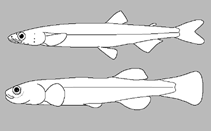 No image available for this species;
drawing shows typical species in Galaxiidae.
Google image
drawing shows typical species in Galaxiidae.
Clasificación / Nombres Nombres comunes | Sinónimos | Catalog of Fishes(Género, Especie) | ITIS | CoL | WoRMS | Cloffa
> Galaxiiformes (Southern smelts) > Galaxiidae (Galaxiids) > Galaxiinae
Etymology: Galaxias: Greek, galaxias, ou = a kind of fish (Ref. 45335); tantangara: Named fro its type locality, a small alpine stream, a tributary of the upper Murrumbidgee River draining from Mount Tantangara; noun in apposition.
Etymology: Galaxias: Greek, galaxias, ou = a kind of fish (Ref. 45335); tantangara: Named fro its type locality, a small alpine stream, a tributary of the upper Murrumbidgee River draining from Mount Tantangara; noun in apposition.
Entorno: milieu / zona climática / rango de profundidad / gama de distribución Ecología
; agua dulce bentopelágico; no migratorio; rango de profundidad 0 - 1 m (Ref. 98815). Subtropical
Distribución Territorios | Áreas FAO | Ecosistemas | Ocurrencias, apariciones | Mapa de puntos | Introducciones | Faunafri
Oceania: Australia.
Tamaño / Peso / Edad
Madurez: Lm ? range ? - ? cm
Max length : 10.3 cm FL macho / no sexado; (Ref. 98815); peso máximo publicado: 13.00 g (Ref. 98815)
Max length : 10.3 cm FL macho / no sexado; (Ref. 98815); peso máximo publicado: 13.00 g (Ref. 98815)
Descripción breve Claves de identificación | Morfología | Morfometría
Radios blandos dorsales (total) : 8 - 11; Radios blandos anales: 10 - 12; Vértebra: 53 - 56. This species is distinguished from its congeners within the Galaxias olidus complex by the following characters: low mean total gill raker count of 10; body stocky and deep through vent and pectoral fin base (12.6-15.6 and 14.9-17.9 % SL); deep caudal peduncle (8.5-10.2 % SL); head obtuse to slightly bulbous in lateral profile and moderately deep (41.4-48.2 % HL) but wide (63.4-72.8 % HL); gape wide (40.2-51.0 % HL and 59.6-72.2 % HW); eye profiles often not visible laterally from ventral view; nostrils are short, not visible from ventral view; caudal fin weakly emarginate to truncate, about as long or slightly longer than caudal peduncle, vertical width of expanded rays usually equal to body depth through the pectoral fin base; caudal peduncle flanges are long, reaching more than half distance to anal fin base; anal fin long (16.3 % SL); most posterior extent of mouth 0.8 eye diameter below ventral margin of eye; dorsal midline is usually flattened anteriorly from above or slightly posterior to pectoral fin bases; no raised lamellae from ventral surface of rays of paired fins; anal fin origin usually under 0.73 distance posteriorly along dorsal fin base; pyloric caeca usually 2, occasionally 1, relatively thin and long (4.7 % SL); gill rakers are short to very short; no distinct black bars along lateral line (Ref. 98815).
Cross section: oval.
Cross section: oval.
Facultative air-breathing in the genus (Ref. 126274); A freshwater fish that is unable to undertake diadromous migrations. Recorded from a small (0.8 m average width and 0.1 m in average depth), cold, clear and fast flowing alpine creek, flowing through an open forest of Eucalyptus, low shrubs and tussock grass, and which is often snow covered during winter. Flow consisted predominantly of riffle and glide, with smaller amounts of cascades. Substrate composed of bedrock, boulder, and cobble, with smaller amounts of pebble and gravel, and sections of silt. Instream cover provided mainly by rock and by bank and vegetation overhang, and pools averaged 0.3 m in depth. Recorded at a density of 1.8 fish/m2 and the only native fish so far recorded from within its range (Ref. 98815).
Ciclo vital y comportamiento de apareamiento Madurez | Reproducción | Puesta | Huevos | Fecundidad | Larva
Referencia principal
Suba sus referencias | Referencias | Coordinador : Berra, Tim M. | Colaboradores
Raadik, T.A., 2014. Fifteen from one: a revision of the Galaxias olidus Günther, 1866 complex (Teleostei, Galaxiidae) in south-eastern Australia recognises three previously described taxa and describes 12 new species. Zootaxa 3898(1):001-198. (Ref. 98815)
Situación en la Lista Roja de la UICN (Ref. 130435: Version 2025-2 (Global))
Critically Endangered (CR) (B1ab(ii,iii,v)+2ab(ii,iii,v)); Date assessed: 13 February 2019
CITES
Not Evaluated
Amenaza para el ser humano
Harmless
Usos humanos
FAO - Publication: search | FishSource |
Más información
Ecología Trófica
Alimentos (presas)
Composición de la dieta
consumo de alimento
Raciones de comida
Despredadores
Alimentos (presas)
Composición de la dieta
consumo de alimento
Raciones de comida
Despredadores
Ecología
Ecología
Ecología
Dinámica de la población
Coeficiente del crecimiento para
Edades / tallas máximas
Longitud-peso rel.
Longitud-longitud rel.
Longitud-frecuencias
Conversión de masas
Reclutamiento
Abundancia
Coeficiente del crecimiento para
Edades / tallas máximas
Longitud-peso rel.
Longitud-longitud rel.
Longitud-frecuencias
Conversión de masas
Reclutamiento
Abundancia
Ciclo de vida
Reproducción
Madurez
Madurez/Gills rel.
Fecundidad
Puesta
Agregaciones de desove
Huevos
Desarrollo de los huevos
Larva
Dinámica larvaria
Reproducción
Madurez
Madurez/Gills rel.
Fecundidad
Puesta
Agregaciones de desove
Huevos
Desarrollo de los huevos
Larva
Dinámica larvaria
Distribución
Territorios
Áreas FAO
Ecosistemas
Ocurrencias, apariciones
Introducciones
BRUVS - Vídeos
Territorios
Áreas FAO
Ecosistemas
Ocurrencias, apariciones
Introducciones
BRUVS - Vídeos
Anatomía
Superficie branquial
Cerebro
Otolito
Superficie branquial
Cerebro
Otolito
Fisiología
Composición corporal
Nutrientes
Consumo del oxígeno
Tipo de natación
Velocidad de natación
Pigmentos visuales
Sonido de peces
Enfermedades y parásitos
Toxicidad (CL50)
Composición corporal
Nutrientes
Consumo del oxígeno
Tipo de natación
Velocidad de natación
Pigmentos visuales
Sonido de peces
Enfermedades y parásitos
Toxicidad (CL50)
Genética
Genoma
Genética
Heterocigosidad
heritabilidad
Diversidad genética
Genoma
Genética
Heterocigosidad
heritabilidad
Diversidad genética
Relacionados con el ser humano
Sistemas de acuicultura
Perfiles de acuicultura
Razas
Ciguatera cases
Sellos, monedas, varios
Sistemas de acuicultura
Perfiles de acuicultura
Razas
Ciguatera cases
Sellos, monedas, varios
Herramientas
Libro electrónico | Guía de campo | Asistente para frecuencias de tallas | Herramienta de ciclo de vida | Mapa de puntos |
Catch-MSY |
Informes especiales
Comprobar el mantenimiento del acuario | Buscar fichas sobre especies | Consulte las hojas informativas sobre acuicultura
Descargar XML
Fuentes de Internet
AFORO (otoliths) | Aquatic Commons | BHL | Cloffa | Websites from users | Check FishWatcher | CISTI | Catalog of Fishes: Género, Especie | DiscoverLife | ECOTOX | FAO - Publication: search | Faunafri | Fishipedia | Fishtrace | GloBI | Google Books | Google Scholar | Google | IGFA World Record | OneZoom | Open Tree of Life | Otolith Atlas of Taiwan Fishes | PubMed | Reef Life Survey | Socotra Atlas | TreeBase | Árbol de la vida | Wikipedia: Go, búsqueda | World Records Freshwater Fishing | Zoobank | Expediente Zoológico
Estimaciones basadas en modelos
Índice de diversidad filogenética (Referencia 82804): PD50 = 0.5000 [Uniqueness, from 0.5 = low to 2.0 = high].
Bayesian length-weight: a=0.00490 (0.00206 - 0.01165), b=3.12 (2.91 - 3.33), in cm total length, based on LWR estimates for this (Sub)family-body shape (Ref. 93245).
Nivel trófico (Referencia 69278): 3.2 ±0.4 se; based on size and trophs of closest relatives
Resiliencia (Referencia 120179): Alto, población duplicada en un tiempo mínimo inferior a 15 meses (Preliminary K or Fecundity.).