



Beobachtung melden im Fish Watcher
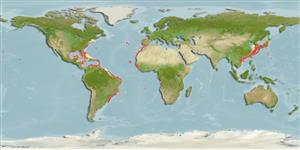
| Native range | All suitable habitat | Point map | Year 2050 |
|
| This map was computer-generated and has not yet been reviewed. |
| Isistius plutodus AquaMaps Data sources: GBIF OBIS |
Hochladen Photos und videos
Bilder | Google Bild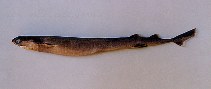 Isistius plutodus
Juvenile Photo von Sazima, I.
Bilder | Google Bild
Juvenile Photo von Sazima, I.
Klassifizierung / Names Namen | Synonyme | Catalog of Fishes(Gattung, Arten) | ITIS | CoL | WoRMS | Cloffa
Elasmobranchii (Haie und Rochen) (sharks and rays) > Squaliformes (Sleeper and dogfish sharks) > Dalatiidae (Sleeper sharks)
Etymology: Isistius: Etymology not explained, probably iso-, from isos (Gr.), equal; istius, from histion (Gr.), sail (i.e., dorsal fin), referring to its two similarly shaped and sized (and posterior) dorsal fins, a character Gill used to diagnose genus. José I. Castro, The Sharks of North America (Oxford University Press, 2011), suggests name may allude to the Egyptian goddess Isis, represented in statuary with her head veiled, or to the dark collar encircling throat of I. brasiliensis, “which could also suggest a veil over the head” (p. 145). This interpretation is rejected by the fact that Gill often used “istius” in the names of several genera distinguished (at least in part) by their dorsal fins (Acanthistius, Brachyistius, Caristius, Dichistius, Goniistius, Iniistius, Micromesistius, Nematistius) (See ETYFish); plutodus: ploutos (Gr.), wealth or abundance; odon (Gr.), tooth, referring to larger size of lower jaw teeth compared with congeners (See ETYFish).
Etymology: Isistius: Etymology not explained, probably iso-, from isos (Gr.), equal; istius, from histion (Gr.), sail (i.e., dorsal fin), referring to its two similarly shaped and sized (and posterior) dorsal fins, a character Gill used to diagnose genus. José I. Castro, The Sharks of North America (Oxford University Press, 2011), suggests name may allude to the Egyptian goddess Isis, represented in statuary with her head veiled, or to the dark collar encircling throat of I. brasiliensis, “which could also suggest a veil over the head” (p. 145). This interpretation is rejected by the fact that Gill often used “istius” in the names of several genera distinguished (at least in part) by their dorsal fins (Acanthistius, Brachyistius, Caristius, Dichistius, Goniistius, Iniistius, Micromesistius, Nematistius) (See ETYFish); plutodus: ploutos (Gr.), wealth or abundance; odon (Gr.), tooth, referring to larger size of lower jaw teeth compared with congeners (See ETYFish).
Umwelt: Milieu / Klimazone / Tiefenbereich / Verbreitungsgebiet Ökologie
seewasser pelagic-neritic; tiefenbereich 60 - 200 m (Ref. 52580). Subtropical; 44°N - 33°S (Ref. 52580)
Verbreitung Territorien | FAO Gebiete | Ökosysteme | Vorkommen | Punkt Karte | Einführungen | Faunafri
Atlantic: off Alabama, USA and the Gulf of Mexico; including Brazil and West Sahara and off Azores. Northwest Pacific: off Okinawa, Japan and Australia (NSW). A very rare species (Ref. 52580).
Größe / Gewicht / Alter
Geschlechtsreife: Lm ? range ? - ? cm
Max length : 42.3 cm TL (female)
Max length : 42.3 cm TL (female)
Kurzbeschreibung Bestimmungsschlüssel | Morphologie | Morphometrie
Rückenflossenstacheln (insgesamt) : 0. The largetooth cookiecutter shark Isistius plutodus has no collar marking around throat, a small asymmetrical caudal fin with a short ventral lobe less than half the length of dorsal caudal margin, bigger mouth and gigantic lower teeth (proportionately the largest in any living shark) in 19 rows (upper teeth = 29 rows). Eyes set well forward on head, with extensive anterior binocular field. Pectoral fins rounded, pelvic fins smaller than dorsal fins.
As with the other member of the genus Isistius, it has a characteristic small cigar-shaped body with two small close-set spineless dorsal fins far posterior on back, no anal fin, huge, triangular-cusped teeth without blades, short, bulbous snout and a unique suctorial lips (Ref. 247).
Body shape (shape guide): elongated.
Body shape (shape guide): elongated.
A very rare species known only from few localities in epipelagic waters. Apparently feeds on small epibenthic and epipelagic invertebrates and fish. Its powerful jaws, big mouth and enormous lower teeth enable it to bite off large portion of its prey in one sweeping motion. A facultative ectoparasite evidenced by its suctorial lips and feeding apparatus. It has extremely short snout and anteriorly positioned eyes which allows for binocular vision (Ref. 247). Caught by mid-water trawl (Ref. 55584). Ovoviviparous (Ref. 205). Has large oily liver which helps it to become neutrally buoyant (`hepatic float').
Lebenszyklus und Paarungsverhalten Geschlechtsreife | Fortpflanzung | Ablaichen | Eier | Fruchtbarkeit | Larven
Distinct pairing with embrace (Ref. 205).
Hauptreferenz
Laden Sie Ihre Referenzen hoch | Referenzen | Koordinator : Compagno, Leonard J.V. | Partner
Compagno, L.J.V., 1984. FAO Species Catalogue. Vol. 4. Sharks of the world. An annotated and illustrated catalogue of shark species known to date. Part 1 - Hexanchiformes to Lamniformes. FAO Fish. Synop. 125(4/1):1-249. Rome, FAO. (Ref. 247)
IUCN Rote Liste Status (Ref. 130435: Version 2025-2 (Global))
nicht bedroht (LC) ; Date assessed: 15 May 2024
CITES
Not Evaluated
Bedrohung für Menschen
Harmless
Nutzung durch Menschen
Fischereien: nicht kommerziell
FAO - Publication: search | FishSource |
Mehr Information
Trophische Ökologie
Lebensmittel (Beutetiere)
Nahrungszusammensetzung
Nahrungsaufnahme
Lebensmittelrationen
Räuber
Lebensmittel (Beutetiere)
Nahrungszusammensetzung
Nahrungsaufnahme
Lebensmittelrationen
Räuber
Populationsdynamik
Wachstumsparameter
Max. Alter/Größen
Länge-Gewicht-Rel.
Länge-Länge-Verhältnis.
Längenhäufigkeiten
Massenkonvertierung
Rekrutierung
Dichte
Wachstumsparameter
Max. Alter/Größen
Länge-Gewicht-Rel.
Länge-Länge-Verhältnis.
Längenhäufigkeiten
Massenkonvertierung
Rekrutierung
Dichte
Lebenszyklus
Fortpflanzung
Geschlechtsreife
Reifung/Kiemen rel.
Fruchtbarkeit
Ablaichen
Laichaggregationen
Eier
Eientwicklung
Larven
Larven Pop.Dyn.
Fortpflanzung
Geschlechtsreife
Reifung/Kiemen rel.
Fruchtbarkeit
Ablaichen
Laichaggregationen
Eier
Eientwicklung
Larven
Larven Pop.Dyn.
Anatomie
Kiemenoberfläche
Gehirn
Otolith
Kiemenoberfläche
Gehirn
Otolith
Physiologie
Körperliche Zusammensetzung
Nährstoffe
Sauerstoffverbrauch
Schwimmart
Schwimmgeschwindigkeit
Visuelle Pigmente
Fischgeräusche
Krankheiten und Parasiten
Toxizität (LC50s)
Körperliche Zusammensetzung
Nährstoffe
Sauerstoffverbrauch
Schwimmart
Schwimmgeschwindigkeit
Visuelle Pigmente
Fischgeräusche
Krankheiten und Parasiten
Toxizität (LC50s)
Genetik
Genom
Genetik
Heterozygotie
Vererbbarkeit
Genetische Vielfalt
Genom
Genetik
Heterozygotie
Vererbbarkeit
Genetische Vielfalt
Menschenbezogen
Aquakultur-Systeme
Aquakultur Profile
Zuchtlinien
Ciguatera-Fälle
Briefmarken, Münzen, Verschiedenes.
Aquakultur-Systeme
Aquakultur Profile
Zuchtlinien
Ciguatera-Fälle
Briefmarken, Münzen, Verschiedenes.
Tools
E-Book | Feldführer | Bestimmungsschlüssel | Längenhäufigkeits Tool | Lebensdaten Tool | Punkt Karte |
Catch-MSY |
Zusatzinformationen
Download XML
Zusammenfassung | Punktdaten | Namen | Photos
Internet Quellen
AFORO (otoliths) | Aquatic Commons | BHL | Cloffa | Websites from users | FishWatcher Einträge suchen | CISTI | Catalog of Fishes: Gattung, Arten | DiscoverLife | ECOTOX | FAO - Publication: search | Faunafri | Fishipedia | Fishtrace | GloBI | Google Books | Google Scholar | Google | IGFA World Record | OneZoom | Open Tree of Life | Otolith Atlas of Taiwan Fishes | PubMed | Reef Life Survey | Socotra Atlas | TreeBase | Tree of Life | Wikipedia: Gehe zu, Suchen | World Records Freshwater Fishing | Zoobank | Zoologischer Rekord
Schätzungen auf der Grundlage von Modellen
Bevorzugte Temperatur (Ref. 123201): 14.1 - 25.1, mean 18.8 °C (based on 225 cells).
Phylogenetischer Diversitätsindex (Ref. 82804): PD50 = 0.7510 [Uniqueness, from 0.5 = low to 2.0 = high].
Bayesian length-weight: a=0.00263 (0.00139 - 0.00499), b=3.10 (2.92 - 3.28), in cm total length, based on LWR estimates for this species & (Sub)family-body (Ref. 93245).
Trophische Ebene (Ref. 69278): 4.2 ±0.4 se; based on size and trophs of closest relatives
Widerstandsfähigkeit (Ref. 120179): niedrig, Verdopplung der Population dauert 4,5 - 14 Jahre. (Fec assumed to be <100).