



Bathyraja microtrachys (Osburn & Nichols, 1916)
Fine-spined skate
muatnaik fotos/gambar dan video
imej Google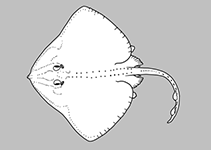 No image available for this species;
drawing shows typical species in Arhynchobatidae.
imej Google
drawing shows typical species in Arhynchobatidae.
klasifikasi / Nama Nama-nama umum | Sinonim (persamaan) | Catalog of Fishes(Marga, Jenis) | ITIS | CoL | WoRMS | Cloffa
Ikan bertulang rawan (sharks and rays) > Rajiformes (Skates and rays) > Arhynchobatidae (Softnose skates)
Etymology: Bathyraja: Greek, bathys = deep + Latin, raja, -ae = a ray (Raja sp) (Ref. 45335); microtrachys: Name from Latin 'micro' meaning small, and 'trachys' meaning spine, referring to the uniform fine prickles covering the dorsal surface.
Etymology: Bathyraja: Greek, bathys = deep + Latin, raja, -ae = a ray (Raja sp) (Ref. 45335); microtrachys: Name from Latin 'micro' meaning small, and 'trachys' meaning spine, referring to the uniform fine prickles covering the dorsal surface.
Lingkungan: lingkungan / zona iklim / kisaran kedalaman / jangkauan distribusi Ekologi
laut batidemersal; kisaran kedalaman 1995 - 3000 m (Ref. 126515), usually 2000 - 3000 m (Ref. 126515). Temperate
Penyebaran Wilayah | Daerah-daerah FAO | Ekosistem | Kemunculan | peta titik | Introduksi | Faunafri
Northeastern Pacific: from British Columbia, south to the Gulf of California
Ukuran / Berat / umur
deskripsi pendek Kunci identifiaksi (pengenalan) | Morfologi | Morfometrik
This moderate sized, rhomboidal skates (91.0 cm TL), with disc length (41.5-51.1% TL), head moderately long (18.3-21.2% TL), internarial distance large (7.3-8.7% TL) is distinguished by the following: claspers short and robust, tip rounded, with very large pseudosiphon and a long, slender pseudorhipidion nearly reaching the tip, V-shaped cleft, no projection; teeth in 23-30 rows on upper jaw and 11-22 rows on lower jaw; pectoral radials 61-74; pelvic fins 14; total vertebrae 130; its dorsal surface evenly covered in fine prickles; thorns on dorsal surface, males with alar thorns, but without malar thorns, middorsal, nuchal, and scapular thorns absent, tail thorns high in number (19-26); interdorsal thorns weak to obsolete (0-1). Colouration: dorsal uniformly brown, usually darker at the margins while ventral is white, brown pectorals and pelvic fins (Ref. 126515).
Cross section: flattened.
Cross section: flattened.
This species inhabits perhaps the deepest waters and prefer low temperature, high oxygen environments compared to its congeners. Little is known about the diet of this species, except noted to consume deep-water shrimps. Based on materials examined, size at maturity for males is at least 64-75 cm TL and 60-70 cm TL for females; with reported size at birth to be about 17 cm TL. Egg cases are small (7.9-8.1 cm TL), dark golden brown in colour, coarsely striated with irregular rasp-like denticles, making it rough to the touch. Horns at the corners with the anterior ones robust at base, but flatten towards tips and the tips curve dorsally and back towards the egg case (Ref. 126515).
Siklus hidup dan perilaku kawin Kematangan | Reproduksi, perkembang biakan | Pemijahan | telur-telur | Fekunditas | Larva
rujukan utama
Unggah referensi Anda | Acuan | Koordinator : McEachran, John | mitra
Knuckey, J.D.S. and D.A. Ebert, 2022. A taxonomic revision of Northeast Pacific softnose skates (Rajiformes: Arhynchobatidae: Bathyraja Ishiyama). Zootaxa 5142(1):1-89. (Ref. 126515)
Status IUCN Red List (Ref. 130435: Version 2025-2 (Global))
kurang bimbang (LC) ; Date assessed: 16 January 2015
CITES
Not Evaluated
ancaman kepada manusia
Harmless
penggunaan manusia
Perikanan: tidak ada kepentingan
FAO - Publication: search | FishSource |
informasi lanjut
Ekologi trofik
Item makanan (mangsa)
Komposisi makanan
Konsumsi makanan
Ransum makanan
Pemangsa
Item makanan (mangsa)
Komposisi makanan
Konsumsi makanan
Ransum makanan
Pemangsa
Ekologi
Ekologi
Ekologi
Dinamika populasi
Parameter pertumbuhan
Maks. usia / ukuran
Panjang-berat rel.
Panjang-panjang rel.
ukuran frekuensi
Konversi massa
pemulihan
Kelimpahan
Parameter pertumbuhan
Maks. usia / ukuran
Panjang-berat rel.
Panjang-panjang rel.
ukuran frekuensi
Konversi massa
pemulihan
Kelimpahan
Siklus hidup
Reproduksi, perkembang biakan
Kematangan
Kedewasaan / insang rel.
Fekunditas
Pemijahan
Agregasi pemijahan
telur-telur
pekembangan telor
Larva
Dinamika larva
Reproduksi, perkembang biakan
Kematangan
Kedewasaan / insang rel.
Fekunditas
Pemijahan
Agregasi pemijahan
telur-telur
pekembangan telor
Larva
Dinamika larva
Anatomi
Area insang
Otak
Otolith
Area insang
Otak
Otolith
Fisiologi
Komposisi tubuh
Nutrisi
Konsumsi oksigen
Jenis renang
Kecepatan berenang
Pigmen visual
Suara ikan
Penyakit & Parasit
Toksisitas (LC50)
Komposisi tubuh
Nutrisi
Konsumsi oksigen
Jenis renang
Kecepatan berenang
Pigmen visual
Suara ikan
Penyakit & Parasit
Toksisitas (LC50)
Genetika
genom
Genetika
Heterozigositas
Diturunkan
Keanekaragaman Genetik
genom
Genetika
Heterozigositas
Diturunkan
Keanekaragaman Genetik
Yang berhubungan dengan manusia
Sistem akuakultur
profil budidaya air
Strain
Kasus Ciguatera
Perangko, koin, dll.
Sistem akuakultur
profil budidaya air
Strain
Kasus Ciguatera
Perangko, koin, dll.
Alat, peralatan
E-book | Penuntun lapangan | tanda freqkuenci panjang | peringkat sejarah hidup | peta titik |
Tangkap-MSY |
laporan khas
muat turun XML
Sumber internet
AFORO (otoliths) | Aquatic Commons | BHL | Cloffa | Websites from users | semak peneliti ikan | CISTI | Catalog of Fishes: Marga, Jenis | DiscoverLife | ECOTOX | FAO - Publication: search | Faunafri | Fishipedia | Fishtrace | GloBI | Google Books | Google Scholar | Google | IGFA World Record | OneZoom | Open Tree of Life | Otolith Atlas of Taiwan Fishes | PubMed | Reef Life Survey | Socotra Atlas | TreeBase | Tree of Life | Wikipedia: pergi, Cari | World Records Freshwater Fishing | Catatan Zoologi
Estimasi berdasarkan model
Indeks keanekaragaman filogenetik (Acuan 82804): PD50 = 0.5000 [Uniqueness, from 0.5 = low to 2.0 = high].
Bayesian length-weight: a=0.00562 (0.00296 - 0.01067), b=3.13 (2.97 - 3.29), in cm total length, based on LWR estimates for this Genus-body shape (Ref. 93245).
Tingkat Trofik (Acuan 69278): 3.9 ±0.7 se; based on size and trophs of closest relatives
Daya lenting (Acuan 120179): Rendah, Waktu penggandaan populasi minimum 4.5 - 14 tahun (Preliminary K or Fecundity.).