



Bathyraja microtrachys (Osburn & Nichols, 1916)
Fine-spined skate
Envoyez vos Photos et vidéos
Images Google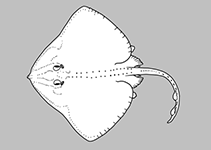 No image available for this species;
drawing shows typical species in Arhynchobatidae.
Images Google
drawing shows typical species in Arhynchobatidae.
Classification / Noms Noms communs | Synonymes | Catalog of Fishes(Genre, Espèce) | ITIS | CoL | WoRMS | Cloffa
Élasmobranches (requins et raies) (sharks and rays) > Rajiformes (Skates and rays) > Arhynchobatidae (Softnose skates)
Etymology: Bathyraja: Greek, bathys = deep + Latin, raja, -ae = a ray (Raja sp) (Ref. 45335); microtrachys: Name from Latin 'micro' meaning small, and 'trachys' meaning spine, referring to the uniform fine prickles covering the dorsal surface.
Etymology: Bathyraja: Greek, bathys = deep + Latin, raja, -ae = a ray (Raja sp) (Ref. 45335); microtrachys: Name from Latin 'micro' meaning small, and 'trachys' meaning spine, referring to the uniform fine prickles covering the dorsal surface.
Environnement : milieu / zone climatique / profondeur / gamme de distribution Écologie
marin bathydémersal; profondeur 1995 - 3000 m (Ref. 126515), usually 2000 - 3000 m (Ref. 126515). Temperate
Distribution Territoires | Zones FAO | Écosystèmes | Occurrences | Carte par point | Introductions | Faunafri
Northeastern Pacific: from British Columbia, south to the Gulf of California
Taille / Poids / Âge
Description synthétique Clés d'identification | Morphologie | Morphométrie
This moderate sized, rhomboidal skates (91.0 cm TL), with disc length (41.5-51.1% TL), head moderately long (18.3-21.2% TL), internarial distance large (7.3-8.7% TL) is distinguished by the following: claspers short and robust, tip rounded, with very large pseudosiphon and a long, slender pseudorhipidion nearly reaching the tip, V-shaped cleft, no projection; teeth in 23-30 rows on upper jaw and 11-22 rows on lower jaw; pectoral radials 61-74; pelvic fins 14; total vertebrae 130; its dorsal surface evenly covered in fine prickles; thorns on dorsal surface, males with alar thorns, but without malar thorns, middorsal, nuchal, and scapular thorns absent, tail thorns high in number (19-26); interdorsal thorns weak to obsolete (0-1). Colouration: dorsal uniformly brown, usually darker at the margins while ventral is white, brown pectorals and pelvic fins (Ref. 126515).
Cross section: flattened.
Cross section: flattened.
This species inhabits perhaps the deepest waters and prefer low temperature, high oxygen environments compared to its congeners. Little is known about the diet of this species, except noted to consume deep-water shrimps. Based on materials examined, size at maturity for males is at least 64-75 cm TL and 60-70 cm TL for females; with reported size at birth to be about 17 cm TL. Egg cases are small (7.9-8.1 cm TL), dark golden brown in colour, coarsely striated with irregular rasp-like denticles, making it rough to the touch. Horns at the corners with the anterior ones robust at base, but flatten towards tips and the tips curve dorsally and back towards the egg case (Ref. 126515).
Cycle de vie et comportement reproducteur Maturité | Reproduction | Frai | Œufs | Fécondité | Larves
Référence principale
Téléchargez vos références | Références | Coordinateur : McEachran, John | Collaborateurs
Knuckey, J.D.S. and D.A. Ebert, 2022. A taxonomic revision of Northeast Pacific softnose skates (Rajiformes: Arhynchobatidae: Bathyraja Ishiyama). Zootaxa 5142(1):1-89. (Ref. 126515)
Statut dans la liste rouge de l'IUCN (Ref. 130435: Version 2025-2 (Global))
Préoccupation mineure (LC) ; Date assessed: 16 January 2015
CITES
Not Evaluated
Menace pour l'homme
Harmless
Utilisations par l'homme
Pêcheries: sans intérêt
FAO - Publication: search | FishSource |
Plus d'informations
Écologie trophique
Aliments (proies)
Composition du régime alimentaire
Consommation alimentaire
Rations alimentaires
Prédateurs
Aliments (proies)
Composition du régime alimentaire
Consommation alimentaire
Rations alimentaires
Prédateurs
Écologie
Écologie
Écologie
Dynamique des populations
Paramètres de croissance
Âges / tailles maximales
Longueur-poids rel.
Rel. longueur-longueur.
Fréquences de longueurs
Conversion de masse
Recrutement
Abondance
Paramètres de croissance
Âges / tailles maximales
Longueur-poids rel.
Rel. longueur-longueur.
Fréquences de longueurs
Conversion de masse
Recrutement
Abondance
Cycle de vie
Reproduction
Maturité
Maturité/épines rel.
Fécondité
Frai
Agrégats de frai
Œufs
Développement de l'œuf
Larves
Dynamique des populations larvaires
Reproduction
Maturité
Maturité/épines rel.
Fécondité
Frai
Agrégats de frai
Œufs
Développement de l'œuf
Larves
Dynamique des populations larvaires
Anatomie
Surface branchiale
Cerveau
Otolithe
Surface branchiale
Cerveau
Otolithe
Physiologie
Composition corporelle
Nutriments
Consommation d'oxygène
Type de natation
Vitesse de nage
Pigments visuels
Son de poisson
Maladies et parasites
Toxicité (CL50)
Composition corporelle
Nutriments
Consommation d'oxygène
Type de natation
Vitesse de nage
Pigments visuels
Son de poisson
Maladies et parasites
Toxicité (CL50)
Génétique
génôme
Génétique
Hétérozygotie
Héritabilité
Diversité génétique
génôme
Génétique
Hétérozygotie
Héritabilité
Diversité génétique
Liées à l'homme
Systèmes d'aquaculture
Profils d'aquaculture
Souches
Cas de ciguatera
Timbres, pièces de monnaie, divers
Systèmes d'aquaculture
Profils d'aquaculture
Souches
Cas de ciguatera
Timbres, pièces de monnaie, divers
Outils
E-book | Guide de terrain | Générateur de fréquences de longueur | Outil de dynamique de population | Carte par point |
Capture-MSY |
Articles particuliers
Télécharger en XML
Sources Internet
AFORO (otoliths) | Aquatic Commons | BHL | Cloffa | Websites from users | FishWatcher | CISTI | Catalog of Fishes: Genre, Espèce | DiscoverLife | ECOTOX | FAO - Publication: search | Faunafri | Fishipedia | Fishtrace | GloBI | Google Books | Google Scholar | Google | IGFA World Record | OneZoom | Open Tree of Life | Otolith Atlas of Taiwan Fishes | PubMed | Reef Life Survey | Socotra Atlas | TreeBase | Arbre de Vie | Wikipedia: aller à, chercher | World Records Freshwater Fishing | Zoological Record
Estimations basées sur des modèles
Indice de diversité phylogénétique (Réf. 82804): PD50 = 0.5000 [Uniqueness, from 0.5 = low to 2.0 = high].
Bayesian length-weight: a=0.00562 (0.00296 - 0.01067), b=3.13 (2.97 - 3.29), in cm total length, based on LWR estimates for this Genus-body shape (Ref. 93245).
Niveau trophique (Réf. 69278): 3.9 ±0.7 se; based on size and trophs of closest relatives
Résilience (Réf. 120179): Faible, temps minimum de doublement de population : 4,5 à 14 années (Preliminary K or Fecundity.).