



Heptapterus carmelitanorum Deprá, Aguilera, Faustino-Fuster, Katz & Azevedo-Santos, 2022
Carmelitano catfish
Envoyez vos Photos et vidéos
Images Google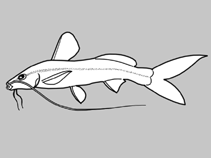 No image available for this species;
drawing shows typical species in Heptapteridae.
Images Google
drawing shows typical species in Heptapteridae.
Classification / Noms Noms communs | Synonymes | Catalog of Fishes(Genre, Espèce) | ITIS | CoL | WoRMS | Cloffa
> Siluriformes (Catfishes) > Heptapteridae (Three-barbeled catfishes)
Etymology: Heptapterus: Greek, epta = seven + Greek, pteron = wing, fin (Ref. 45335); carmelitanorum: Name from Carmelitanos (Portuguese), the local appellation of people born or living in Carmo do Rio Claro, Minas Gerais, Brazil (where the species was discovered) and especially in honor of Ana Maria Vilela Soares, José Cândido de Mello Carvalho, Moara Lemos, and Carlos Roberto Bueno Júnior, for their contributions to biological science: noun in apposition.
Etymology: Heptapterus: Greek, epta = seven + Greek, pteron = wing, fin (Ref. 45335); carmelitanorum: Name from Carmelitanos (Portuguese), the local appellation of people born or living in Carmo do Rio Claro, Minas Gerais, Brazil (where the species was discovered) and especially in honor of Ana Maria Vilela Soares, José Cândido de Mello Carvalho, Moara Lemos, and Carlos Roberto Bueno Júnior, for their contributions to biological science: noun in apposition.
Environnement : milieu / zone climatique / profondeur / gamme de distribution Écologie
marin démersal; profondeur 0 - 1 m (Ref. 127242). Tropical
Distribution Territoires | Zones FAO | Écosystèmes | Occurrences | Carte par point | Introductions | Faunafri
South America: Brazil.
Taille / Poids / Âge
Description synthétique Clés d'identification | Morphologie | Morphométrie
This species is distinguished from its congeners by the following characters: anal-fin insertion less than one eye diameter posterior to a vertical through the adipose-fin insertion (vs. more than one eye diameter posterior); differs from all congeners, except H. borodini, by having an isognathous mouth (vs. slightly to moderately retrognathous); differs from all congeners except H. borodini and H. hollandi, by the keel formed by ventral procurrent caudal-fin rays shallow, far from reaching anal-fin base (vs. keel formed by ventral procurrent caudal-fin rays deep, continuing almost to the anal-fin base, even though its anterior part is devoid of fin rays); differs from H. borodini and H. hollandi by having an almost elliptical caudal fin (vs. lanceolate in H. borodini, obliquely truncate to falcate in H. hollandi; length of its dorsal lobe 18.3-19.3% SL (vs. 24.4-43.3% SL in H. borodini); differs from congeners, except carnatus, mbya, qenqo, and some specimens of H. hollandi, by having inconspicuous dorsal bars (vs. conspicuous); differs borodini, carnatus, exilis, hollandi, mustelinus, ornaticeps, by having 14-15 anal-fin rays (vs. 10-12 in borodini, hollandi; 18-21 in H. carnatus; 16-19 in H. exilis; 18-23 in H. mustelinus; and 19 in H. ornaticeps); differs from H. exilis by having a complete lateral line (in adults), continuous to base of hypural plate (vs. incomplete, not reaching dorsal-fin insertion); differs further from H. hollandi by having i,6 dorsal-fin rays (vs. i,7) (Ref. 127242).
Cross section: oval.
Cross section: oval.
Collection area with the water extremely clear (small characids readily observed) and
well oxygenated. The stream was shallow (not exceeding 1 meter), and its bed was completely formed by rocks; light penetration was low during samplings. the reach, submerged tree roots and accumulated leaves and fruits (especially Fabaceae) formed some microhabitats for some species, notably Trichomycterus candidus and Cetopsorhamdia iheringi, Specimens of this species were captured in environments that combined rocks (generally juxtaposed) and a more turbulent flow. The species is apparently demersal upon observation sampling. The species was collected with C. iheringi, Hoplias malabaricus, Knodus moenkhausii, Odontostilbe weitzmani, Oligosarcus argenteus, Pareiorhina sp., Psalidodon sp., T. candidus, T. septemradiatus (Ref.
Cycle de vie et comportement reproducteur Maturité | Reproduction | Frai | Œufs | Fécondité | Larves
Référence principale
Téléchargez vos références | Références | Coordinateur : Bockmann, Flavio | Collaborateurs
Deprá, G. de Carvalho, G. Aguilera, D.R. Faustino-Fuster, A.M. Katz and V.M. Azevedo-Santos, 2022. Redefinition of Heptapterus (Heptapteridae) and description of Heptapterus carmelitanorum, a new species from the upper Paraná River basin in Brazil. Zoosyst. Evol. 98(2):327-343. (Ref. 127242)
CITES
Not Evaluated
Menace pour l'homme
Harmless
Utilisations par l'homme
FAO - Publication: search | FishSource |
Plus d'informations
Écologie trophique
Aliments (proies)
Composition du régime alimentaire
Consommation alimentaire
Rations alimentaires
Prédateurs
Aliments (proies)
Composition du régime alimentaire
Consommation alimentaire
Rations alimentaires
Prédateurs
Écologie
Écologie
Écologie
Dynamique des populations
Paramètres de croissance
Âges / tailles maximales
Longueur-poids rel.
Rel. longueur-longueur.
Fréquences de longueurs
Conversion de masse
Recrutement
Abondance
Paramètres de croissance
Âges / tailles maximales
Longueur-poids rel.
Rel. longueur-longueur.
Fréquences de longueurs
Conversion de masse
Recrutement
Abondance
Cycle de vie
Reproduction
Maturité
Maturité/épines rel.
Fécondité
Frai
Agrégats de frai
Œufs
Développement de l'œuf
Larves
Dynamique des populations larvaires
Reproduction
Maturité
Maturité/épines rel.
Fécondité
Frai
Agrégats de frai
Œufs
Développement de l'œuf
Larves
Dynamique des populations larvaires
Anatomie
Surface branchiale
Cerveau
Otolithe
Surface branchiale
Cerveau
Otolithe
Physiologie
Composition corporelle
Nutriments
Consommation d'oxygène
Type de natation
Vitesse de nage
Pigments visuels
Son de poisson
Maladies et parasites
Toxicité (CL50)
Composition corporelle
Nutriments
Consommation d'oxygène
Type de natation
Vitesse de nage
Pigments visuels
Son de poisson
Maladies et parasites
Toxicité (CL50)
Génétique
génôme
Génétique
Hétérozygotie
Héritabilité
Diversité génétique
génôme
Génétique
Hétérozygotie
Héritabilité
Diversité génétique
Liées à l'homme
Systèmes d'aquaculture
Profils d'aquaculture
Souches
Cas de ciguatera
Timbres, pièces de monnaie, divers
Systèmes d'aquaculture
Profils d'aquaculture
Souches
Cas de ciguatera
Timbres, pièces de monnaie, divers
Outils
E-book | Guide de terrain | Générateur de fréquences de longueur | Outil de dynamique de population | Carte par point |
Capture-MSY |
Articles particuliers
Télécharger en XML
Sources Internet
AFORO (otoliths) | Aquatic Commons | BHL | Cloffa | Websites from users | FishWatcher | CISTI | Catalog of Fishes: Genre, Espèce | DiscoverLife | ECOTOX | FAO - Publication: search | Faunafri | Fishipedia | Fishtrace | GloBI | Google Books | Google Scholar | Google | IGFA World Record | OneZoom | Open Tree of Life | Otolith Atlas of Taiwan Fishes | PubMed | Reef Life Survey | Socotra Atlas | TreeBase | Arbre de Vie | Wikipedia: aller à, chercher | World Records Freshwater Fishing | Zoobank | Zoological Record
Estimations basées sur des modèles
Indice de diversité phylogénétique (Réf. 82804): PD50 = 0.5002 [Uniqueness, from 0.5 = low to 2.0 = high].
Bayesian length-weight: a=0.00813 (0.00379 - 0.01743), b=2.97 (2.79 - 3.15), in cm total length, based on LWR estimates for this (Sub)family-body shape (Ref. 93245).
Niveau trophique (Réf. 69278): 3.5 ±0.4 se; based on size and trophs of closest relatives
Résilience (Réf. 120179): Faible, temps minimum de doublement de population : 4,5 à 14 années (Preliminary K or Fecundity.).