



Heptapterus carmelitanorum Deprá, Aguilera, Faustino-Fuster, Katz & Azevedo-Santos, 2022
Carmelitano catfish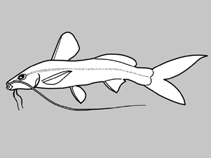
分類 / 名前 共通名の | 類義語 | Catalog of Fishes(部類, 種) | ITIS | CoL | WoRMS | Cloffa
> Siluriformes (Catfishes) > Heptapteridae (Three-barbeled catfishes)
Etymology: Heptapterus: Greek, epta = seven + Greek, pteron = wing, fin (Ref. 45335); carmelitanorum: Name from Carmelitanos (Portuguese), the local appellation of people born or living in Carmo do Rio Claro, Minas Gerais, Brazil (where the species was discovered) and especially in honor of Ana Maria Vilela Soares, José Cândido de Mello Carvalho, Moara Lemos, and Carlos Roberto Bueno Júnior, for their contributions to biological science: noun in apposition.
Etymology: Heptapterus: Greek, epta = seven + Greek, pteron = wing, fin (Ref. 45335); carmelitanorum: Name from Carmelitanos (Portuguese), the local appellation of people born or living in Carmo do Rio Claro, Minas Gerais, Brazil (where the species was discovered) and especially in honor of Ana Maria Vilela Soares, José Cândido de Mello Carvalho, Moara Lemos, and Carlos Roberto Bueno Júnior, for their contributions to biological science: noun in apposition.
環境:環境 / 気候帯 / 深さの範囲 / 分布範囲 生態学
海 底生の; 深さの範囲 0 - 1 m (Ref. 127242). Tropical
分布 領土 | 国連食糧農業機関の区域 | エコシステム | 事件 | 目的のマップ | 導入 | Faunafri
South America: Brazil.
サイズ / 重さ / 年齢
簡単な記述 検索表 | 形態学 | 形態計測学
This species is distinguished from its congeners by the following characters: anal-fin insertion less than one eye diameter posterior to a vertical through the adipose-fin insertion (vs. more than one eye diameter posterior); differs from all congeners, except H. borodini, by having an isognathous mouth (vs. slightly to moderately retrognathous); differs from all congeners except H. borodini and H. hollandi, by the keel formed by ventral procurrent caudal-fin rays shallow, far from reaching anal-fin base (vs. keel formed by ventral procurrent caudal-fin rays deep, continuing almost to the anal-fin base, even though its anterior part is devoid of fin rays); differs from H. borodini and H. hollandi by having an almost elliptical caudal fin (vs. lanceolate in H. borodini, obliquely truncate to falcate in H. hollandi; length of its dorsal lobe 18.3-19.3% SL (vs. 24.4-43.3% SL in H. borodini); differs from congeners, except carnatus, mbya, qenqo, and some specimens of H. hollandi, by having inconspicuous dorsal bars (vs. conspicuous); differs borodini, carnatus, exilis, hollandi, mustelinus, ornaticeps, by having 14-15 anal-fin rays (vs. 10-12 in borodini, hollandi; 18-21 in H. carnatus; 16-19 in H. exilis; 18-23 in H. mustelinus; and 19 in H. ornaticeps); differs from H. exilis by having a complete lateral line (in adults), continuous to base of hypural plate (vs. incomplete, not reaching dorsal-fin insertion); differs further from H. hollandi by having i,6 dorsal-fin rays (vs. i,7) (Ref. 127242).
Cross section: oval.
Cross section: oval.
Collection area with the water extremely clear (small characids readily observed) and
well oxygenated. The stream was shallow (not exceeding 1 meter), and its bed was completely formed by rocks; light penetration was low during samplings. the reach, submerged tree roots and accumulated leaves and fruits (especially Fabaceae) formed some microhabitats for some species, notably Trichomycterus candidus and Cetopsorhamdia iheringi, Specimens of this species were captured in environments that combined rocks (generally juxtaposed) and a more turbulent flow. The species is apparently demersal upon observation sampling. The species was collected with C. iheringi, Hoplias malabaricus, Knodus moenkhausii, Odontostilbe weitzmani, Oligosarcus argenteus, Pareiorhina sp., Psalidodon sp., T. candidus, T. septemradiatus (Ref.
ライフサイクルと交尾行動 成熟 | 繁殖 | 放精 | 卵 | 生産力 | 幼生
主な参考文献
参考文献のアップロード | 参考文献 | コーディネーター : Bockmann, Flavio | 協力者
Deprá, G. de Carvalho, G. Aguilera, D.R. Faustino-Fuster, A.M. Katz and V.M. Azevedo-Santos, 2022. Redefinition of Heptapterus (Heptapteridae) and description of Heptapterus carmelitanorum, a new species from the upper Paraná River basin in Brazil. Zoosyst. Evol. 98(2):327-343. (Ref. 127242)
CITES
Not Evaluated
人間に対する脅威
Harmless
人間の用途
FAO - Publication: search | FishSource |
より多くの情報
養殖生態
食料品(獲物)
餌の構成
摂食量
食料配給
捕食動物
食料品(獲物)
餌の構成
摂食量
食料配給
捕食動物
生態学
生態学
生態学
人口動態
成長のパラメーター
最大年齢/サイズ
長さ-重量比。
長短関係。
体長組成
質量変換
補充
豊度
成長のパラメーター
最大年齢/サイズ
長さ-重量比。
長短関係。
体長組成
質量変換
補充
豊度
ライフサイクル
繁殖
成熟
成熟度/エラ
生産力
放精
産卵群
卵
卵の開発
幼生
幼生の動力
繁殖
成熟
成熟度/エラ
生産力
放精
産卵群
卵
卵の開発
幼生
幼生の動力
解剖学
カマ
脳
オトリス
カマ
脳
オトリス
生理学
体組成
栄養素
酸素消費
水泳タイプ
泳ぐ速さ
視覚色素
フィッシュ・サウンド
病気と寄生虫
毒性(LC50)
体組成
栄養素
酸素消費
水泳タイプ
泳ぐ速さ
視覚色素
フィッシュ・サウンド
病気と寄生虫
毒性(LC50)
遺伝子の
ゲノム
遺伝子の
ヘテロ接合性
遺伝
遺伝的多様性
ゲノム
遺伝子の
ヘテロ接合性
遺伝
遺伝的多様性
用具
特記事項
XMLをダウンロードして下さい
インターネットの情報源
AFORO (otoliths) | Aquatic Commons | BHL | Cloffa | Websites from users | Check FishWatcher | CISTI | Catalog of Fishes: 部類, 種 | DiscoverLife | ECOTOX | FAO - Publication: search | Faunafri | Fishipedia | Fishtrace | GloBI | Google Books | Google Scholar | Google | IGFA World Record | OneZoom | Open Tree of Life | Otolith Atlas of Taiwan Fishes | PubMed | Reef Life Survey | Socotra Atlas | TreeBase | 生命の木 | Wikipedia: 行く, 検索する | World Records Freshwater Fishing | Zoobank | 動物に関する記録
モデルに基づく推定値
系統多様性指数 (参照 82804): PD50 = 0.5002 [Uniqueness, from 0.5 = low to 2.0 = high].
Bayesian length-weight: a=0.00813 (0.00379 - 0.01743), b=2.97 (2.79 - 3.15), in cm total length, based on LWR estimates for this (Sub)family-body shape (Ref. 93245).
栄養段階 (参照 69278): 3.5 ±0.4 se; based on size and trophs of closest relatives
回復力 (参照 120179): 低い, 4.5年~14年の倍増期間の最小個体群 (Preliminary K or Fecundity.).