>
Perciformes/Notothenioidei (Icefishes) >
Nototheniidae (Cod icefishes) > Trematominae
Etymology: Trematomus: Greek, trematos = hole + Greek, tomo = section, cut (Ref. 45335); bernacchii: Species name bernacchii honors Louis Bernarcchi, an Australian physicist-meteorologist; specimen collected on the Southern Cross Expedition and served on Scott's 1901 expedition (Ref. 45168).
Eponymy: Louis Charles ‘Bunny’ Bernacchi (1876–1942) was a physicist and astronomer who took part in several expeditions to Antarctica. [...] (Ref. 128868), visit book page.
More on author: Boulenger.
Issue
The genus Pseudotrematomus is a synonym of Trematomus, which is confirmed by a molecular study to be published (J.-C. Hureau, pers. comm. 08 Jun. 2010).
Environment: milieu / climate zone / пределы глубины / distribution range
экология
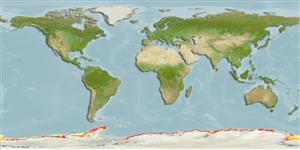
морской демерсальный; пределы глубины 0 - 700 m (Ref. 11892), usually 0 - 200 m (Ref. 45168). Polar; 61°S - 78°S
Southern Ocean: Peter Island, South Shetland, Elephant and South Orkney islands. Mac-Robertson, Queen Mary, Adelie Coasts, Weddell, Davis and Ross seas. East Antarctica from Queen Maud Land to Terre Adelie.
Length at first maturity / Size / Вес / Возраст
половая зрелость: Lm ?, range 18 - ? cm
Max length : 28.0 cm TL самец/пол неопределен; (Ref. 5179); 35.0 cm TL (female); common length : 25.0 cm TL самец/пол неопределен; (Ref. 2121); наибольший возраст (опубликованны данные): 10 годы (Ref. 5179)
Краткое описание
определительные ключи | морфология | морфометрия
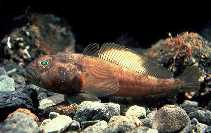
колючие лучи спинного плавника (общее число) : 4 - 6; членистые (мягкие) лучи спинного плавника (общее число) : 34 - 39; членистые (мягкие) лучи анального плавника: 31 - 35. Body brownish, large dark spots in two or three series on body. Spinous dorsal blackish in upper part (Ref. 11892).
Body shape (shape guide): fusiform / normal.
Found in seafloors, well adapted to extremely low and stable temperatures (-1.86°C), annual mean temperature of McMurdo Sound) (Ref. 45168). Feed on polychaetes, gastropods, isopods, amphipods and few algae. Spawn once a year (Ref. 1071). Utilized for human consumption.
Although members of this Family are known to tend to egg masses, it is assumed that because of the high fecundity, this species is a non-guarder (RF), to be corrected if direct information becomes available.
Dewitt, H.H., P.C. Heemstra and O. Gon, 1990. Nototheniidae. p. 279-331. In O. Gon and P.C. Heemstra (eds.) Fishes of the Southern Ocean. J.L.B. Smith Institute of Ichthyology, Grahamstown, South Africa. (Ref. 5179)
Статус Красного Списка МСОП (Ref. 130435: Version 2025-1)
Угроза для людей
Harmless
Использование человеком
рыболовство: коммерческий
дополнительная информация
инструменты
Специальные отчеты
Скачать в формате XML
ресурсы в Интернет
Estimates based on models
Preferred temperature (ссылка
123201): -1.8 - -0.8, mean -1.7 °C (based on 2076 cells).
Phylogenetic diversity index (ссылка
82804): PD
50 = 0.5001 [Uniqueness, from 0.5 = low to 2.0 = high].
Bayesian length-weight: a=0.00537 (0.00279 - 0.01033), b=3.24 (3.08 - 3.40), in cm total length, based on LWR estimates for this Genus-body shape (Ref.
93245).
Trophic level (ссылка
69278): 3.4 ±0.1 se; based on diet studies.
Generation time: 5.9 (2.0 - 12.2) years. Estimated as median ln(3)/K based on 11
growth studies.
устойчивость к внешним воздействиям (ссылка
120179): средний (среднего размера), минимальное время удвоения популяции 1.4-4.4 года (K=0.19-0.91; tm=3-6; tmax=10; Fec=1,200-3,123).
Fishing Vulnerability (Ref.
59153): Moderate to high vulnerability (53 of 100).
🛈
Nutrients (Ref.
124155): Calcium = 31.4 [18.6, 70.0] mg/100g; Iron = 0.456 [0.206, 0.860] mg/100g; Protein = 17.3 [16.3, 18.4] %; Omega3 = 0.417 [0.228, 0.727] g/100g; Selenium = 15.4 [6.7, 32.6] μg/100g; VitaminA = 15.6 [3.5, 70.7] μg/100g; Zinc = 0.515 [0.356, 0.761] mg/100g (wet weight); based on
nutrient studies.