



Xeniamia atrithorax Fraser & Prokofiev, 2016
Uploaden van uw Foto's en video's
Google afbeelding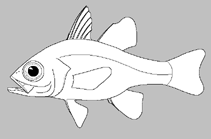 No image available for this species;
drawing shows typical species in Apogonidae.
Google afbeelding
drawing shows typical species in Apogonidae.
Classificatie / Namen Lokale namen | Synoniemen | Catalog of Fishes(Genus, Soort(en)) | ITIS | CoL | WoRMS | Cloffa
> Kurtiformes (Nurseryfishes, cardinalfishes.) > Apogonidae (Cardinalfishes) > Apogoninae
Etymology: Xeniamia: Name from Greek 'Xenos' meaning stranger and 'Amia' referring to a type of fish, often used with cardinalfish names, treated as feminine noun; atrithorax: Name from Latin 'ater, atra, atrum' meaning black and Greek 'thorax' a masculine noun meaning breastplate, referring to the position of numerous melanophores as a dark spot in advanced of the pelvic-fin base; noun in apposition.
Etymology: Xeniamia: Name from Greek 'Xenos' meaning stranger and 'Amia' referring to a type of fish, often used with cardinalfish names, treated as feminine noun; atrithorax: Name from Latin 'ater, atra, atrum' meaning black and Greek 'thorax' a masculine noun meaning breastplate, referring to the position of numerous melanophores as a dark spot in advanced of the pelvic-fin base; noun in apposition.
Milieu: milieu / Klimaatzone / Diepte / verspreidingsgebied Ecologie
Verspreiding Gebieden | FAO regio's | Ecosystemen | Voorkomen | Verspreidingskaart | Introducties | Faunafri
Western Pacific: South China Sea off Khanh Hoa Province, Vietnam.
Grootte / Gewicht / Leeftijd
Maturiteit: Lm ? range ? - ? cm
Max length : 3.0 cm SL (female)
Max length : 3.0 cm SL (female)
Korte beschrijving Determinatiesleutels | Morfologie | Morfometrie
Dorsale stekels (totaal) : 9; Dorsale zachte stralen (totaal) : 9; Anale stekels: 2; Anale zachte stralen: 8; Wervels: 24. This miniature species (less than 3.0 cm SL) is distinguished by the following characters: with a large melanophore patch anterior to insertion of pelvic fin, extending forward on each side of isthmus, progressively thinning out; black stomach, anterior intestine pale with black spots black intestine from second bend; interior of lower gill chamber blackish with concentrated melanophores extending forward to dorsal part of isthmus; D VIII-I,9 with eighth dorsal spine visible, fourth dorsal spine longer than third; A II,8; first gill arch with 9 gill rakers (Ref. 110227).
Cross section: compressed.
Cross section: compressed.
This species has been taken in shrimp trawls on muddy bottom. Most specimens were collected from 70-119 m, some from 40-60 m, in the main waterway of the Bay of Nha Trang (latter samples might have been pumped through canyons cutting out the outer shelf as proposed for
other fish taxa collected from the unusually shallow depths in this area (Ref. 84063). No specimens or fragments of sea urchins commonly trawled together with Siphamia specimens. Year-to-year fluctuations in density of population were observed with this species present at 18 of 22 stations trawling eastward and southward of Pyramid Island in 2005 and 2007 and two of 17 stations sampled in 2006 and 2009-2012. All samples were made between April and July, and no specimens were collected during a winter monsoon season (October-January). It always appeared in groups of about 10-60 specimens per trawl, with many specimens having ripe ova or brooding eggs. The smallest, 1.45 cm SL was immature. The males with buccal enlargement suggestive of brooding eggs were 2.2-2.4 cm SL and showed loss of teeth on the vomer and palatines. A 2.3 cm SL male had approximately 280 orangish eggs, 0.5 mm in diameter. Females with developed ova were as small as 2.3 cm SL. The largest gravid female was 2.95 cm SL. No possible indications for commensal relationships of this species were present (Ref. 110227).
Levenscyclus en paargedrag Maturiteit | Voortplanting | Paaien | Eieren | Fecunditeit | Larven
Hoofdreferentie
Upload uw referenties | Referenties | Coördinator | Medewerkers
Fraser, T.H. and A.M. Prokofiev, 2016. A new genus and species of cardinalfish (Percomorpha, Apogonidae, Sphaeramiini) from the coastal waters of Vietnam: luminescent or not? Zootaxa 4144(2):227-242. (Ref. 110227)
CITES
Not Evaluated
Gevaar voor de mens
Harmless
Gebruik door de mens
Visserij: bycatch
FAO - Publication: search | FishSource |
Meer informatie
Trofische ecologie
Voedsel (prooien)
Dieetsamenstelling
Voedselconsumptie
Voedselrantsoenen
Predatoren
Voedsel (prooien)
Dieetsamenstelling
Voedselconsumptie
Voedselrantsoenen
Predatoren
Ecologie
Ecologie
Ecologie
Populatiedynamica
Groeiparameters
Max. leeftijden / maten
Lengte-gewicht rel.
Lengte-lengte rel.
Lengtefrequenties
Massaconversie
Rekrutering
Abundantie
Groeiparameters
Max. leeftijden / maten
Lengte-gewicht rel.
Lengte-lengte rel.
Lengtefrequenties
Massaconversie
Rekrutering
Abundantie
Levenscyclus
Voortplanting
Maturiteit
Rijpheid/kieuwen rel.
Fecunditeit
Paaien
Paaibestanden
Eieren
Ontwikkeling van de eieren
Larven
Larvale populatiedynamiek
Voortplanting
Maturiteit
Rijpheid/kieuwen rel.
Fecunditeit
Paaien
Paaibestanden
Eieren
Ontwikkeling van de eieren
Larven
Larvale populatiedynamiek
Anatomie
Kieuwoppervlak
Hersenen
Otoliet
Kieuwoppervlak
Hersenen
Otoliet
Fysiologie
Lichaamssamenstelling
Voedingsstoffen
Zuurstofverbruik
Type zwemmen
Zwemsnelheid
Visuele pigmenten
Vis geluid
Ziekten en parasieten
Toxiciteit (LC50)
Lichaamssamenstelling
Voedingsstoffen
Zuurstofverbruik
Type zwemmen
Zwemsnelheid
Visuele pigmenten
Vis geluid
Ziekten en parasieten
Toxiciteit (LC50)
Genetica
genoom
Genetica
Heterozygositeit
Erfelijkheid
Genetische diversiteit
genoom
Genetica
Heterozygositeit
Erfelijkheid
Genetische diversiteit
Menselijk gerelateerd
Aquacultuursystemen
Aquacultuurprofielen
Kweeklijnen
Ciguatera gevallen
Postzegels, munten, diversen.
Aquacultuursystemen
Aquacultuurprofielen
Kweeklijnen
Ciguatera gevallen
Postzegels, munten, diversen.
Tools
Speciale rapporten
Bekijk gegevens voor het houden in een aquarium | Bekijk Fact Sheets voor de soort | Bekijk Aquacultuur Fact Sheets
Download XML
Internetbronnen
AFORO (otoliths) | Aquatic Commons | BHL | Cloffa | Websites from users | Bekijk FishWatcher | CISTI | Catalog of Fishes: Genus, Soort(en) | DiscoverLife | ECOTOX | FAO - Publication: search | Faunafri | Fishipedia | Fishtrace | GloBI | Google Books | Google Scholar | Google | IGFA World Record | OneZoom | Open Tree of Life | Otolith Atlas of Taiwan Fishes | PubMed | Reef Life Survey | Socotra Atlas | TreeBase | Tree of Life | Wikipedia: ga naar, zoek | World Records Freshwater Fishing | Zoobank | Zoological Record
Schattingen op basis van modellen
Fylogenetische diversiteitsindex (Ref. 82804): PD50 = 1.0000 [Uniqueness, from 0.5 = low to 2.0 = high].
Bayesian length-weight: a=0.01514 (0.00700 - 0.03275), b=3.07 (2.89 - 3.25), in cm total length, based on LWR estimates for this (Sub)family-body shape (Ref. 93245).
Trofisch niveau (Ref. 69278): 3.2 ±0.5 se; based on size and trophs of closest relatives
Weerstandsvermogen (Ref. 120179): Hoog, minimale populatieverdubbelingstijd minder dan 15 maanden (Preliminary K or Fecundity.).